

586
14 Basic Measurement and Monitoring Techniques
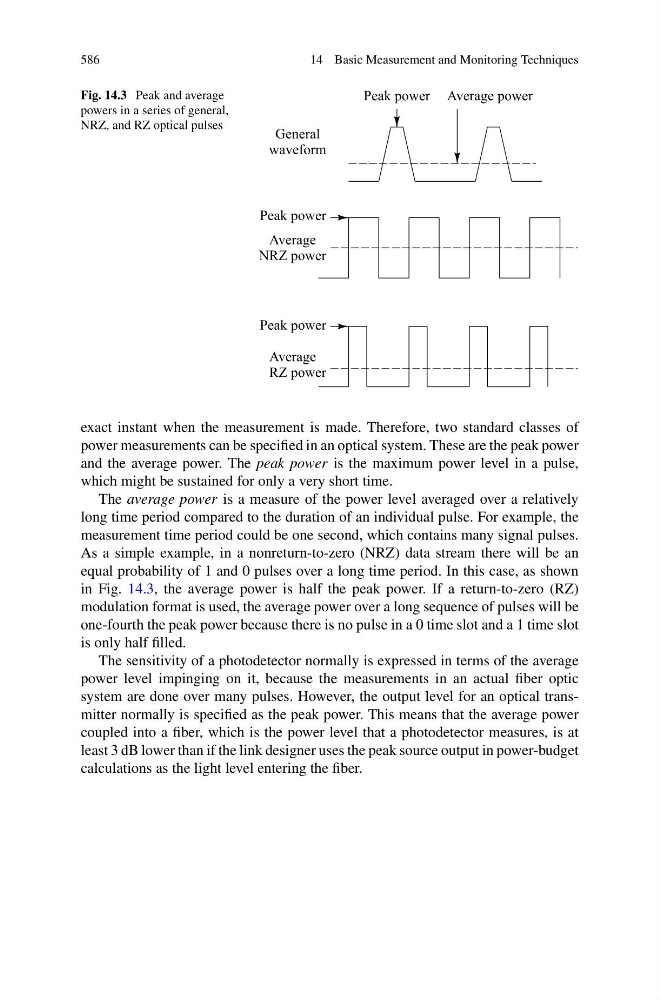
Fig. 14.3 Peak and average
powers in a series of general,
NRZ, and RZ optical pulses
exact instant when the measurement is made. Therefore, two standard classes of
power measurements can be specified in an optical system. These are the peak power
and the average power. The peak power is the maximum power level in a pulse,
which might be sustained for only a very short time.
The average power is a measure of the power level averaged over a relatively
long time period compared to the duration of an individual pulse. For example, the
measurement time period could be one second, which contains many signal pulses.
As a simple example, in a nonreturn-to-zero (NRZ) data stream there will be an
equal probability of 1 and 0 pulses over a long time period. In this case, as shown
in Fig. 14.3, the average power is half the peak power. If a return-to-zero (RZ)
modulation format is used, the average power over a long sequence of pulses will be
one-fourth the peak power because there is no pulse in a 0 time slot and a 1 time slot
is only half filled.
The sensitivity of a photodetector normally is expressed in terms of the average
power level impinging on it, because the measurements in an actual fiber optic
system are done over many pulses. However, the output level for an optical transmitter normally is specified as the peak power. This means that the average power
coupled into a fiber, which is the power level that a photodetector measures, is at
least 3 dB lower than if the link designer uses the peak source output in power-budget
calculations as the light level entering the fiber.