

560
13 Fiber Optic Communication Networks
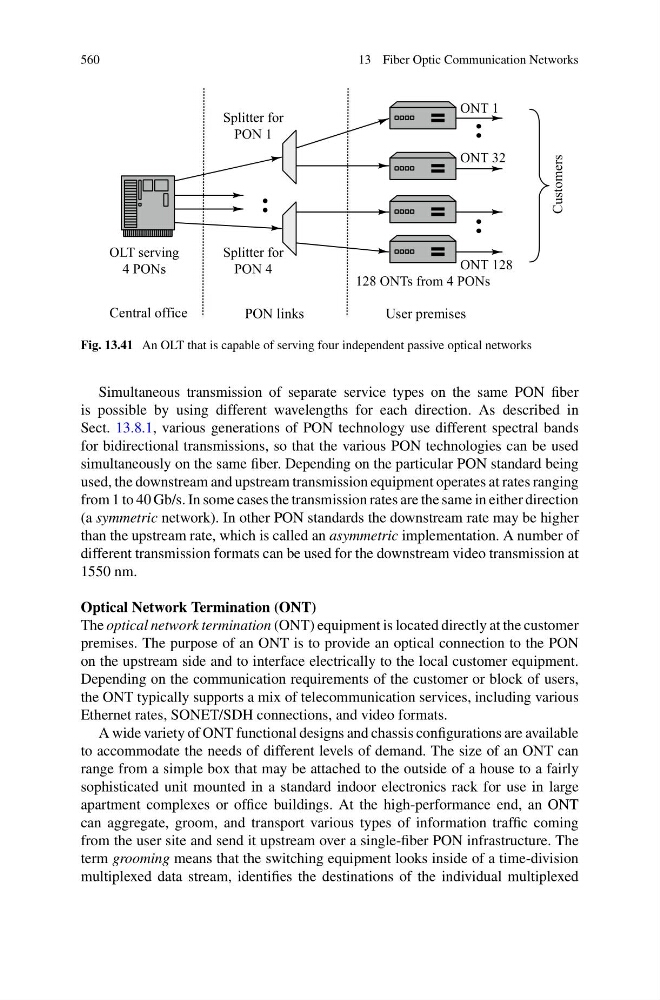
Central office
User premises
PON links
Fig. 13.41 An OLT that is capable of serving four independent passive optical networks
Simultaneous transmission of separate service types on the same PON fiber
is possible by using different wavelengths for each direction. As described in
Sect. 13.8.1, various generations of PON technology use different spectral bands
for bidirectional transmissions, so that the various PON technologies can be used
simultaneously on the same fiber. Depending on the particular PON standard being
used, the downstream and upstream transmission equipment operates at rates ranging
from 1 to 40 Gb/s. In some cases the transmission rates are the same in either direction
(a symmetric network). In other PON standards the downstream rate may be higher
than the upstream rate, which is called an asymmetric implementation. A number of
different transmission formats can be used for the downstream video transmission at
1550 nm.
Optical Network Termination (ONT)
The optical network termination (ONT) equipment is located directly at the customer
premises. The purpose of an ONT is to provide an optical connection to the PON
on the upstream side and to interface electrically to the local customer equipment.
Depending on the communication requirements of the customer or block of users,
the ONT typically supports a mix of telecommunication services, including various
Ethernet rates, SONET/SDH connections, and video formats.
A wide variety of ONT functional designs and chassis configurations are available
to accommodate the needs of different levels of demand. The size of an ONT can
range from a simple box that may be attached to the outside of a house to a fairly
sophisticated unit mounted in a standard indoor electronics rack for use in large
apartment complexes or office buildings. At the high-performance end, an ONT
can aggregate, groom, and transport various types of information traffic coming
from the user site and send it upstream over a single-fiber PON infrastructure. The
term grooming means that the switching equipment looks inside of a time-division
multiplexed data stream, identifies the destinations of the individual multiplexed