

534
13 Fiber Optic Communication Networks
13.4.3 Transceivers for 100 Gb/s Links
A number of different coherent, self-coherent, and direct-detection-based optical
transmission techniques have been proposed for links operating at 100 Gb/s. These
techniques typically involve a combination of polarization division multiplexing
(PDM) with differential quadrature phase-shift keying (DQPSK) or orthogonal
frequency division multiplexing (OFDM) [19]. Of these proposals, the data communications and telecom industries have selected polarization multiplexed quadrature
phase-shift keying (PM-QPSK) as the preferred format for deployment within 50GHz-spaced 100-Gb/s applications. This agreement arose because of the capability of
PM-QPSK-formatted signals to pass through multiple optical add/drop multiplexers
(see Sect. 13.5) and the tolerance of such signals to polarization-mode dispersion
effects.
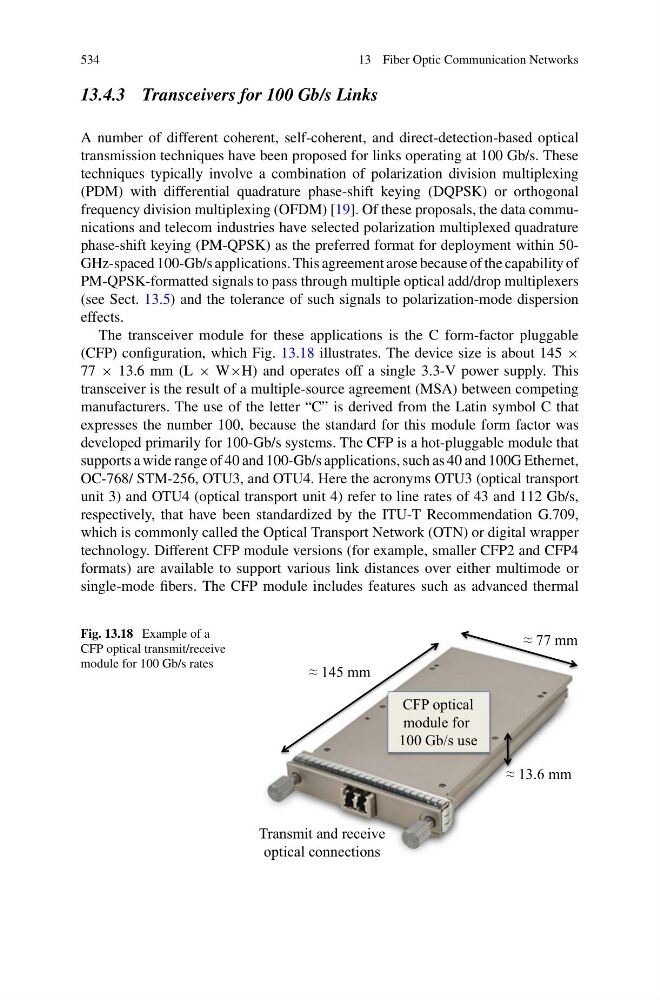
The transceiver module for these applications is the C form-factor pluggable
(CFP) configuration, which Fig. 13.18 illustrates. The device size is about 145 ×
77 × 13.6 mm (L × W×H) and operates off a single 3.3-V power supply. This
transceiver is the result of a multiple-source agreement (MSA) between competing
manufacturers. The use of the letter “C” is derived from the Latin symbol C that
expresses the number 100, because the standard for this module form factor was
developed primarily for 100-Gb/s systems. The CFP is a hot-pluggable module that
supports a wide range of 40 and 100-Gb/s applications, such as 40 and 100G Ethernet,
OC-768/ STM-256, OTU3, and OTU4. Here the acronyms OTU3 (optical transport
unit 3) and OTU4 (optical transport unit 4) refer to line rates of 43 and 112 Gb/s,
respectively, that have been standardized by the ITU-T Recommendation G.709,
which is commonly called the Optical Transport Network (OTN) or digital wrapper
technology. Different CFP module versions (for example, smaller CFP2 and CFP4
formats) are available to support various link distances over either multimode or
single-mode fibers. The CFP module includes features such as advanced thermal
Fig. 13.18 Example of a
CFP optical transmit/receive
module for 100 Gb/s rates
≈ 145 mm
≈ 13.6 mm
≈ 77 mm
CFP optical
module for
100 Gb/s use
Transmit and receive
optical connections