

532
13 Fiber Optic Communication Networks
L max = (40 m)(2000/500) + 100 m = 260 m
Because the calculated length is less than 300 m, this link would comply with the
installation standard.
Drill Problem 13.4 An engineer wants to create a link consisting of 50 m of
OM2 fiber that has a 500-MHz bandwidth and 90 m of OM3 fiber that has a
1500-MHz bandwidth. Show that the effective maximum link length is 240 m.
If transmission at 10 Gb/s is attempted over legacy OM1 multimode fibers, the
signal is restricted to distances of only about 33 m. To achieve 300-m transmission
distances at 10-Gb/s over legacy multimode fibers, an alternative scheme is to send
four 3.125-Gb/s data streams over four different wavelengths. A number of manufacturers offer 850-nm VCSEL sources that can be modulated directly at 10 Gb/s.
Both the transmitter and receiver can be housed in the same package.
For access network applications ranging from 7 to 20 km, which the 10-GbE
specification calls long-reach (LR), the links need to use InGaAsP-based distributed
feedback (DFB) lasers operating at 1310 nm over single-mode fibers. These links
operate near the 1310-nm dispersion minimum of G.652 single-mode fibers and the
light sources can be modulated directly.
For metro network applications ranging from 40 to 80 km, which the 10-GbE specification calls extended-reach (ER), the links need to use externally modulated DFB
lasers operating at 1550 nm over single-mode fibers. A variety of transceiver packages
exist for both LR and ER applications. Three of the several configurations include
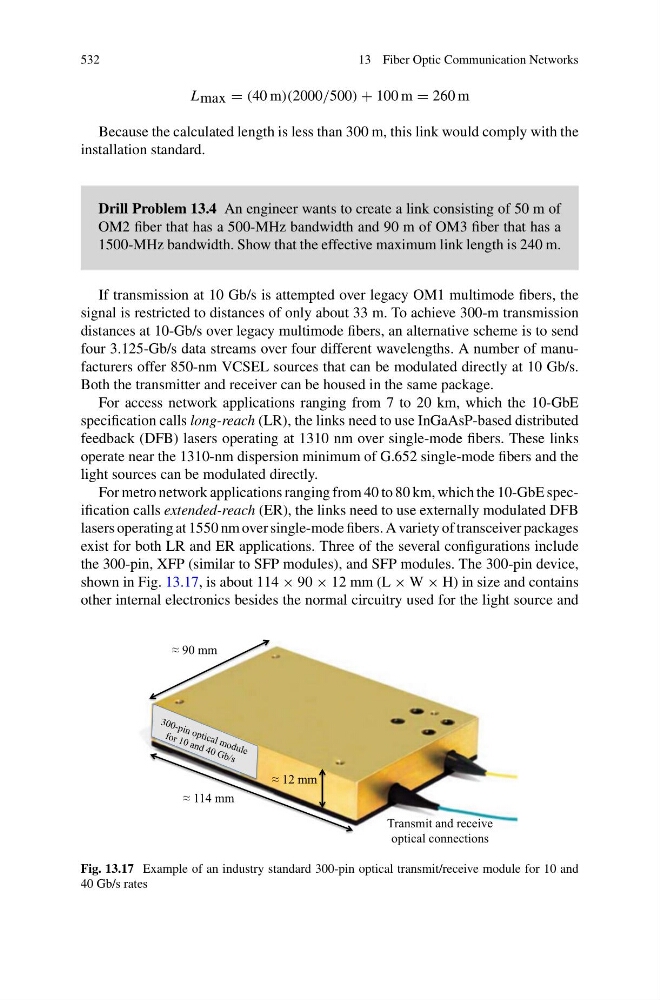
the 300-pin, XFP (similar to SFP modules), and SFP modules. The 300-pin device,
shown in Fig. 13.17, is about 114 × 90 × 12 mm (L × W × H) in size and contains
other internal electronics besides the normal circuitry used for the light source and
≈ 12 mm
≈ 114 mm
≈ 90 mm
Transmit and receive
optical connections
Fig. 13.17 Example of an industry standard 300-pin optical transmit/receive module for 10 and
40 Gb/s rates