

13.4 High-Speed Lightwave Transceivers
529
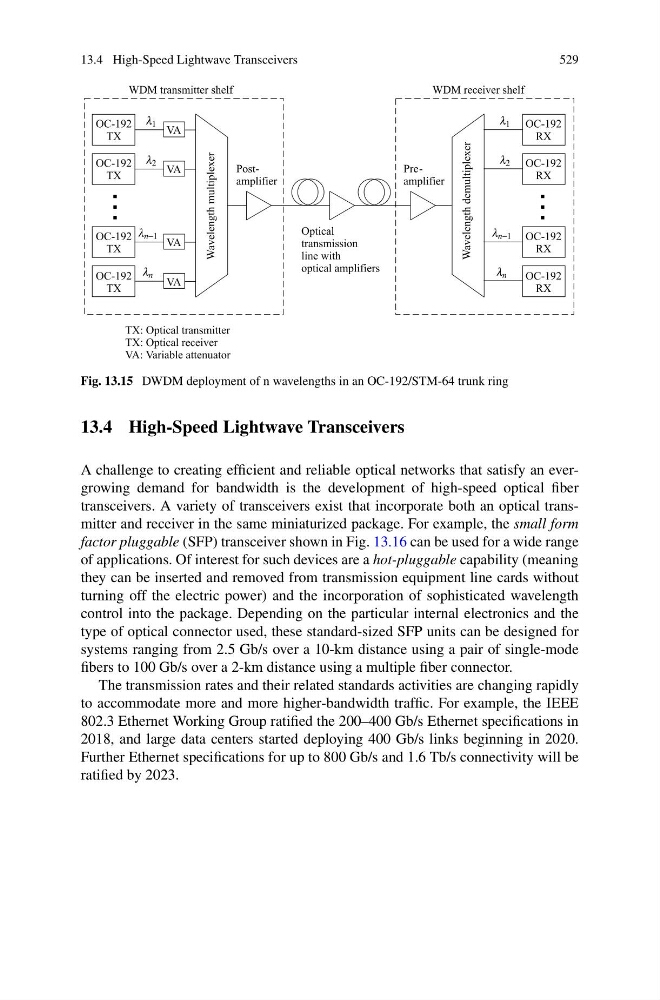
Fig. 13.15 DWDM deployment of n wavelengths in an OC-192/STM-64 trunk ring
13.4 High-Speed Lightwave Transceivers
A challenge to creating efficient and reliable optical networks that satisfy an evergrowing demand for bandwidth is the development of high-speed optical fiber
transceivers. A variety of transceivers exist that incorporate both an optical transmitter and receiver in the same miniaturized package. For example, the small form
factor pluggable (SFP) transceiver shown in Fig. 13.16 can be used for a wide range
of applications. Of interest for such devices are a hot-pluggable capability (meaning
they can be inserted and removed from transmission equipment line cards without
turning off the electric power) and the incorporation of sophisticated wavelength
control into the package. Depending on the particular internal electronics and the
type of optical connector used, these standard-sized SFP units can be designed for
systems ranging from 2.5 Gb/s over a 10-km distance using a pair of single-mode
fibers to 100 Gb/s over a 2-km distance using a multiple fiber connector.
The transmission rates and their related standards activities are changing rapidly
to accommodate more and more higher-bandwidth traffic. For example, the IEEE
802.3 Ethernet Working Group ratified the 200–400 Gb/s Ethernet specifications in
2018, and large data centers started deploying 400 Gb/s links beginning in 2020.
Further Ethernet specifications for up to 800 Gb/s and 1.6 Tb/s connectivity will be
ratified by 2023.
529
Fig. 13.15 DWDM deployment of n wavelengths in an OC-192/STM-64 trunk ring
13.4 High-Speed Lightwave Transceivers
A challenge to creating efficient and reliable optical networks that satisfy an evergrowing demand for bandwidth is the development of high-speed optical fiber
transceivers. A variety of transceivers exist that incorporate both an optical transmitter and receiver in the same miniaturized package. For example, the small form
factor pluggable (SFP) transceiver shown in Fig. 13.16 can be used for a wide range
of applications. Of interest for such devices are a hot-pluggable capability (meaning
they can be inserted and removed from transmission equipment line cards without
turning off the electric power) and the incorporation of sophisticated wavelength
control into the package. Depending on the particular internal electronics and the
type of optical connector used, these standard-sized SFP units can be designed for
systems ranging from 2.5 Gb/s over a 10-km distance using a pair of single-mode
fibers to 100 Gb/s over a 2-km distance using a multiple fiber connector.
The transmission rates and their related standards activities are changing rapidly
to accommodate more and more higher-bandwidth traffic. For example, the IEEE
802.3 Ethernet Working Group ratified the 200–400 Gb/s Ethernet specifications in
2018, and large data centers started deploying 400 Gb/s links beginning in 2020.
Further Ethernet specifications for up to 800 Gb/s and 1.6 Tb/s connectivity will be
ratified by 2023.