

514
13 Fiber Optic Communication Networks
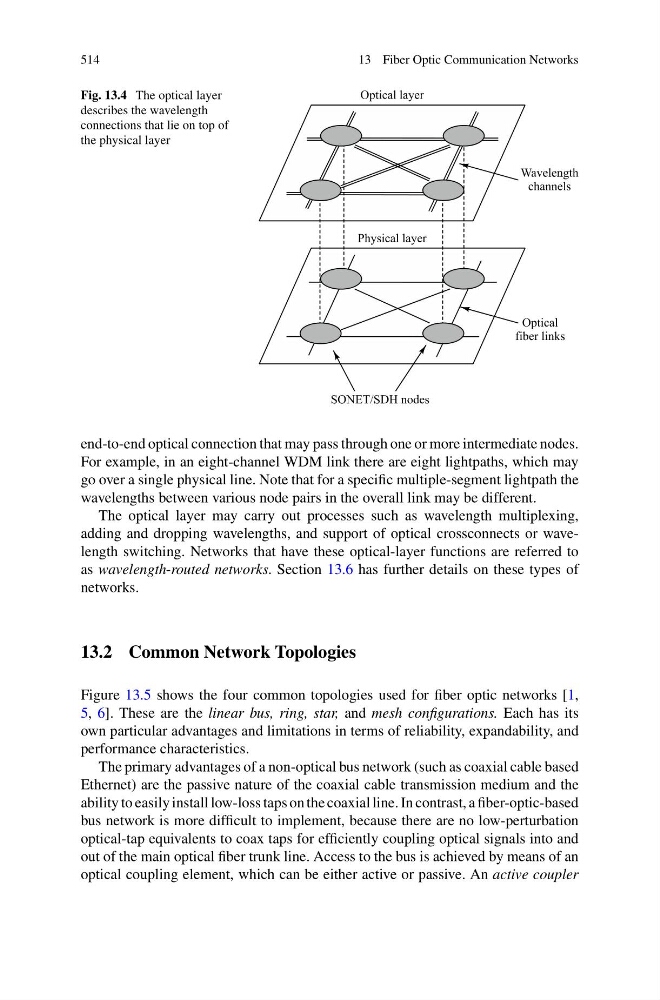
Fig. 13.4 The optical layer
describes the wavelength
connections that lie on top of
the physical layer
end-to-end optical connection that may pass through one or more intermediate nodes.
For example, in an eight-channel WDM link there are eight lightpaths, which may
go over a single physical line. Note that for a specific multiple-segment lightpath the
wavelengths between various node pairs in the overall link may be different.
The optical layer may carry out processes such as wavelength multiplexing,
adding and dropping wavelengths, and support of optical crossconnects or wavelength switching. Networks that have these optical-layer functions are referred to
as wavelength-routed networks. Section 13.6 has further details on these types of
networks.
13.2 Common Network Topologies
Figure 13.5 shows the four common topologies used for fiber optic networks [1,
5, 6]. These are the linear bus, ring, star, and mesh configurations. Each has its
own particular advantages and limitations in terms of reliability, expandability, and
performance characteristics.
The primary advantages of a non-optical bus network (such as coaxial cable based
Ethernet) are the passive nature of the coaxial cable transmission medium and the
ability to easily install low-loss taps on the coaxial line. In contrast, a fiber-optic-based
bus network is more difficult to implement, because there are no low-perturbation
optical-tap equivalents to coax taps for efficiently coupling optical signals into and
out of the main optical fiber trunk line. Access to the bus is achieved by means of an
optical coupling element, which can be either active or passive. An active coupler
13 Fiber Optic Communication Networks
Fig. 13.4 The optical layer
describes the wavelength
connections that lie on top of
the physical layer
end-to-end optical connection that may pass through one or more intermediate nodes.
For example, in an eight-channel WDM link there are eight lightpaths, which may
go over a single physical line. Note that for a specific multiple-segment lightpath the
wavelengths between various node pairs in the overall link may be different.
The optical layer may carry out processes such as wavelength multiplexing,
adding and dropping wavelengths, and support of optical crossconnects or wavelength switching. Networks that have these optical-layer functions are referred to
as wavelength-routed networks. Section 13.6 has further details on these types of
networks.
13.2 Common Network Topologies
Figure 13.5 shows the four common topologies used for fiber optic networks [1,
5, 6]. These are the linear bus, ring, star, and mesh configurations. Each has its
own particular advantages and limitations in terms of reliability, expandability, and
performance characteristics.
The primary advantages of a non-optical bus network (such as coaxial cable based
Ethernet) are the passive nature of the coaxial cable transmission medium and the
ability to easily install low-loss taps on the coaxial line. In contrast, a fiber-optic-based
bus network is more difficult to implement, because there are no low-perturbation
optical-tap equivalents to coax taps for efficiently coupling optical signals into and
out of the main optical fiber trunk line. Access to the bus is achieved by means of an
optical coupling element, which can be either active or passive. An active coupler