

512
13 Fiber Optic Communication Networks
13.1.3 Layered Structure Approach to Network Architectures
When discussing the design and implementation of a telecom system, the term
network architecture is used to describe the general physical arrangement and operational characteristics of communicating equipment together with a common set of
communication protocols. A protocol is a set of rules and conventions that governs
the generation, formatting, control, exchange, and interpretation of information that
is transmitted through a telecom network or that is stored in a database.
A traditional approach to setting up a protocol is to subdivide it into a number of
individual pieces or layers of manageable and comprehensible size. The result is a
layered structure of services, which is called a protocol stack. In this scheme each
layer is responsible for providing a set of functions or capabilities to the layer above
it by using the functions or capabilities of the layer below. A user at the highest layer
is offered all the capabilities of the lower levels for interacting with other users and
peripheral equipment distributed on the network.
As an example of a structured approach for simplifying the complexity of modern
networks, the International Standards Organization (ISO) developed an open system
interconnect (OSI) reference model for dividing the functions of a network into
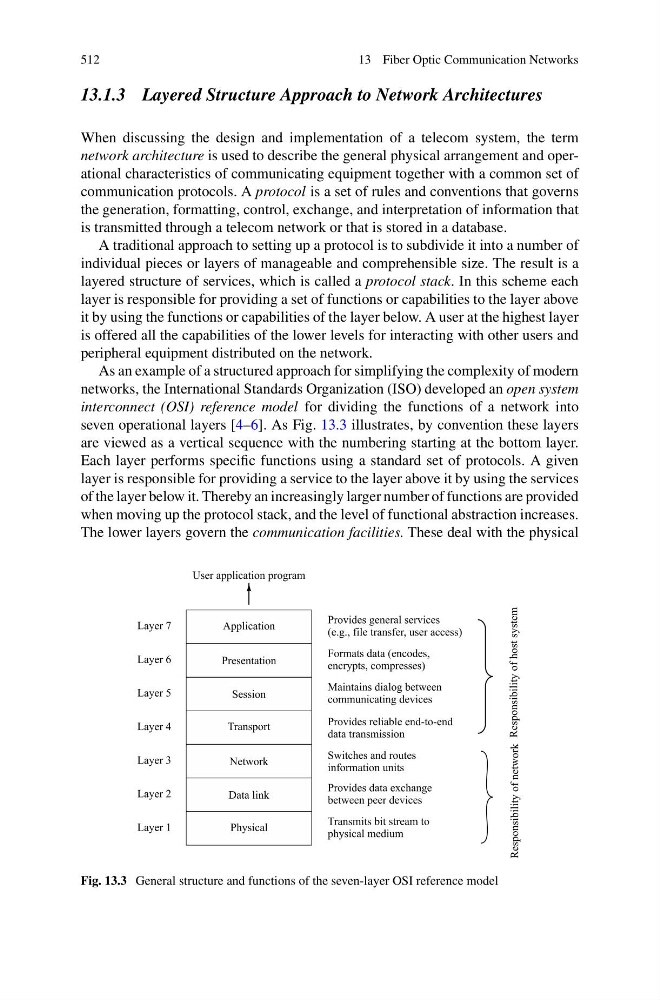
seven operational layers [4–6]. As Fig. 13.3 illustrates, by convention these layers
are viewed as a vertical sequence with the numbering starting at the bottom layer.
Each layer performs specific functions using a standard set of protocols. A given
layer is responsible for providing a service to the layer above it by using the services
of the layer below it. Thereby an increasingly larger number of functions are provided
when moving up the protocol stack, and the level of functional abstraction increases.
The lower layers govern the communication facilities. These deal with the physical
Fig. 13.3 General structure and functions of the seven-layer OSI reference model
13 Fiber Optic Communication Networks
13.1.3 Layered Structure Approach to Network Architectures
When discussing the design and implementation of a telecom system, the term
network architecture is used to describe the general physical arrangement and operational characteristics of communicating equipment together with a common set of
communication protocols. A protocol is a set of rules and conventions that governs
the generation, formatting, control, exchange, and interpretation of information that
is transmitted through a telecom network or that is stored in a database.
A traditional approach to setting up a protocol is to subdivide it into a number of
individual pieces or layers of manageable and comprehensible size. The result is a
layered structure of services, which is called a protocol stack. In this scheme each
layer is responsible for providing a set of functions or capabilities to the layer above
it by using the functions or capabilities of the layer below. A user at the highest layer
is offered all the capabilities of the lower levels for interacting with other users and
peripheral equipment distributed on the network.
As an example of a structured approach for simplifying the complexity of modern
networks, the International Standards Organization (ISO) developed an open system
interconnect (OSI) reference model for dividing the functions of a network into
seven operational layers [4–6]. As Fig. 13.3 illustrates, by convention these layers
are viewed as a vertical sequence with the numbering starting at the bottom layer.
Each layer performs specific functions using a standard set of protocols. A given
layer is responsible for providing a service to the layer above it by using the services
of the layer below it. Thereby an increasingly larger number of functions are provided
when moving up the protocol stack, and the level of functional abstraction increases.
The lower layers govern the communication facilities. These deal with the physical
Fig. 13.3 General structure and functions of the seven-layer OSI reference model