

32
2 Optical Fiber Structures and Light Guiding Principles
waveguide. This involves solving Maxwell’s equations subject to the cylindrical
boundary conditions of the fiber.
2.1 The Nature of Light
The concepts concerning the nature of light have undergone several variations during
the history of physics [1]. Until the early seventeenth century, it was generally
believed that light consisted of a stream of minute particles that were emitted by
luminous sources. These particles were pictured as traveling in straight lines, and it
was assumed that they could penetrate transparent materials but were reflected from
opaque ones. This theory adequately described certain large-scale optical effects,
such as reflection and refraction, but failed to explain finer-scale phenomena, such
as interference and diffraction.
Fresnel gave the correct explanation of diffraction in 1815. He showed that the
approximately rectilinear propagation character of light could be interpreted on the
assumption that light is a wave motion, and that the diffraction fringes could thus be
accounted for in detail. Later, the work of Maxwell in 1864 theorized that light waves
must be electromagnetic in nature. Furthermore, observation of polarization effects
indicated that light waves are transverse (i.e., the wave motion is perpendicular to the
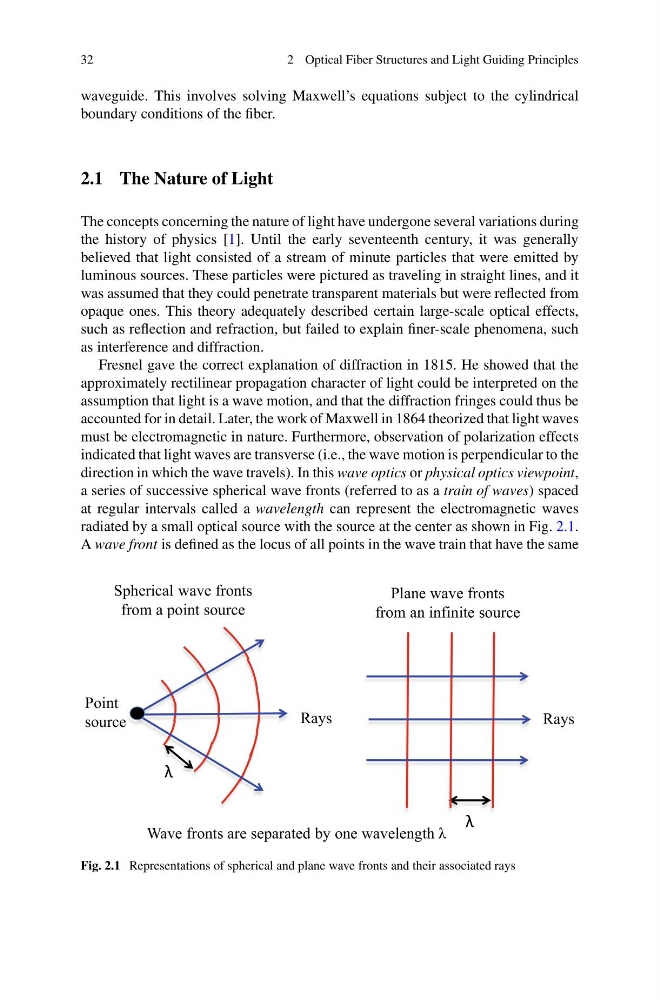
direction in which the wave travels). In this wave optics or physical optics viewpoint,
a series of successive spherical wave fronts (referred to as a train of waves) spaced
at regular intervals called a wavelength can represent the electromagnetic waves
radiated by a small optical source with the source at the center as shown in Fig. 2.1.
A wave front is defined as the locus of all points in the wave train that have the same
Spherical wave fronts
from a point source
Point
source
Wave fronts are separated by one wavelength λ
Plane wave fronts
from an infinite source
Rays
Rays
λ
λ
Fig. 2.1 Representations of spherical and plane wave fronts and their associated rays
2 Optical Fiber Structures and Light Guiding Principles
waveguide. This involves solving Maxwell’s equations subject to the cylindrical
boundary conditions of the fiber.
2.1 The Nature of Light
The concepts concerning the nature of light have undergone several variations during
the history of physics [1]. Until the early seventeenth century, it was generally
believed that light consisted of a stream of minute particles that were emitted by
luminous sources. These particles were pictured as traveling in straight lines, and it
was assumed that they could penetrate transparent materials but were reflected from
opaque ones. This theory adequately described certain large-scale optical effects,
such as reflection and refraction, but failed to explain finer-scale phenomena, such
as interference and diffraction.
Fresnel gave the correct explanation of diffraction in 1815. He showed that the
approximately rectilinear propagation character of light could be interpreted on the
assumption that light is a wave motion, and that the diffraction fringes could thus be
accounted for in detail. Later, the work of Maxwell in 1864 theorized that light waves
must be electromagnetic in nature. Furthermore, observation of polarization effects
indicated that light waves are transverse (i.e., the wave motion is perpendicular to the
direction in which the wave travels). In this wave optics or physical optics viewpoint,
a series of successive spherical wave fronts (referred to as a train of waves) spaced
at regular intervals called a wavelength can represent the electromagnetic waves
radiated by a small optical source with the source at the center as shown in Fig. 2.1.
A wave front is defined as the locus of all points in the wave train that have the same
Spherical wave fronts
from a point source
Point
source
Wave fronts are separated by one wavelength λ
Plane wave fronts
from an infinite source
Rays
Rays
λ
λ
Fig. 2.1 Representations of spherical and plane wave fronts and their associated rays