

12.6 Cross-Phase Modulation in WDM Systems
489
where the parameters are the same as for Eq. (12.8). When multiple wavelengths
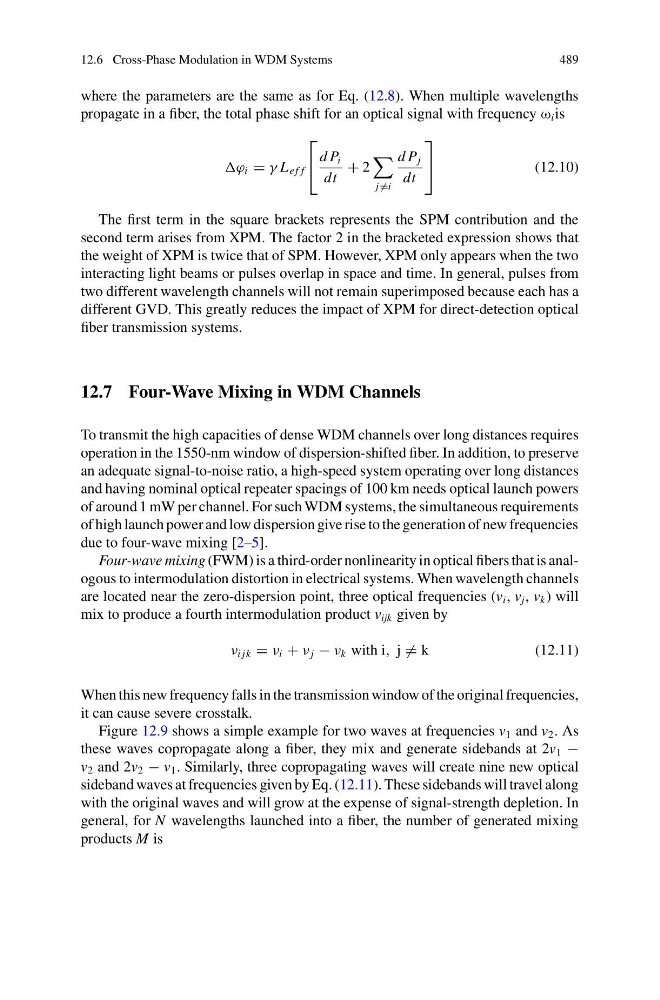
propagate in a fiber, the total phase shift for an optical signal with frequency ω i is
ϕ i = γ L e f f
⎡
⎣ d P i
dt
+ 2
j =i
d P j
dt
⎤
⎦
(12.10)
The first term in the square brackets represents the SPM contribution and the
second term arises from XPM. The factor 2 in the bracketed expression shows that
the weight of XPM is twice that of SPM. However, XPM only appears when the two
interacting light beams or pulses overlap in space and time. In general, pulses from
two different wavelength channels will not remain superimposed because each has a
different GVD. This greatly reduces the impact of XPM for direct-detection optical
fiber transmission systems.
12.7 Four-Wave Mixing in WDM Channels
To transmit the high capacities of dense WDM channels over long distances requires
operation in the 1550-nm window of dispersion-shifted fiber. In addition, to preserve
an adequate signal-to-noise ratio, a high-speed system operating over long distances
and having nominal optical repeater spacings of 100 km needs optical launch powers
of around 1 mW per channel. For such WDM systems, the simultaneous requirements
of high launch power and low dispersion give rise to the generation of new frequencies
due to four-wave mixing [2–5].
Four-wave mixing (FWM) is a third-order nonlinearity in optical fibers that is analogous to intermodulation distortion in electrical systems. When wavelength channels
are located near the zero-dispersion point, three optical frequencies (v i , v j , v k ) will
mix to produce a fourth intermodulation product v ijk given by
ν i jk = ν i + ν j − ν k with i, j = k
(12.11)
When this new frequency falls in the transmission window of the original frequencies,
it can cause severe crosstalk.
Figure 12.9 shows a simple example for two waves at frequencies v 1 and v 2 . As
these waves copropagate along a fiber, they mix and generate sidebands at 2v 1 −
v 2 and 2v 2 − v 1 . Similarly, three copropagating waves will create nine new optical
sideband waves at frequencies given by Eq. (12.11). These sidebands will travel along
with the original waves and will grow at the expense of signal-strength depletion. In
general, for N wavelengths launched into a fiber, the number of generated mixing
products M is
489
where the parameters are the same as for Eq. (12.8). When multiple wavelengths
propagate in a fiber, the total phase shift for an optical signal with frequency ω i is
ϕ i = γ L e f f
⎡
⎣ d P i
dt
+ 2
j =i
d P j
dt
⎤
⎦
(12.10)
The first term in the square brackets represents the SPM contribution and the
second term arises from XPM. The factor 2 in the bracketed expression shows that
the weight of XPM is twice that of SPM. However, XPM only appears when the two
interacting light beams or pulses overlap in space and time. In general, pulses from
two different wavelength channels will not remain superimposed because each has a
different GVD. This greatly reduces the impact of XPM for direct-detection optical
fiber transmission systems.
12.7 Four-Wave Mixing in WDM Channels
To transmit the high capacities of dense WDM channels over long distances requires
operation in the 1550-nm window of dispersion-shifted fiber. In addition, to preserve
an adequate signal-to-noise ratio, a high-speed system operating over long distances
and having nominal optical repeater spacings of 100 km needs optical launch powers
of around 1 mW per channel. For such WDM systems, the simultaneous requirements
of high launch power and low dispersion give rise to the generation of new frequencies
due to four-wave mixing [2–5].
Four-wave mixing (FWM) is a third-order nonlinearity in optical fibers that is analogous to intermodulation distortion in electrical systems. When wavelength channels
are located near the zero-dispersion point, three optical frequencies (v i , v j , v k ) will
mix to produce a fourth intermodulation product v ijk given by
ν i jk = ν i + ν j − ν k with i, j = k
(12.11)
When this new frequency falls in the transmission window of the original frequencies,
it can cause severe crosstalk.
Figure 12.9 shows a simple example for two waves at frequencies v 1 and v 2 . As
these waves copropagate along a fiber, they mix and generate sidebands at 2v 1 −
v 2 and 2v 2 − v 1 . Similarly, three copropagating waves will create nine new optical
sideband waves at frequencies given by Eq. (12.11). These sidebands will travel along
with the original waves and will grow at the expense of signal-strength depletion. In
general, for N wavelengths launched into a fiber, the number of generated mixing
products M is