

484
12 Nonlinear Processes in Optical Fibers
Drill Problem 12.2 Assume the following parameter values: g R = 4.7 × 10
−14
m/W, L eff = 21 km, ν c = 125 GHz, and A eff = 55 μm
2 . Verify the examples
given in Table 12.3 of the maximum launch power P for various channel counts
and channel separations of s = 50 and 100 GHz for a SRS power penalty of
0.5 dB.
12.4 Stimulated Brillouin Scattering
Stimulated Brillouin scattering arises when a strong optical signal generates an
acoustic wave that produces variations in the refractive index [2–5,7]. These index
variations cause lightwaves to scatter in the backward direction along the fiber
toward the transmitter. This backscattered light experiences gain from the forwardpropagating signals, which leads to depletion of the signal power. The frequency of
the scattered light at a wavelength λ experiences a Doppler shift given by
v B = 2nV s /λ
(12.4)
where n is the index of refraction and V s is the velocity of sound in the material. In
silica, this interaction occurs over a very narrow Brillouin linewidth of B =20 MHz
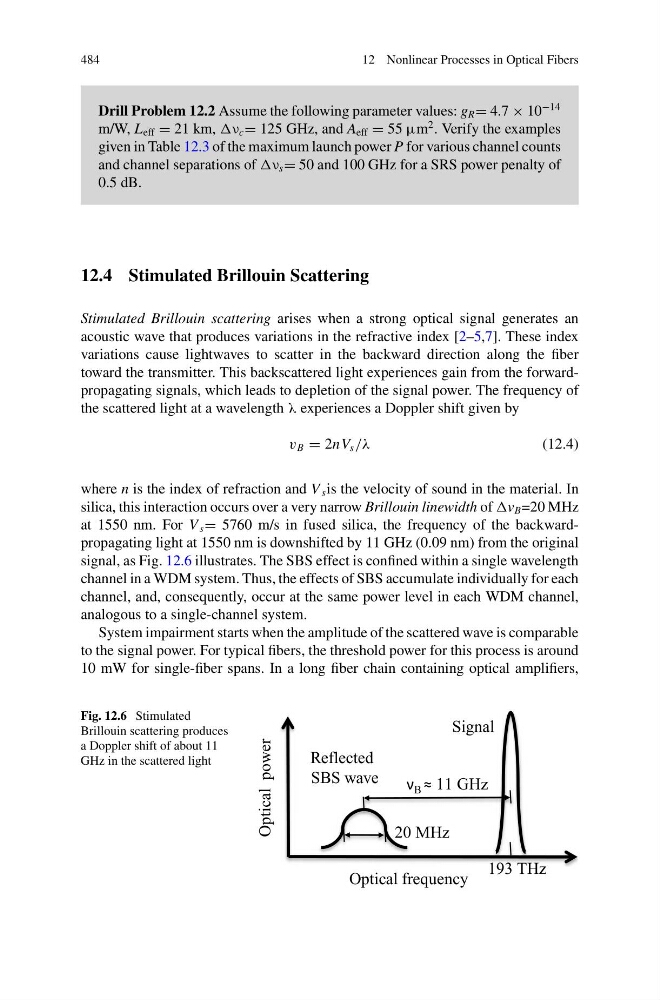
at 1550 nm. For V s = 5760 m/s in fused silica, the frequency of the backwardpropagating light at 1550 nm is downshifted by 11 GHz (0.09 nm) from the original
signal, as Fig. 12.6 illustrates. The SBS effect is confined within a single wavelength
channel in a WDM system. Thus, the effects of SBS accumulate individually for each
channel, and, consequently, occur at the same power level in each WDM channel,
analogous to a single-channel system.
System impairment starts when the amplitude of the scattered wave is comparable
to the signal power. For typical fibers, the threshold power for this process is around
10 mW for single-fiber spans. In a long fiber chain containing optical amplifiers,
Fig. 12.6 Stimulated
Brillouin scattering produces
a Doppler shift of about 11
GHz in the scattered light
12 Nonlinear Processes in Optical Fibers
Drill Problem 12.2 Assume the following parameter values: g R = 4.7 × 10
−14
m/W, L eff = 21 km, ν c = 125 GHz, and A eff = 55 μm
2 . Verify the examples
given in Table 12.3 of the maximum launch power P for various channel counts
and channel separations of s = 50 and 100 GHz for a SRS power penalty of
0.5 dB.
12.4 Stimulated Brillouin Scattering
Stimulated Brillouin scattering arises when a strong optical signal generates an
acoustic wave that produces variations in the refractive index [2–5,7]. These index
variations cause lightwaves to scatter in the backward direction along the fiber
toward the transmitter. This backscattered light experiences gain from the forwardpropagating signals, which leads to depletion of the signal power. The frequency of
the scattered light at a wavelength λ experiences a Doppler shift given by
v B = 2nV s /λ
(12.4)
where n is the index of refraction and V s is the velocity of sound in the material. In
silica, this interaction occurs over a very narrow Brillouin linewidth of B =20 MHz
at 1550 nm. For V s = 5760 m/s in fused silica, the frequency of the backwardpropagating light at 1550 nm is downshifted by 11 GHz (0.09 nm) from the original
signal, as Fig. 12.6 illustrates. The SBS effect is confined within a single wavelength
channel in a WDM system. Thus, the effects of SBS accumulate individually for each
channel, and, consequently, occur at the same power level in each WDM channel,
analogous to a single-channel system.
System impairment starts when the amplitude of the scattered wave is comparable
to the signal power. For typical fibers, the threshold power for this process is around
10 mW for single-fiber spans. In a long fiber chain containing optical amplifiers,
Fig. 12.6 Stimulated
Brillouin scattering produces
a Doppler shift of about 11
GHz in the scattered light