

440
11 Basics of Optical Amplifiers
11.1.2 Amplifier Classifications
The three main optical amplifier types can be classified as semiconductor optical
amplifiers (SOAs), active-fiber or doped-fiber amplifiers (DFAs), and Raman amplifiers. This section first gives a concise overview of these amplifier types; details are
in the following sections. All optical amplifiers increase the power level of incident
light through a stimulated emission or an optical power transfer process. In SOAs
and DFAs the mechanism for creating the population inversion that is needed for
stimulated emission to occur is the same as the process that is used in laser diodes.
Although the structure of such an optical amplifier is similar to that of a laser, it does
not have the optical feedback mechanism that is necessary for lasing to take place.
Thus an optical amplifier can boost incoming signal levels, but it cannot generate a
coherent optical output by itself.
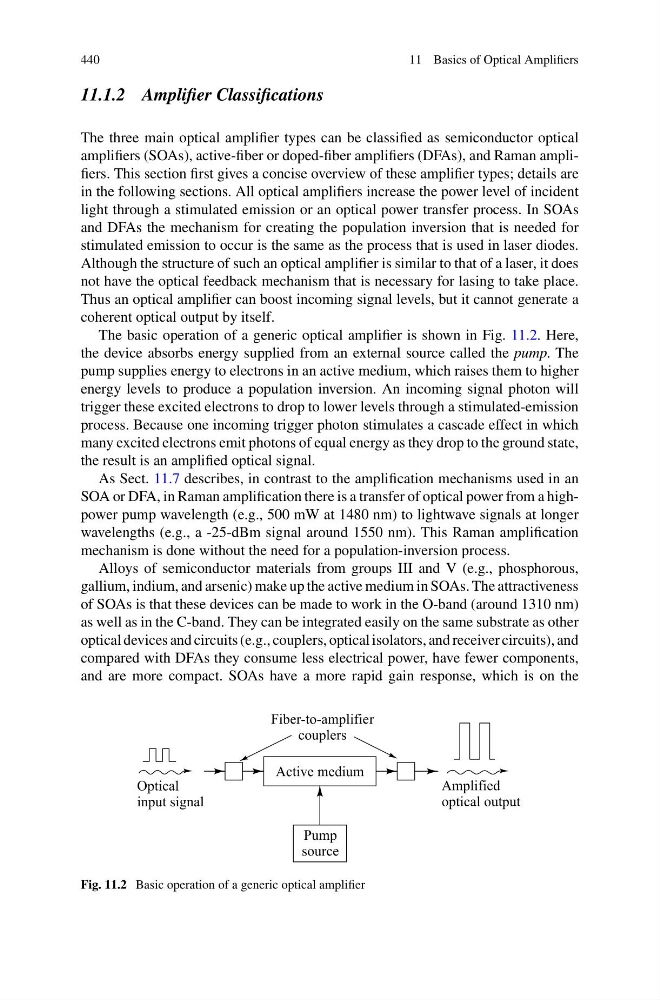
The basic operation of a generic optical amplifier is shown in Fig. 11.2. Here,
the device absorbs energy supplied from an external source called the pump. The
pump supplies energy to electrons in an active medium, which raises them to higher
energy levels to produce a population inversion. An incoming signal photon will
trigger these excited electrons to drop to lower levels through a stimulated-emission
process. Because one incoming trigger photon stimulates a cascade effect in which
many excited electrons emit photons of equal energy as they drop to the ground state,
the result is an amplified optical signal.
As Sect. 11.7 describes, in contrast to the amplification mechanisms used in an
SOA or DFA, in Raman amplification there is a transfer of optical power from a highpower pump wavelength (e.g., 500 mW at 1480 nm) to lightwave signals at longer
wavelengths (e.g., a -25-dBm signal around 1550 nm). This Raman amplification
mechanism is done without the need for a population-inversion process.
Alloys of semiconductor materials from groups III and V (e.g., phosphorous,
gallium, indium, and arsenic) make up the active medium in SOAs. The attractiveness
of SOAs is that these devices can be made to work in the O-band (around 1310 nm)
as well as in the C-band. They can be integrated easily on the same substrate as other
optical devices and circuits (e.g., couplers, optical isolators, and receiver circuits), and
compared with DFAs they consume less electrical power, have fewer components,
and are more compact. SOAs have a more rapid gain response, which is on the
Fig. 11.2 Basic operation of a generic optical amplifier
11 Basics of Optical Amplifiers
11.1.2 Amplifier Classifications
The three main optical amplifier types can be classified as semiconductor optical
amplifiers (SOAs), active-fiber or doped-fiber amplifiers (DFAs), and Raman amplifiers. This section first gives a concise overview of these amplifier types; details are
in the following sections. All optical amplifiers increase the power level of incident
light through a stimulated emission or an optical power transfer process. In SOAs
and DFAs the mechanism for creating the population inversion that is needed for
stimulated emission to occur is the same as the process that is used in laser diodes.
Although the structure of such an optical amplifier is similar to that of a laser, it does
not have the optical feedback mechanism that is necessary for lasing to take place.
Thus an optical amplifier can boost incoming signal levels, but it cannot generate a
coherent optical output by itself.
The basic operation of a generic optical amplifier is shown in Fig. 11.2. Here,
the device absorbs energy supplied from an external source called the pump. The
pump supplies energy to electrons in an active medium, which raises them to higher
energy levels to produce a population inversion. An incoming signal photon will
trigger these excited electrons to drop to lower levels through a stimulated-emission
process. Because one incoming trigger photon stimulates a cascade effect in which
many excited electrons emit photons of equal energy as they drop to the ground state,
the result is an amplified optical signal.
As Sect. 11.7 describes, in contrast to the amplification mechanisms used in an
SOA or DFA, in Raman amplification there is a transfer of optical power from a highpower pump wavelength (e.g., 500 mW at 1480 nm) to lightwave signals at longer
wavelengths (e.g., a -25-dBm signal around 1550 nm). This Raman amplification
mechanism is done without the need for a population-inversion process.
Alloys of semiconductor materials from groups III and V (e.g., phosphorous,
gallium, indium, and arsenic) make up the active medium in SOAs. The attractiveness
of SOAs is that these devices can be made to work in the O-band (around 1310 nm)
as well as in the C-band. They can be integrated easily on the same substrate as other
optical devices and circuits (e.g., couplers, optical isolators, and receiver circuits), and
compared with DFAs they consume less electrical power, have fewer components,
and are more compact. SOAs have a more rapid gain response, which is on the
Fig. 11.2 Basic operation of a generic optical amplifier