

9.7 Summary
379
= 3% and the other 30 signals have m i = 4%, find the optical modulation index
of the laser.
9.4 Consider an analog system having 120 channels, each modulated at 2.3%. The
link consists of 12 km of single-mode fiber having a loss of 1 dB/km, plus a
connector having a 0.5-dB loss on each end. The laser source couples 2 mW of
optical power into the fiber and has RIN = −135 dB/Hz. The pin photodiode
receiver has a responsivity of 0.6 A/W, B e = 5 GHz, i D = 10 nA, R eq = 50
and F t = 3 dB. Find the carrier-to-noise ratio for this system.
9.5 What is the carrier-to-noise ratio for the system described in Prob. 9.4 if the
pin photodiode is replaced with an InGaAs avalanche photodiode having M =
10 and F(M) = M
0.7 ?
9.6 Consider a 32-channel FDM system with a 4.4% modulation index per channel.
Let RIN = –135 dB/Hz, and assume the pin photodiode receiver has a
responsivity of 0.6A/W, B e = 5 GHz, i D = 10 nA, R eq = 50 , and F t =
3 dB.
(a) Find the carrier-to-noise ratio for this link if the received optical power is
−10 dBm.
(b) Find the carrier-to-noise ratio if the modulation index is increased to 7%
per channel and the received optical power is decreased to −13 dBm.
Answers
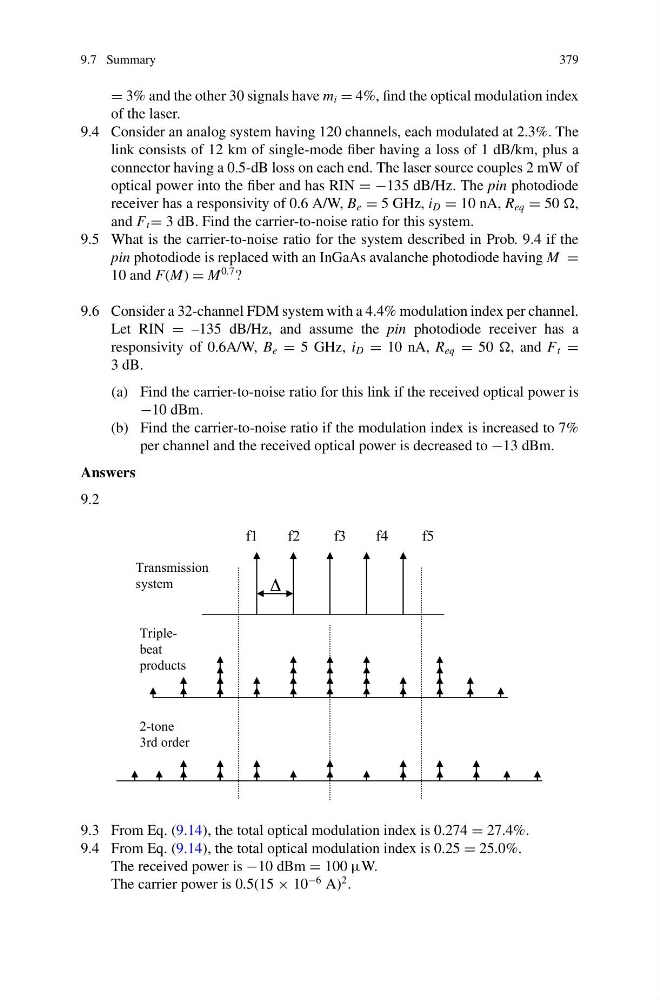
9.2
f1
f2
f3
f4
f5
Transmission
system
Triplebeat
products
2-tone
3rd order
9.3 From Eq. (9.14), the total optical modulation index is 0.274 = 27.4%.
9.4 From Eq. (9.14), the total optical modulation index is 0.25 = 25.0%.
The received power is −10 dBm = 100 µW.
The carrier power is 0.5(15 × 10
−6 A)
2 .
379
= 3% and the other 30 signals have m i = 4%, find the optical modulation index
of the laser.
9.4 Consider an analog system having 120 channels, each modulated at 2.3%. The
link consists of 12 km of single-mode fiber having a loss of 1 dB/km, plus a
connector having a 0.5-dB loss on each end. The laser source couples 2 mW of
optical power into the fiber and has RIN = −135 dB/Hz. The pin photodiode
receiver has a responsivity of 0.6 A/W, B e = 5 GHz, i D = 10 nA, R eq = 50
and F t = 3 dB. Find the carrier-to-noise ratio for this system.
9.5 What is the carrier-to-noise ratio for the system described in Prob. 9.4 if the
pin photodiode is replaced with an InGaAs avalanche photodiode having M =
10 and F(M) = M
0.7 ?
9.6 Consider a 32-channel FDM system with a 4.4% modulation index per channel.
Let RIN = –135 dB/Hz, and assume the pin photodiode receiver has a
responsivity of 0.6A/W, B e = 5 GHz, i D = 10 nA, R eq = 50 , and F t =
3 dB.
(a) Find the carrier-to-noise ratio for this link if the received optical power is
−10 dBm.
(b) Find the carrier-to-noise ratio if the modulation index is increased to 7%
per channel and the received optical power is decreased to −13 dBm.
Answers
9.2
f1
f2
f3
f4
f5
Transmission
system
Triplebeat
products
2-tone
3rd order
9.3 From Eq. (9.14), the total optical modulation index is 0.274 = 27.4%.
9.4 From Eq. (9.14), the total optical modulation index is 0.25 = 25.0%.
The received power is −10 dBm = 100 µW.
The carrier power is 0.5(15 × 10
−6 A)
2 .