

9.3 Multichannel Amplitude Modulation
371
9.3 Multichannel Amplitude Modulation
The initial widespread application of analog fiber optic links, which started in the late
1980s, was to CATV networks [11]. These coax-based television networks operate
in a frequency range from 50 to 88 MHz and from 120 to 550 MHz. The band from
88 to 120 MHz is not used, because it is reserved for FM radio broadcast. The CATV
networks can deliver over 80 amplitude-modulated vestigial-sideband (AM-VSB)
video channels, each having a noise bandwidth of 4 MHz within a channel bandwidth
of 6 MHz with signal-to-noise ratios exceeding 47 dB. To remain compatible with
existing coax-based networks, a multichannel AM-VSB format is chosen for the
fiber optic system.
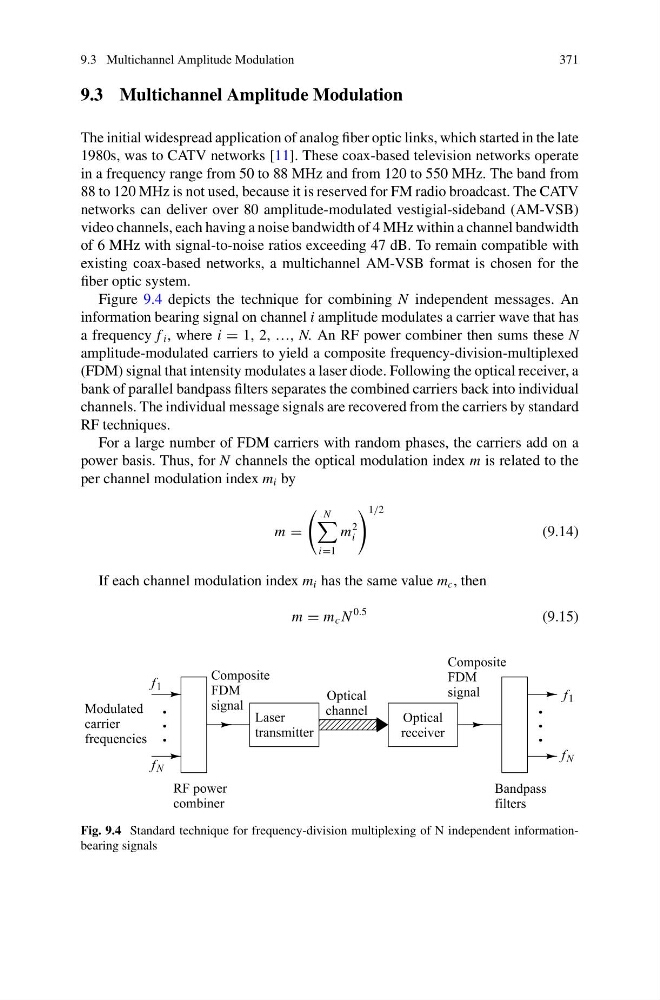
Figure 9.4 depicts the technique for combining N independent messages. An
information bearing signal on channel i amplitude modulates a carrier wave that has
a frequency f i , where i = 1, 2, …, N. An RF power combiner then sums these N
amplitude-modulated carriers to yield a composite frequency-division-multiplexed
(FDM) signal that intensity modulates a laser diode. Following the optical receiver, a
bank of parallel bandpass filters separates the combined carriers back into individual
channels. The individual message signals are recovered from the carriers by standard
RF techniques.
For a large number of FDM carriers with random phases, the carriers add on a
power basis. Thus, for N channels the optical modulation index m is related to the
per channel modulation index m i by
m =
N
i=1
m
2
i
1/2
(9.14)
If each channel modulation index m i has the same value m c , then
m = m c N
0.5
(9.15)
Fig. 9.4 Standard technique for frequency-division multiplexing of N independent informationbearing signals
371
9.3 Multichannel Amplitude Modulation
The initial widespread application of analog fiber optic links, which started in the late
1980s, was to CATV networks [11]. These coax-based television networks operate
in a frequency range from 50 to 88 MHz and from 120 to 550 MHz. The band from
88 to 120 MHz is not used, because it is reserved for FM radio broadcast. The CATV
networks can deliver over 80 amplitude-modulated vestigial-sideband (AM-VSB)
video channels, each having a noise bandwidth of 4 MHz within a channel bandwidth
of 6 MHz with signal-to-noise ratios exceeding 47 dB. To remain compatible with
existing coax-based networks, a multichannel AM-VSB format is chosen for the
fiber optic system.
Figure 9.4 depicts the technique for combining N independent messages. An
information bearing signal on channel i amplitude modulates a carrier wave that has
a frequency f i , where i = 1, 2, …, N. An RF power combiner then sums these N
amplitude-modulated carriers to yield a composite frequency-division-multiplexed
(FDM) signal that intensity modulates a laser diode. Following the optical receiver, a
bank of parallel bandpass filters separates the combined carriers back into individual
channels. The individual message signals are recovered from the carriers by standard
RF techniques.
For a large number of FDM carriers with random phases, the carriers add on a
power basis. Thus, for N channels the optical modulation index m is related to the
per channel modulation index m i by
m =
N
i=1
m
2
i
1/2
(9.14)
If each channel modulation index m i has the same value m c , then
m = m c N
0.5
(9.15)
Fig. 9.4 Standard technique for frequency-division multiplexing of N independent informationbearing signals