

16
1 Perspectives on Lightwave Communications
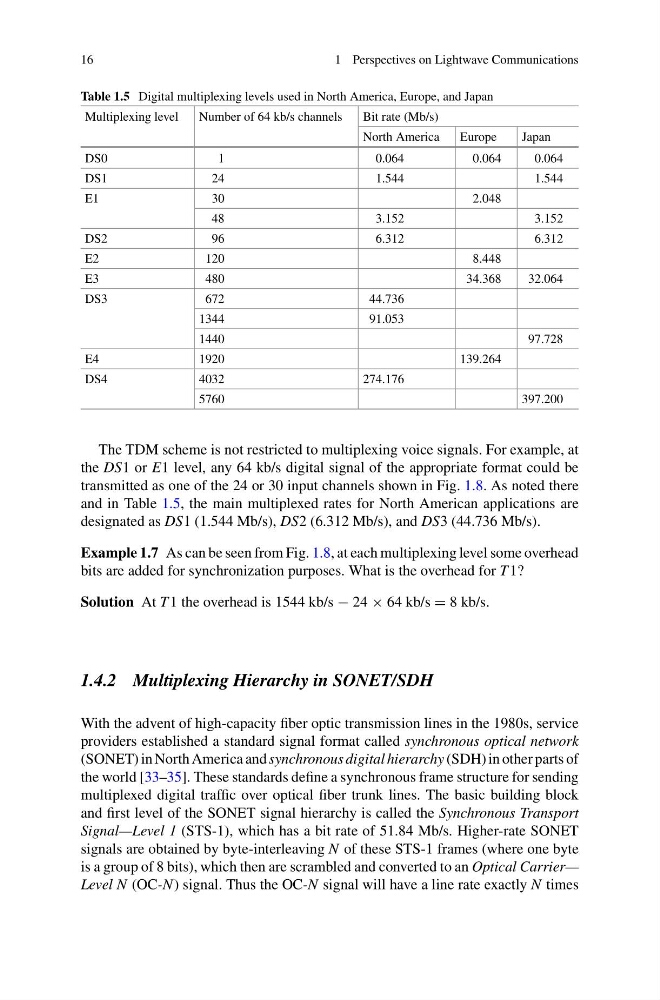
Table 1.5 Digital multiplexing levels used in North America, Europe, and Japan
Multiplexing level
Number of 64 kb/s channels
Bit rate (Mb/s)
North America
Europe
Japan
DS0
1
0.064
0.064
0.064
DS1
24
1.544
1.544
E1
30
2.048
48
3.152
3.152
DS2
96
6.312
6.312
E2
120
8.448
E3
480
34.368
32.064
DS3
672
44.736
1344
91.053
1440
97.728
E4
1920
139.264
DS4
4032
274.176
5760
397.200
The TDM scheme is not restricted to multiplexing voice signals. For example, at
the DS1 or E1 level, any 64 kb/s digital signal of the appropriate format could be
transmitted as one of the 24 or 30 input channels shown in Fig. 1.8. As noted there
and in Table 1.5, the main multiplexed rates for North American applications are
designated as DS1 (1.544 Mb/s), DS2 (6.312 Mb/s), and DS3 (44.736 Mb/s).
Example 1.7 As can be seen from Fig. 1.8, at each multiplexing level some overhead
bits are added for synchronization purposes. What is the overhead for T 1?
Solution At T 1 the overhead is 1544 kb/s − 24 × 64 kb/s = 8 kb/s.
1.4.2 Multiplexing Hierarchy in SONET/SDH
With the advent of high-capacity fiber optic transmission lines in the 1980s, service
providers established a standard signal format called synchronous optical network
(SONET) in North America and synchronous digital hierarchy (SDH) in other parts of
the world [33–35]. These standards define a synchronous frame structure for sending
multiplexed digital traffic over optical fiber trunk lines. The basic building block
and first level of the SONET signal hierarchy is called the Synchronous Transport
Signal—Level 1 (STS-1), which has a bit rate of 51.84 Mb/s. Higher-rate SONET
signals are obtained by byte-interleaving N of these STS-1 frames (where one byte
is a group of 8 bits), which then are scrambled and converted to an Optical Carrier—
Level N (OC-N) signal. Thus the OC-N signal will have a line rate exactly N times
1 Perspectives on Lightwave Communications
Table 1.5 Digital multiplexing levels used in North America, Europe, and Japan
Multiplexing level
Number of 64 kb/s channels
Bit rate (Mb/s)
North America
Europe
Japan
DS0
1
0.064
0.064
0.064
DS1
24
1.544
1.544
E1
30
2.048
48
3.152
3.152
DS2
96
6.312
6.312
E2
120
8.448
E3
480
34.368
32.064
DS3
672
44.736
1344
91.053
1440
97.728
E4
1920
139.264
DS4
4032
274.176
5760
397.200
The TDM scheme is not restricted to multiplexing voice signals. For example, at
the DS1 or E1 level, any 64 kb/s digital signal of the appropriate format could be
transmitted as one of the 24 or 30 input channels shown in Fig. 1.8. As noted there
and in Table 1.5, the main multiplexed rates for North American applications are
designated as DS1 (1.544 Mb/s), DS2 (6.312 Mb/s), and DS3 (44.736 Mb/s).
Example 1.7 As can be seen from Fig. 1.8, at each multiplexing level some overhead
bits are added for synchronization purposes. What is the overhead for T 1?
Solution At T 1 the overhead is 1544 kb/s − 24 × 64 kb/s = 8 kb/s.
1.4.2 Multiplexing Hierarchy in SONET/SDH
With the advent of high-capacity fiber optic transmission lines in the 1980s, service
providers established a standard signal format called synchronous optical network
(SONET) in North America and synchronous digital hierarchy (SDH) in other parts of
the world [33–35]. These standards define a synchronous frame structure for sending
multiplexed digital traffic over optical fiber trunk lines. The basic building block
and first level of the SONET signal hierarchy is called the Synchronous Transport
Signal—Level 1 (STS-1), which has a bit rate of 51.84 Mb/s. Higher-rate SONET
signals are obtained by byte-interleaving N of these STS-1 frames (where one byte
is a group of 8 bits), which then are scrambled and converted to an Optical Carrier—
Level N (OC-N) signal. Thus the OC-N signal will have a line rate exactly N times