

338
8 Digital Optical Fiber Links
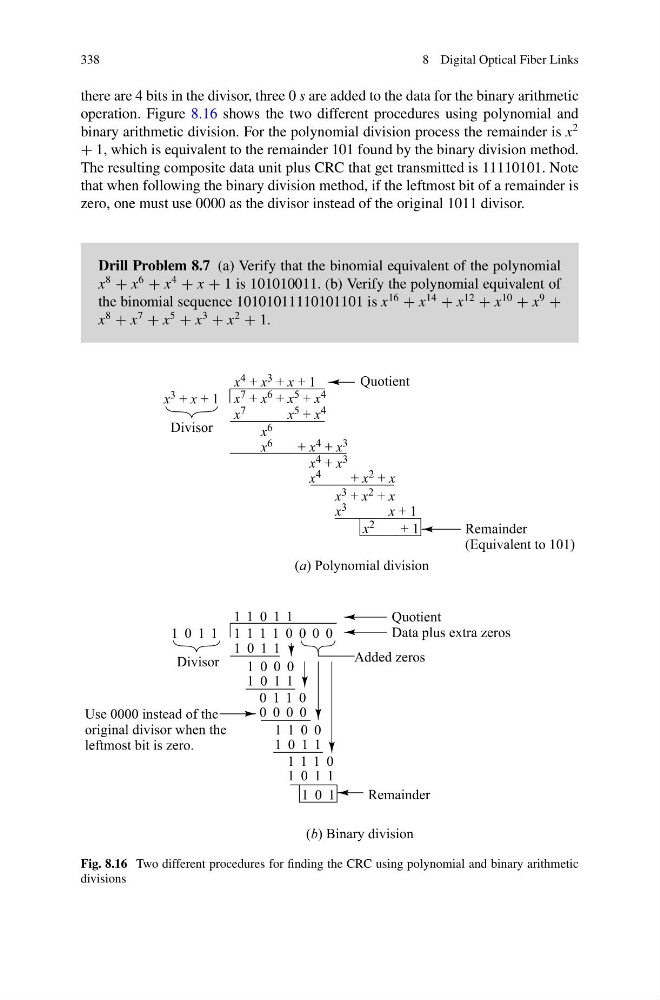
there are 4 bits in the divisor, three 0 s are added to the data for the binary arithmetic
operation. Figure 8.16 shows the two different procedures using polynomial and
binary arithmetic division. For the polynomial division process the remainder is x
2
+ 1, which is equivalent to the remainder 101 found by the binary division method.
The resulting composite data unit plus CRC that get transmitted is 11110101. Note
that when following the binary division method, if the leftmost bit of a remainder is
zero, one must use 0000 as the divisor instead of the original 1011 divisor.
Drill Problem 8.7 (a) Verify that the binomial equivalent of the polynomial
x
8
+ x
6
+ x
4
+ x + 1 is 101010011. (b) Verify the polynomial equivalent of
the binomial sequence 10101011110101101 is x
16
+ x
14
+ x
12
+ x
10
+ x
9
+
x
8
+ x
7
+ x
5
+ x
3
+ x
2
+ 1.
Fig. 8.16 Two different procedures for finding the CRC using polynomial and binary arithmetic
divisions
8 Digital Optical Fiber Links
there are 4 bits in the divisor, three 0 s are added to the data for the binary arithmetic
operation. Figure 8.16 shows the two different procedures using polynomial and
binary arithmetic division. For the polynomial division process the remainder is x
2
+ 1, which is equivalent to the remainder 101 found by the binary division method.
The resulting composite data unit plus CRC that get transmitted is 11110101. Note
that when following the binary division method, if the leftmost bit of a remainder is
zero, one must use 0000 as the divisor instead of the original 1011 divisor.
Drill Problem 8.7 (a) Verify that the binomial equivalent of the polynomial
x
8
+ x
6
+ x
4
+ x + 1 is 101010011. (b) Verify the polynomial equivalent of
the binomial sequence 10101011110101101 is x
16
+ x
14
+ x
12
+ x
10
+ x
9
+
x
8
+ x
7
+ x
5
+ x
3
+ x
2
+ 1.
Fig. 8.16 Two different procedures for finding the CRC using polynomial and binary arithmetic
divisions