

8.2 Concepts of Link Power Penalties
323
value of D CD = 18 ps/(nm km) at 1550 nm, whereas a G.655 fiber has a chromatic
dispersion value of about D CD = 4 ps/(nm km) at 1550 nm.
The accumulated chromatic dispersion increases with distance along a link. Therefore, either a transmission system has to be designed to tolerate the total dispersion,
or some type of optical or electronic dispersion compensation method has to be
employed [14–17]. A basic estimate of what limitation chromatic dispersion imposes
on link performance can be made by specifying that the accumulated dispersion
should be less than a fraction ε of the bit period T b = 1/B, where B is the bit rate.
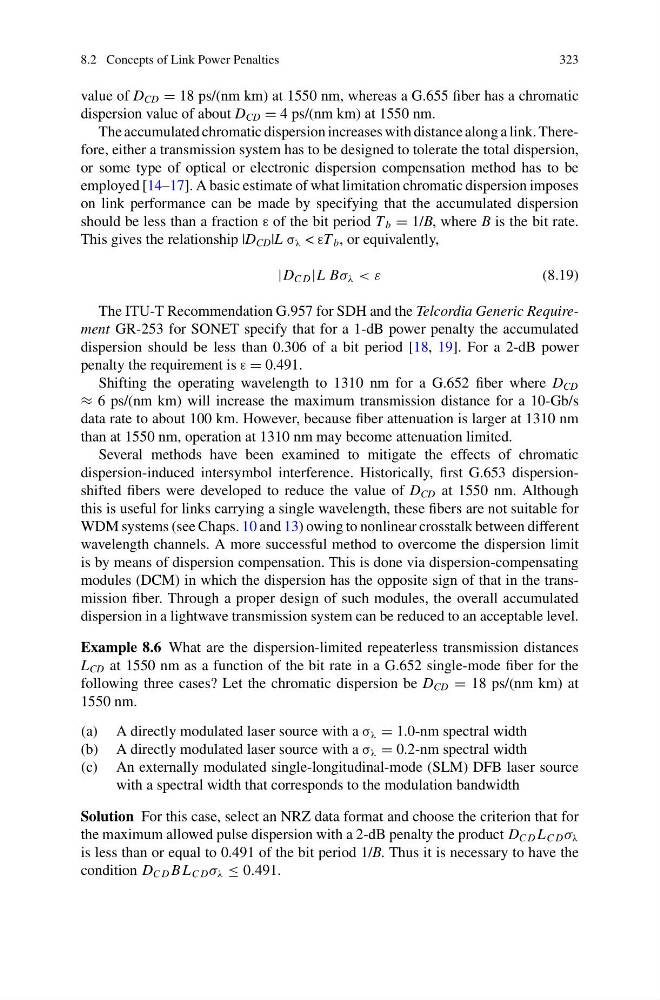
This gives the relationship |D CD |L σ λ < εT b , or equivalently,
|D C D |L Bσ λ < ε
(8.19)
The ITU-T Recommendation G.957 for SDH and the Telcordia Generic Requirement GR-253 for SONET specify that for a 1-dB power penalty the accumulated
dispersion should be less than 0.306 of a bit period [18, 19]. For a 2-dB power
penalty the requirement is ε = 0.491.
Shifting the operating wavelength to 1310 nm for a G.652 fiber where D CD
≈ 6 ps/(nm km) will increase the maximum transmission distance for a 10-Gb/s
data rate to about 100 km. However, because fiber attenuation is larger at 1310 nm
than at 1550 nm, operation at 1310 nm may become attenuation limited.
Several methods have been examined to mitigate the effects of chromatic
dispersion-induced intersymbol interference. Historically, first G.653 dispersionshifted fibers were developed to reduce the value of D CD at 1550 nm. Although
this is useful for links carrying a single wavelength, these fibers are not suitable for
WDM systems (see Chaps. 10 and 13) owing to nonlinear crosstalk between different
wavelength channels. A more successful method to overcome the dispersion limit
is by means of dispersion compensation. This is done via dispersion-compensating
modules (DCM) in which the dispersion has the opposite sign of that in the transmission fiber. Through a proper design of such modules, the overall accumulated
dispersion in a lightwave transmission system can be reduced to an acceptable level.
Example 8.6 What are the dispersion-limited repeaterless transmission distances
L CD at 1550 nm as a function of the bit rate in a G.652 single-mode fiber for the
following three cases? Let the chromatic dispersion be D CD = 18 ps/(nm km) at
1550 nm.
(a) A directly modulated laser source with a σ λ = 1.0-nm spectral width
(b) A directly modulated laser source with a σ λ = 0.2-nm spectral width
(c) An externally modulated single-longitudinal-mode (SLM) DFB laser source
with a spectral width that corresponds to the modulation bandwidth
Solution For this case, select an NRZ data format and choose the criterion that for
the maximum allowed pulse dispersion with a 2-dB penalty the product D C D L C D σ λ
is less than or equal to 0.491 of the bit period 1/B. Thus it is necessary to have the
condition D C D B L C D σ λ ≤ 0.491.
323
value of D CD = 18 ps/(nm km) at 1550 nm, whereas a G.655 fiber has a chromatic
dispersion value of about D CD = 4 ps/(nm km) at 1550 nm.
The accumulated chromatic dispersion increases with distance along a link. Therefore, either a transmission system has to be designed to tolerate the total dispersion,
or some type of optical or electronic dispersion compensation method has to be
employed [14–17]. A basic estimate of what limitation chromatic dispersion imposes
on link performance can be made by specifying that the accumulated dispersion
should be less than a fraction ε of the bit period T b = 1/B, where B is the bit rate.
This gives the relationship |D CD |L σ λ < εT b , or equivalently,
|D C D |L Bσ λ < ε
(8.19)
The ITU-T Recommendation G.957 for SDH and the Telcordia Generic Requirement GR-253 for SONET specify that for a 1-dB power penalty the accumulated
dispersion should be less than 0.306 of a bit period [18, 19]. For a 2-dB power
penalty the requirement is ε = 0.491.
Shifting the operating wavelength to 1310 nm for a G.652 fiber where D CD
≈ 6 ps/(nm km) will increase the maximum transmission distance for a 10-Gb/s
data rate to about 100 km. However, because fiber attenuation is larger at 1310 nm
than at 1550 nm, operation at 1310 nm may become attenuation limited.
Several methods have been examined to mitigate the effects of chromatic
dispersion-induced intersymbol interference. Historically, first G.653 dispersionshifted fibers were developed to reduce the value of D CD at 1550 nm. Although
this is useful for links carrying a single wavelength, these fibers are not suitable for
WDM systems (see Chaps. 10 and 13) owing to nonlinear crosstalk between different
wavelength channels. A more successful method to overcome the dispersion limit
is by means of dispersion compensation. This is done via dispersion-compensating
modules (DCM) in which the dispersion has the opposite sign of that in the transmission fiber. Through a proper design of such modules, the overall accumulated
dispersion in a lightwave transmission system can be reduced to an acceptable level.
Example 8.6 What are the dispersion-limited repeaterless transmission distances
L CD at 1550 nm as a function of the bit rate in a G.652 single-mode fiber for the
following three cases? Let the chromatic dispersion be D CD = 18 ps/(nm km) at
1550 nm.
(a) A directly modulated laser source with a σ λ = 1.0-nm spectral width
(b) A directly modulated laser source with a σ λ = 0.2-nm spectral width
(c) An externally modulated single-longitudinal-mode (SLM) DFB laser source
with a spectral width that corresponds to the modulation bandwidth
Solution For this case, select an NRZ data format and choose the criterion that for
the maximum allowed pulse dispersion with a 2-dB penalty the product D C D L C D σ λ
is less than or equal to 0.491 of the bit period 1/B. Thus it is necessary to have the
condition D C D B L C D σ λ ≤ 0.491.