

8.1 Basic Optical Fiber Links
307
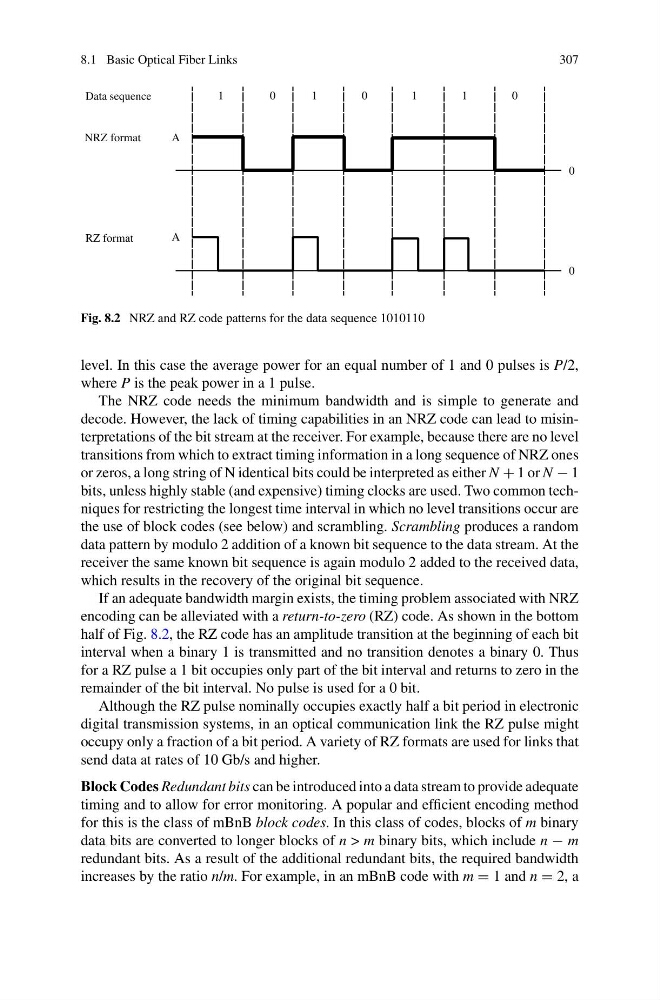
Fig. 8.2 NRZ and RZ code patterns for the data sequence 1010110
level. In this case the average power for an equal number of 1 and 0 pulses is P/2,
where P is the peak power in a 1 pulse.
The NRZ code needs the minimum bandwidth and is simple to generate and
decode. However, the lack of timing capabilities in an NRZ code can lead to misinterpretations of the bit stream at the receiver. For example, because there are no level
transitions from which to extract timing information in a long sequence of NRZ ones
or zeros, a long string of N identical bits could be interpreted as either N + 1 or N − 1
bits, unless highly stable (and expensive) timing clocks are used. Two common techniques for restricting the longest time interval in which no level transitions occur are
the use of block codes (see below) and scrambling. Scrambling produces a random
data pattern by modulo 2 addition of a known bit sequence to the data stream. At the
receiver the same known bit sequence is again modulo 2 added to the received data,
which results in the recovery of the original bit sequence.
If an adequate bandwidth margin exists, the timing problem associated with NRZ
encoding can be alleviated with a return-to-zero (RZ) code. As shown in the bottom
half of Fig. 8.2, the RZ code has an amplitude transition at the beginning of each bit
interval when a binary 1 is transmitted and no transition denotes a binary 0. Thus
for a RZ pulse a 1 bit occupies only part of the bit interval and returns to zero in the
remainder of the bit interval. No pulse is used for a 0 bit.
Although the RZ pulse nominally occupies exactly half a bit period in electronic
digital transmission systems, in an optical communication link the RZ pulse might
occupy only a fraction of a bit period. A variety of RZ formats are used for links that
send data at rates of 10 Gb/s and higher.
Block Codes Redundant bits can be introduced into a data stream to provide adequate
timing and to allow for error monitoring. A popular and efficient encoding method
for this is the class of mBnB block codes. In this class of codes, blocks of m binary
data bits are converted to longer blocks of n > m binary bits, which include n − m
redundant bits. As a result of the additional redundant bits, the required bandwidth
increases by the ratio n/m. For example, in an mBnB code with m = 1 and n = 2, a
307
Fig. 8.2 NRZ and RZ code patterns for the data sequence 1010110
level. In this case the average power for an equal number of 1 and 0 pulses is P/2,
where P is the peak power in a 1 pulse.
The NRZ code needs the minimum bandwidth and is simple to generate and
decode. However, the lack of timing capabilities in an NRZ code can lead to misinterpretations of the bit stream at the receiver. For example, because there are no level
transitions from which to extract timing information in a long sequence of NRZ ones
or zeros, a long string of N identical bits could be interpreted as either N + 1 or N − 1
bits, unless highly stable (and expensive) timing clocks are used. Two common techniques for restricting the longest time interval in which no level transitions occur are
the use of block codes (see below) and scrambling. Scrambling produces a random
data pattern by modulo 2 addition of a known bit sequence to the data stream. At the
receiver the same known bit sequence is again modulo 2 added to the received data,
which results in the recovery of the original bit sequence.
If an adequate bandwidth margin exists, the timing problem associated with NRZ
encoding can be alleviated with a return-to-zero (RZ) code. As shown in the bottom
half of Fig. 8.2, the RZ code has an amplitude transition at the beginning of each bit
interval when a binary 1 is transmitted and no transition denotes a binary 0. Thus
for a RZ pulse a 1 bit occupies only part of the bit interval and returns to zero in the
remainder of the bit interval. No pulse is used for a 0 bit.
Although the RZ pulse nominally occupies exactly half a bit period in electronic
digital transmission systems, in an optical communication link the RZ pulse might
occupy only a fraction of a bit period. A variety of RZ formats are used for links that
send data at rates of 10 Gb/s and higher.
Block Codes Redundant bits can be introduced into a data stream to provide adequate
timing and to allow for error monitoring. A popular and efficient encoding method
for this is the class of mBnB block codes. In this class of codes, blocks of m binary
data bits are converted to longer blocks of n > m binary bits, which include n − m
redundant bits. As a result of the additional redundant bits, the required bandwidth
increases by the ratio n/m. For example, in an mBnB code with m = 1 and n = 2, a