

12
1 Perspectives on Lightwave Communications
Thus, −3 dB (or a 3 dB attenuation or loss) means that the signal has lost half its
power. If an amplifier is inserted into the link at this point to boost the signal back
to its original level, then that amplifier has a 3 dB gain. If the amplifier has a 6 dB
gain, then it boosts the signal power level to twice the original value.
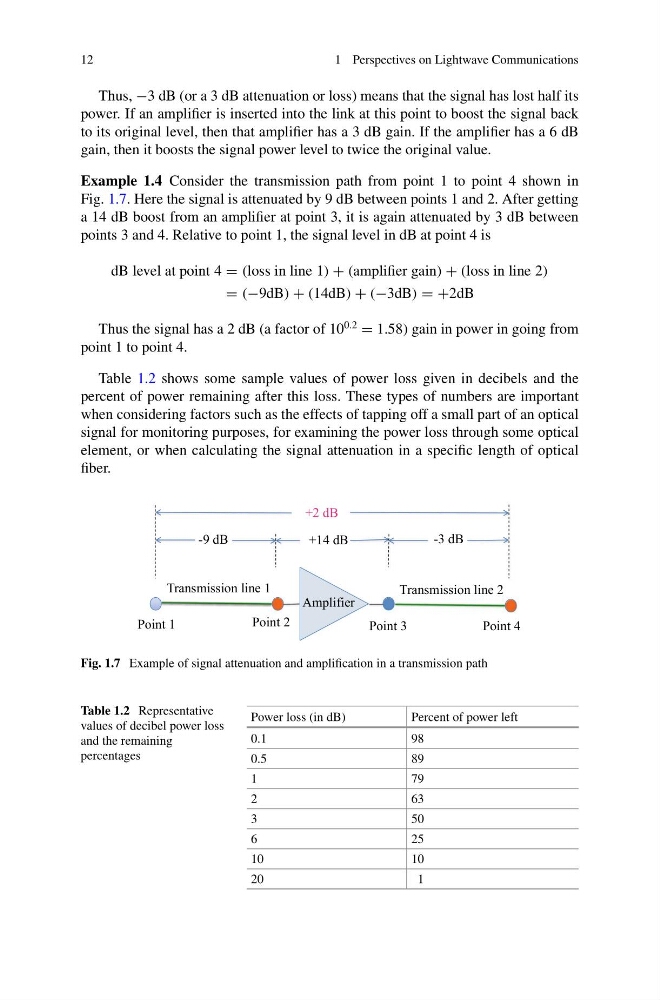
Example 1.4 Consider the transmission path from point 1 to point 4 shown in
Fig. 1.7. Here the signal is attenuated by 9 dB between points 1 and 2. After getting
a 14 dB boost from an amplifier at point 3, it is again attenuated by 3 dB between
points 3 and 4. Relative to point 1, the signal level in dB at point 4 is
dB level at point 4 = (loss in line 1) + (amplifier gain) + (loss in line 2)
= (−9dB) + (14dB) + (−3dB) = +2dB
Thus the signal has a 2 dB (a factor of 10
0.2
= 1.58) gain in power in going from
point 1 to point 4.
Table 1.2 shows some sample values of power loss given in decibels and the
percent of power remaining after this loss. These types of numbers are important
when considering factors such as the effects of tapping off a small part of an optical
signal for monitoring purposes, for examining the power loss through some optical
element, or when calculating the signal attenuation in a specific length of optical
fiber.
Transmission line 1
Point 1
Point 2
Point 3
Amplifier
Transmission line 2
Point 4
-9 dB
+14 dB
-3 dB
+2 dB
Fig. 1.7 Example of signal attenuation and amplification in a transmission path
Table 1.2 Representative
values of decibel power loss
and the remaining
percentages
Power loss (in dB)
Percent of power left
0.1
98
0.5
89
1
79
2
63
3
50
6
25
10
10
20
1
1 Perspectives on Lightwave Communications
Thus, −3 dB (or a 3 dB attenuation or loss) means that the signal has lost half its
power. If an amplifier is inserted into the link at this point to boost the signal back
to its original level, then that amplifier has a 3 dB gain. If the amplifier has a 6 dB
gain, then it boosts the signal power level to twice the original value.
Example 1.4 Consider the transmission path from point 1 to point 4 shown in
Fig. 1.7. Here the signal is attenuated by 9 dB between points 1 and 2. After getting
a 14 dB boost from an amplifier at point 3, it is again attenuated by 3 dB between
points 3 and 4. Relative to point 1, the signal level in dB at point 4 is
dB level at point 4 = (loss in line 1) + (amplifier gain) + (loss in line 2)
= (−9dB) + (14dB) + (−3dB) = +2dB
Thus the signal has a 2 dB (a factor of 10
0.2
= 1.58) gain in power in going from
point 1 to point 4.
Table 1.2 shows some sample values of power loss given in decibels and the
percent of power remaining after this loss. These types of numbers are important
when considering factors such as the effects of tapping off a small part of an optical
signal for monitoring purposes, for examining the power loss through some optical
element, or when calculating the signal attenuation in a specific length of optical
fiber.
Transmission line 1
Point 1
Point 2
Point 3
Amplifier
Transmission line 2
Point 4
-9 dB
+14 dB
-3 dB
+2 dB
Fig. 1.7 Example of signal attenuation and amplification in a transmission path
Table 1.2 Representative
values of decibel power loss
and the remaining
percentages
Power loss (in dB)
Percent of power left
0.1
98
0.5
89
1
79
2
63
3
50
6
25
10
10
20
1