

7.6 Summary
299
but it has two limitations: (a) equalization methods are required for broadband applications and (b) it has a limited dynamic range. The transimpedance amplifier is less
sensitive because of a higher noise penalty, but it has the benefit of a wider dynamic
range without equalization.
For passive optical network (PON) applications, a specially designed burst-mode
receiver is needed. These receivers can quickly extract the decision threshold and
determine the signal phase from a set of overhead bits placed at the beginning of
each packet burst. However, this methodology results in a receiver sensitivity power
penalty of up to 3 dB. The key requirements of a burst-mode receiver are high sensitivity, wide dynamic range, and fast response time. The sensitivity is important in
relation to the optical power budget, because, for example, a 3-dB sensitivity improvement allows more customers to be attached to the PON. A wide dynamic range is
essential for achieving a long network reach, that is, to be able to accommodate users
located both close and far away from the central office.
The eye diagram is a powerful measurement tool for assessing the data-handling
ability of a digital transmission system. This method has been used extensively for
evaluating the performance of wire-line systems and also applies to optical fiber data
links. To reduce costly and time-consuming test periods, a Q-factor technique can
be used. Although some accuracy is lost in this method, it reduces the test times to
minutes instead of hours. In this method the receiver threshold is decreased, which
increases the probability of errors and thus decreases test time.
Problems
7.1 Consider a photodetector that has a quantum efficiency η = 0.75.
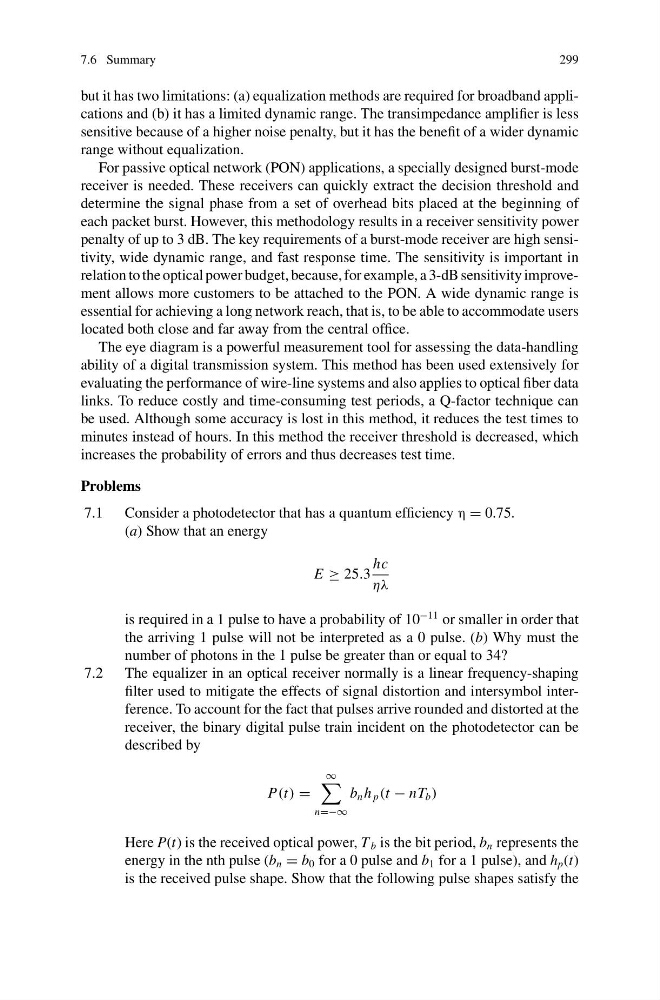
(a) Show that an energy
E ≥ 25.3
hc
ηλ
is required in a 1 pulse to have a probability of 10
−11 or smaller in order that
the arriving 1 pulse will not be interpreted as a 0 pulse. (b) Why must the
number of photons in the 1 pulse be greater than or equal to 34?
7.2 The equalizer in an optical receiver normally is a linear frequency-shaping
filter used to mitigate the effects of signal distortion and intersymbol interference. To account for the fact that pulses arrive rounded and distorted at the
receiver, the binary digital pulse train incident on the photodetector can be
described by
P(t) =
∞
n=−∞
b n h p (t − nT b )
Here P(t) is the received optical power, T b is the bit period, b n represents the
energy in the nth pulse (b n = b 0 for a 0 pulse and b 1 for a 1 pulse), and h p (t)
is the received pulse shape. Show that the following pulse shapes satisfy the
299
but it has two limitations: (a) equalization methods are required for broadband applications and (b) it has a limited dynamic range. The transimpedance amplifier is less
sensitive because of a higher noise penalty, but it has the benefit of a wider dynamic
range without equalization.
For passive optical network (PON) applications, a specially designed burst-mode
receiver is needed. These receivers can quickly extract the decision threshold and
determine the signal phase from a set of overhead bits placed at the beginning of
each packet burst. However, this methodology results in a receiver sensitivity power
penalty of up to 3 dB. The key requirements of a burst-mode receiver are high sensitivity, wide dynamic range, and fast response time. The sensitivity is important in
relation to the optical power budget, because, for example, a 3-dB sensitivity improvement allows more customers to be attached to the PON. A wide dynamic range is
essential for achieving a long network reach, that is, to be able to accommodate users
located both close and far away from the central office.
The eye diagram is a powerful measurement tool for assessing the data-handling
ability of a digital transmission system. This method has been used extensively for
evaluating the performance of wire-line systems and also applies to optical fiber data
links. To reduce costly and time-consuming test periods, a Q-factor technique can
be used. Although some accuracy is lost in this method, it reduces the test times to
minutes instead of hours. In this method the receiver threshold is decreased, which
increases the probability of errors and thus decreases test time.
Problems
7.1 Consider a photodetector that has a quantum efficiency η = 0.75.
(a) Show that an energy
E ≥ 25.3
hc
ηλ
is required in a 1 pulse to have a probability of 10
−11 or smaller in order that
the arriving 1 pulse will not be interpreted as a 0 pulse. (b) Why must the
number of photons in the 1 pulse be greater than or equal to 34?
7.2 The equalizer in an optical receiver normally is a linear frequency-shaping
filter used to mitigate the effects of signal distortion and intersymbol interference. To account for the fact that pulses arrive rounded and distorted at the
receiver, the binary digital pulse train incident on the photodetector can be
described by
P(t) =
∞
n=−∞
b n h p (t − nT b )
Here P(t) is the received optical power, T b is the bit period, b n represents the
energy in the nth pulse (b n = b 0 for a 0 pulse and b 1 for a 1 pulse), and h p (t)
is the received pulse shape. Show that the following pulse shapes satisfy the