

290
7 Optical Receiver Operation
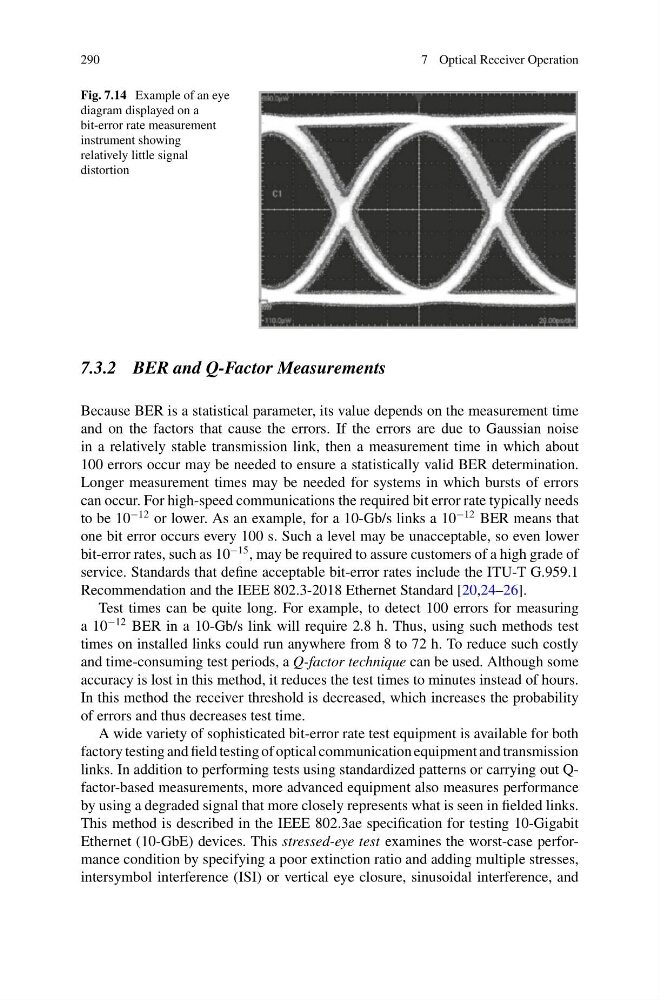
Fig. 7.14 Example of an eye
diagram displayed on a
bit-error rate measurement
instrument showing
relatively little signal
distortion
7.3.2 BER and Q-Factor Measurements
Because BER is a statistical parameter, its value depends on the measurement time
and on the factors that cause the errors. If the errors are due to Gaussian noise
in a relatively stable transmission link, then a measurement time in which about
100 errors occur may be needed to ensure a statistically valid BER determination.
Longer measurement times may be needed for systems in which bursts of errors
can occur. For high-speed communications the required bit error rate typically needs
to be 10
−12 or lower. As an example, for a 10-Gb/s links a 10
−12 BER means that
one bit error occurs every 100 s. Such a level may be unacceptable, so even lower
bit-error rates, such as 10
−15 , may be required to assure customers of a high grade of
service. Standards that define acceptable bit-error rates include the ITU-T G.959.1
Recommendation and the IEEE 802.3-2018 Ethernet Standard [20,24–26].
Test times can be quite long. For example, to detect 100 errors for measuring
a 10
−12 BER in a 10-Gb/s link will require 2.8 h. Thus, using such methods test
times on installed links could run anywhere from 8 to 72 h. To reduce such costly
and time-consuming test periods, a Q-factor technique can be used. Although some
accuracy is lost in this method, it reduces the test times to minutes instead of hours.
In this method the receiver threshold is decreased, which increases the probability
of errors and thus decreases test time.
A wide variety of sophisticated bit-error rate test equipment is available for both
factory testing and field testing of optical communication equipment and transmission
links. In addition to performing tests using standardized patterns or carrying out Qfactor-based measurements, more advanced equipment also measures performance
by using a degraded signal that more closely represents what is seen in fielded links.
This method is described in the IEEE 802.3ae specification for testing 10-Gigabit
Ethernet (10-GbE) devices. This stressed-eye test examines the worst-case performance condition by specifying a poor extinction ratio and adding multiple stresses,
intersymbol interference (ISI) or vertical eye closure, sinusoidal interference, and
7 Optical Receiver Operation
Fig. 7.14 Example of an eye
diagram displayed on a
bit-error rate measurement
instrument showing
relatively little signal
distortion
7.3.2 BER and Q-Factor Measurements
Because BER is a statistical parameter, its value depends on the measurement time
and on the factors that cause the errors. If the errors are due to Gaussian noise
in a relatively stable transmission link, then a measurement time in which about
100 errors occur may be needed to ensure a statistically valid BER determination.
Longer measurement times may be needed for systems in which bursts of errors
can occur. For high-speed communications the required bit error rate typically needs
to be 10
−12 or lower. As an example, for a 10-Gb/s links a 10
−12 BER means that
one bit error occurs every 100 s. Such a level may be unacceptable, so even lower
bit-error rates, such as 10
−15 , may be required to assure customers of a high grade of
service. Standards that define acceptable bit-error rates include the ITU-T G.959.1
Recommendation and the IEEE 802.3-2018 Ethernet Standard [20,24–26].
Test times can be quite long. For example, to detect 100 errors for measuring
a 10
−12 BER in a 10-Gb/s link will require 2.8 h. Thus, using such methods test
times on installed links could run anywhere from 8 to 72 h. To reduce such costly
and time-consuming test periods, a Q-factor technique can be used. Although some
accuracy is lost in this method, it reduces the test times to minutes instead of hours.
In this method the receiver threshold is decreased, which increases the probability
of errors and thus decreases test time.
A wide variety of sophisticated bit-error rate test equipment is available for both
factory testing and field testing of optical communication equipment and transmission
links. In addition to performing tests using standardized patterns or carrying out Qfactor-based measurements, more advanced equipment also measures performance
by using a degraded signal that more closely represents what is seen in fielded links.
This method is described in the IEEE 802.3ae specification for testing 10-Gigabit
Ethernet (10-GbE) devices. This stressed-eye test examines the worst-case performance condition by specifying a poor extinction ratio and adding multiple stresses,
intersymbol interference (ISI) or vertical eye closure, sinusoidal interference, and