

266
6 Photodetection Devices
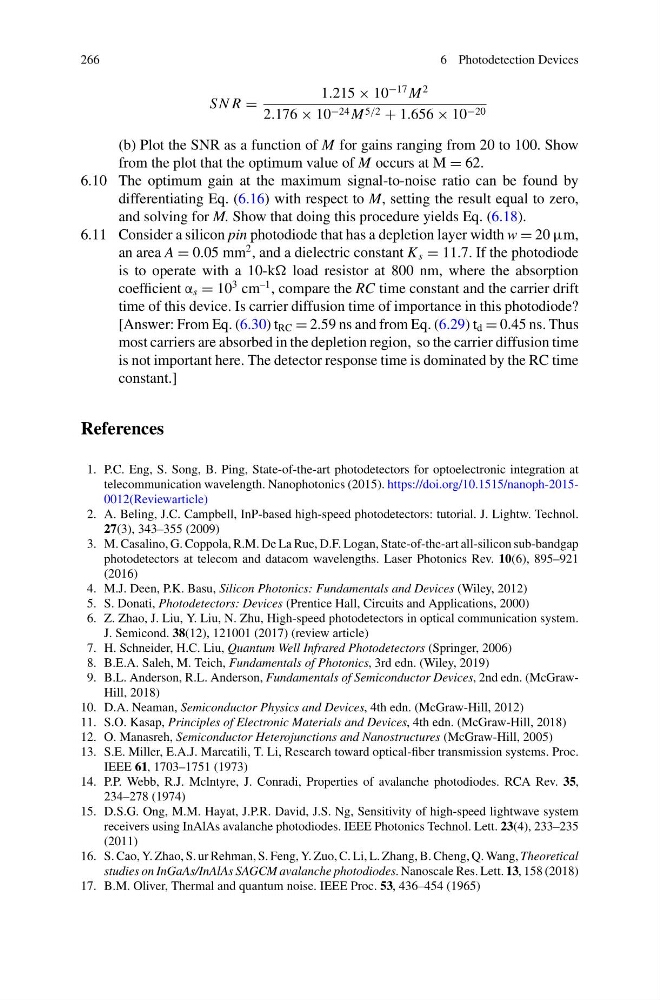
S N R =
1.215 × 10
−17 M
2
2.176 × 10 −24 M 5/2 + 1.656 × 10 −20
(b) Plot the SNR as a function of M for gains ranging from 20 to 100. Show
from the plot that the optimum value of M occurs at M = 62.
6.10 The optimum gain at the maximum signal-to-noise ratio can be found by
differentiating Eq. (6.16) with respect to M, setting the result equal to zero,
and solving for M. Show that doing this procedure yields Eq. (6.18).
6.11 Consider a silicon pin photodiode that has a depletion layer width w = 20 μm,
an area A = 0.05 mm
2 , and a dielectric constant K s = 11.7. If the photodiode
is to operate with a 10-k load resistor at 800 nm, where the absorption
coefficient α s = 10
3 cm
–1 , compare the RC time constant and the carrier drift
time of this device. Is carrier diffusion time of importance in this photodiode?
[Answer: From Eq. (6.30) t RC = 2.59 ns and from Eq. (6.29) t d = 0.45 ns. Thus
most carriers are absorbed in the depletion region, so the carrier diffusion time
is not important here. The detector response time is dominated by the RC time
constant.]
References
1. P.C. Eng, S. Song, B. Ping, State-of-the-art photodetectors for optoelectronic integration at
telecommunication wavelength. Nanophotonics (2015). https://doi.org/10.1515/nanoph-20150012(Reviewarticle)
2. A. Beling, J.C. Campbell, InP-based high-speed photodetectors: tutorial. J. Lightw. Technol.
27(3), 343–355 (2009)
3. M. Casalino, G. Coppola, R.M. De La Rue, D.F. Logan, State-of-the-art all-silicon sub-bandgap
photodetectors at telecom and datacom wavelengths. Laser Photonics Rev. 10(6), 895–921
(2016)
4. M.J. Deen, P.K. Basu, Silicon Photonics: Fundamentals and Devices (Wiley, 2012)
5. S. Donati, Photodetectors: Devices (Prentice Hall, Circuits and Applications, 2000)
6. Z. Zhao, J. Liu, Y. Liu, N. Zhu, High-speed photodetectors in optical communication system.
J. Semicond. 38(12), 121001 (2017) (review article)
7. H. Schneider, H.C. Liu, Quantum Well Infrared Photodetectors (Springer, 2006)
8. B.E.A. Saleh, M. Teich, Fundamentals of Photonics, 3rd edn. (Wiley, 2019)
9. B.L. Anderson, R.L. Anderson, Fundamentals of Semiconductor Devices, 2nd edn. (McGrawHill, 2018)
10. D.A. Neaman, Semiconductor Physics and Devices, 4th edn. (McGraw-Hill, 2012)
11. S.O. Kasap, Principles of Electronic Materials and Devices, 4th edn. (McGraw-Hill, 2018)
12. O. Manasreh, Semiconductor Heterojunctions and Nanostructures (McGraw-Hill, 2005)
13. S.E. Miller, E.A.J. Marcatili, T. Li, Research toward optical-fiber transmission systems. Proc.
IEEE 61, 1703–1751 (1973)
14. P.P. Webb, R.J. Mclntyre, J. Conradi, Properties of avalanche photodiodes. RCA Rev. 35,
234–278 (1974)
15. D.S.G. Ong, M.M. Hayat, J.P.R. David, J.S. Ng, Sensitivity of high-speed lightwave system
receivers using InAlAs avalanche photodiodes. IEEE Photonics Technol. Lett. 23(4), 233–235
(2011)
16. S. Cao, Y. Zhao, S. ur Rehman, S. Feng, Y. Zuo, C. Li, L. Zhang, B. Cheng, Q. Wang, Theoretical
studies on InGaAs/InAlAs SAGCM avalanche photodiodes. Nanoscale Res. Lett. 13, 158 (2018)
17. B.M. Oliver, Thermal and quantum noise. IEEE Proc. 53, 436–454 (1965)
6 Photodetection Devices
S N R =
1.215 × 10
−17 M
2
2.176 × 10 −24 M 5/2 + 1.656 × 10 −20
(b) Plot the SNR as a function of M for gains ranging from 20 to 100. Show
from the plot that the optimum value of M occurs at M = 62.
6.10 The optimum gain at the maximum signal-to-noise ratio can be found by
differentiating Eq. (6.16) with respect to M, setting the result equal to zero,
and solving for M. Show that doing this procedure yields Eq. (6.18).
6.11 Consider a silicon pin photodiode that has a depletion layer width w = 20 μm,
an area A = 0.05 mm
2 , and a dielectric constant K s = 11.7. If the photodiode
is to operate with a 10-k load resistor at 800 nm, where the absorption
coefficient α s = 10
3 cm
–1 , compare the RC time constant and the carrier drift
time of this device. Is carrier diffusion time of importance in this photodiode?
[Answer: From Eq. (6.30) t RC = 2.59 ns and from Eq. (6.29) t d = 0.45 ns. Thus
most carriers are absorbed in the depletion region, so the carrier diffusion time
is not important here. The detector response time is dominated by the RC time
constant.]
References
1. P.C. Eng, S. Song, B. Ping, State-of-the-art photodetectors for optoelectronic integration at
telecommunication wavelength. Nanophotonics (2015). https://doi.org/10.1515/nanoph-20150012(Reviewarticle)
2. A. Beling, J.C. Campbell, InP-based high-speed photodetectors: tutorial. J. Lightw. Technol.
27(3), 343–355 (2009)
3. M. Casalino, G. Coppola, R.M. De La Rue, D.F. Logan, State-of-the-art all-silicon sub-bandgap
photodetectors at telecom and datacom wavelengths. Laser Photonics Rev. 10(6), 895–921
(2016)
4. M.J. Deen, P.K. Basu, Silicon Photonics: Fundamentals and Devices (Wiley, 2012)
5. S. Donati, Photodetectors: Devices (Prentice Hall, Circuits and Applications, 2000)
6. Z. Zhao, J. Liu, Y. Liu, N. Zhu, High-speed photodetectors in optical communication system.
J. Semicond. 38(12), 121001 (2017) (review article)
7. H. Schneider, H.C. Liu, Quantum Well Infrared Photodetectors (Springer, 2006)
8. B.E.A. Saleh, M. Teich, Fundamentals of Photonics, 3rd edn. (Wiley, 2019)
9. B.L. Anderson, R.L. Anderson, Fundamentals of Semiconductor Devices, 2nd edn. (McGrawHill, 2018)
10. D.A. Neaman, Semiconductor Physics and Devices, 4th edn. (McGraw-Hill, 2012)
11. S.O. Kasap, Principles of Electronic Materials and Devices, 4th edn. (McGraw-Hill, 2018)
12. O. Manasreh, Semiconductor Heterojunctions and Nanostructures (McGraw-Hill, 2005)
13. S.E. Miller, E.A.J. Marcatili, T. Li, Research toward optical-fiber transmission systems. Proc.
IEEE 61, 1703–1751 (1973)
14. P.P. Webb, R.J. Mclntyre, J. Conradi, Properties of avalanche photodiodes. RCA Rev. 35,
234–278 (1974)
15. D.S.G. Ong, M.M. Hayat, J.P.R. David, J.S. Ng, Sensitivity of high-speed lightwave system
receivers using InAlAs avalanche photodiodes. IEEE Photonics Technol. Lett. 23(4), 233–235
(2011)
16. S. Cao, Y. Zhao, S. ur Rehman, S. Feng, Y. Zuo, C. Li, L. Zhang, B. Cheng, Q. Wang, Theoretical
studies on InGaAs/InAlAs SAGCM avalanche photodiodes. Nanoscale Res. Lett. 13, 158 (2018)
17. B.M. Oliver, Thermal and quantum noise. IEEE Proc. 53, 436–454 (1965)