

6
1 Perspectives on Lightwave Communications
Whereas electrical signal transmission tends to use frequency to designate the signal
operating bands, optical communication generally uses wavelength to designate the
spectral operating region and photon energy or optical power when discussing topics
such as signal strength or electro-optical component performance. However, note that
in some cases the units of optical frequency are used, for example, when dealing with
nonlinear effects in fibers.
As can be seen from Fig. 1.2, there are three different ways to measure the physical
properties of a wave in various regions in the EM spectrum. These measurement units
are related by some simple equations. First of all, in a vacuum the speed of light c is
equal to the wavelength λ (Greek letter lambda) times the frequency ν (Greek letter
nu), so that
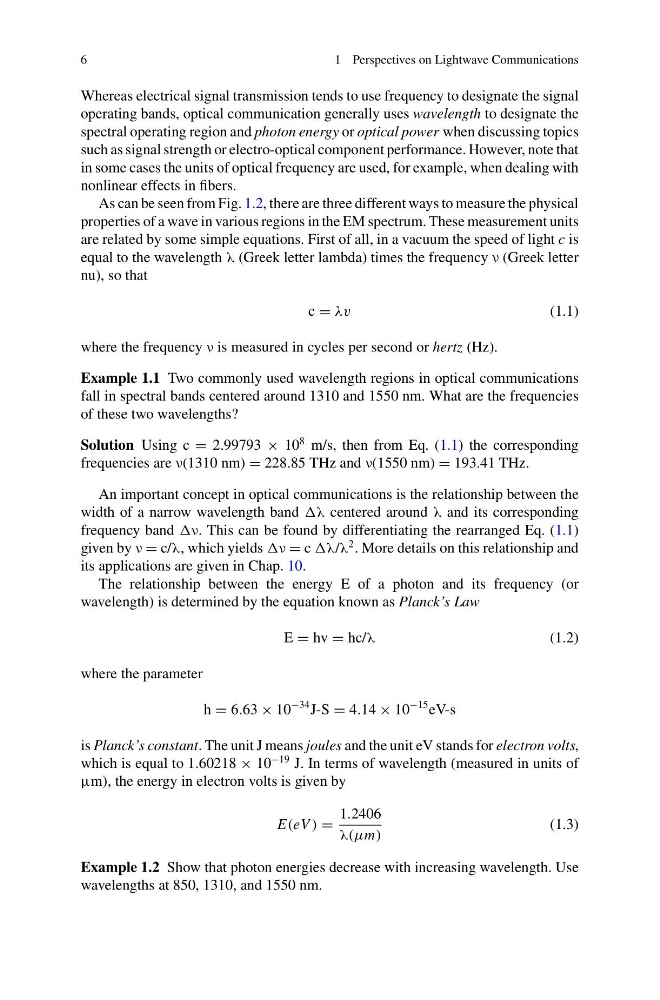
c = λv
(1.1)
where the frequency ν is measured in cycles per second or hertz (Hz).
Example 1.1 Two commonly used wavelength regions in optical communications
fall in spectral bands centered around 1310 and 1550 nm. What are the frequencies
of these two wavelengths?
Solution Using c = 2.99793 × 10
8 m/s, then from Eq. (1.1) the corresponding
frequencies are ν(1310 nm) = 228.85 THz and ν(1550 nm) = 193.41 THz.
An important concept in optical communications is the relationship between the
width of a narrow wavelength band λ centered around λ and its corresponding
frequency band ν. This can be found by differentiating the rearranged Eq. (1.1)
given by ν = c/λ, which yields ν = c λ/λ
2 . More details on this relationship and
its applications are given in Chap. 10.
The relationship between the energy E of a photon and its frequency (or
wavelength) is determined by the equation known as Planck’s Law
E = hv = hc/λ
(1.2)
where the parameter
h = 6.63 × 10
−34 J-S = 4.14 × 10
−15 eV-s
is Planck’s constant. The unit J means joules and the unit eV stands for electron volts,
which is equal to 1.60218 × 10
−19 J. In terms of wavelength (measured in units of
μm), the energy in electron volts is given by
E(eV ) =
1.2406
λ(μm)
(1.3)
Example 1.2 Show that photon energies decrease with increasing wavelength. Use
wavelengths at 850, 1310, and 1550 nm.
1 Perspectives on Lightwave Communications
Whereas electrical signal transmission tends to use frequency to designate the signal
operating bands, optical communication generally uses wavelength to designate the
spectral operating region and photon energy or optical power when discussing topics
such as signal strength or electro-optical component performance. However, note that
in some cases the units of optical frequency are used, for example, when dealing with
nonlinear effects in fibers.
As can be seen from Fig. 1.2, there are three different ways to measure the physical
properties of a wave in various regions in the EM spectrum. These measurement units
are related by some simple equations. First of all, in a vacuum the speed of light c is
equal to the wavelength λ (Greek letter lambda) times the frequency ν (Greek letter
nu), so that
c = λv
(1.1)
where the frequency ν is measured in cycles per second or hertz (Hz).
Example 1.1 Two commonly used wavelength regions in optical communications
fall in spectral bands centered around 1310 and 1550 nm. What are the frequencies
of these two wavelengths?
Solution Using c = 2.99793 × 10
8 m/s, then from Eq. (1.1) the corresponding
frequencies are ν(1310 nm) = 228.85 THz and ν(1550 nm) = 193.41 THz.
An important concept in optical communications is the relationship between the
width of a narrow wavelength band λ centered around λ and its corresponding
frequency band ν. This can be found by differentiating the rearranged Eq. (1.1)
given by ν = c/λ, which yields ν = c λ/λ
2 . More details on this relationship and
its applications are given in Chap. 10.
The relationship between the energy E of a photon and its frequency (or
wavelength) is determined by the equation known as Planck’s Law
E = hv = hc/λ
(1.2)
where the parameter
h = 6.63 × 10
−34 J-S = 4.14 × 10
−15 eV-s
is Planck’s constant. The unit J means joules and the unit eV stands for electron volts,
which is equal to 1.60218 × 10
−19 J. In terms of wavelength (measured in units of
μm), the energy in electron volts is given by
E(eV ) =
1.2406
λ(μm)
(1.3)
Example 1.2 Show that photon energies decrease with increasing wavelength. Use
wavelengths at 850, 1310, and 1550 nm.