

4.5 Summary
205
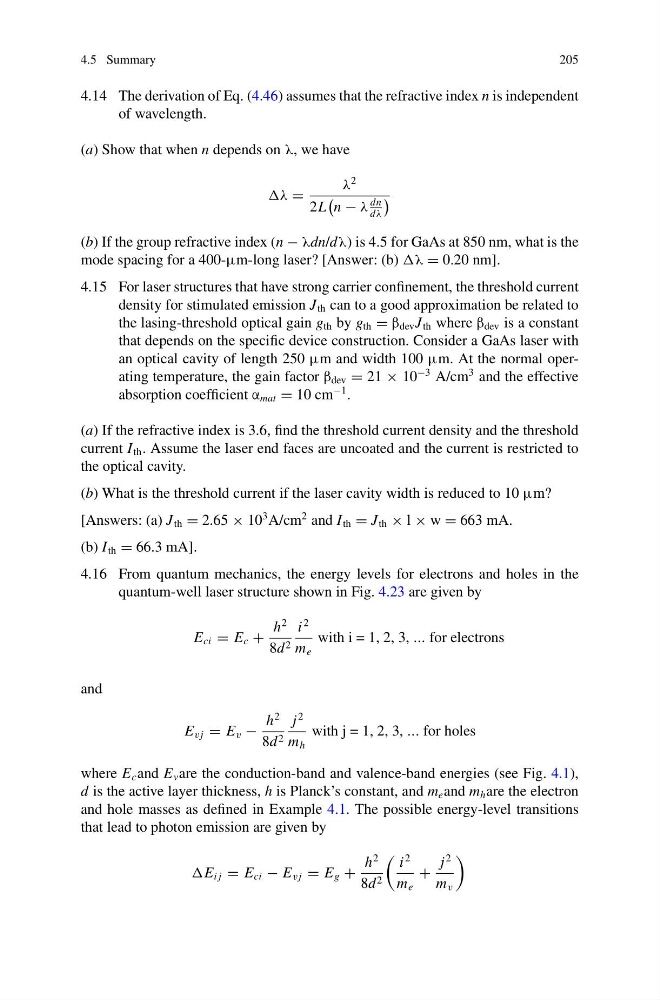
4.14 The derivation of Eq. (4.46) assumes that the refractive index n is independent
of wavelength.
(a) Show that when n depends on λ, we have
λ =
λ
2
2L
n − λ
dn
dλ
(b) If the group refractive index (n − λdn/dλ) is 4.5 for GaAs at 850 nm, what is the
mode spacing for a 400-μm-long laser? [Answer: (b) λ = 0.20 nm].
4.15 For laser structures that have strong carrier confinement, the threshold current
density for stimulated emission J th can to a good approximation be related to
the lasing-threshold optical gain g th by g th = β dev J th where β dev is a constant
that depends on the specific device construction. Consider a GaAs laser with
an optical cavity of length 250 μm and width 100 μm. At the normal operating temperature, the gain factor β dev = 21 × 10
−3 A/cm
3 and the effective
absorption coefficient α mat = 10 cm
−1 .
(a) If the refractive index is 3.6, find the threshold current density and the threshold
current I th . Assume the laser end faces are uncoated and the current is restricted to
the optical cavity.
(b) What is the threshold current if the laser cavity width is reduced to 10 μm?
[Answers: (a) J th = 2.65 × 10
3 A/cm
2 and I th = J th × l × w = 663 mA.
(b) I th = 66.3 mA].
4.16 From quantum mechanics, the energy levels for electrons and holes in the
quantum-well laser structure shown in Fig. 4.23 are given by
E ci = E c +
h
2
8d 2
i
2
m e
with i = 1, 2, 3, ... for electrons
and
E v j = E v −
h
2
8d 2
j
2
m h
with j = 1, 2, 3, ... for holes
where E c and E v are the conduction-band and valence-band energies (see Fig. 4.1),
d is the active layer thickness, h is Planck’s constant, and m e and m h are the electron
and hole masses as defined in Example 4.1. The possible energy-level transitions
that lead to photon emission are given by
E i j = E ci − E v j = E g +
h
2
8d 2
i
2
m e
+
j
2
m v
205
4.14 The derivation of Eq. (4.46) assumes that the refractive index n is independent
of wavelength.
(a) Show that when n depends on λ, we have
λ =
λ
2
2L
n − λ
dn
dλ
(b) If the group refractive index (n − λdn/dλ) is 4.5 for GaAs at 850 nm, what is the
mode spacing for a 400-μm-long laser? [Answer: (b) λ = 0.20 nm].
4.15 For laser structures that have strong carrier confinement, the threshold current
density for stimulated emission J th can to a good approximation be related to
the lasing-threshold optical gain g th by g th = β dev J th where β dev is a constant
that depends on the specific device construction. Consider a GaAs laser with
an optical cavity of length 250 μm and width 100 μm. At the normal operating temperature, the gain factor β dev = 21 × 10
−3 A/cm
3 and the effective
absorption coefficient α mat = 10 cm
−1 .
(a) If the refractive index is 3.6, find the threshold current density and the threshold
current I th . Assume the laser end faces are uncoated and the current is restricted to
the optical cavity.
(b) What is the threshold current if the laser cavity width is reduced to 10 μm?
[Answers: (a) J th = 2.65 × 10
3 A/cm
2 and I th = J th × l × w = 663 mA.
(b) I th = 66.3 mA].
4.16 From quantum mechanics, the energy levels for electrons and holes in the
quantum-well laser structure shown in Fig. 4.23 are given by
E ci = E c +
h
2
8d 2
i
2
m e
with i = 1, 2, 3, ... for electrons
and
E v j = E v −
h
2
8d 2
j
2
m h
with j = 1, 2, 3, ... for holes
where E c and E v are the conduction-band and valence-band energies (see Fig. 4.1),
d is the active layer thickness, h is Planck’s constant, and m e and m h are the electron
and hole masses as defined in Example 4.1. The possible energy-level transitions
that lead to photon emission are given by
E i j = E ci − E v j = E g +
h
2
8d 2
i
2
m e
+
j
2
m v