

4.3 Principles of Laser Diodes
191
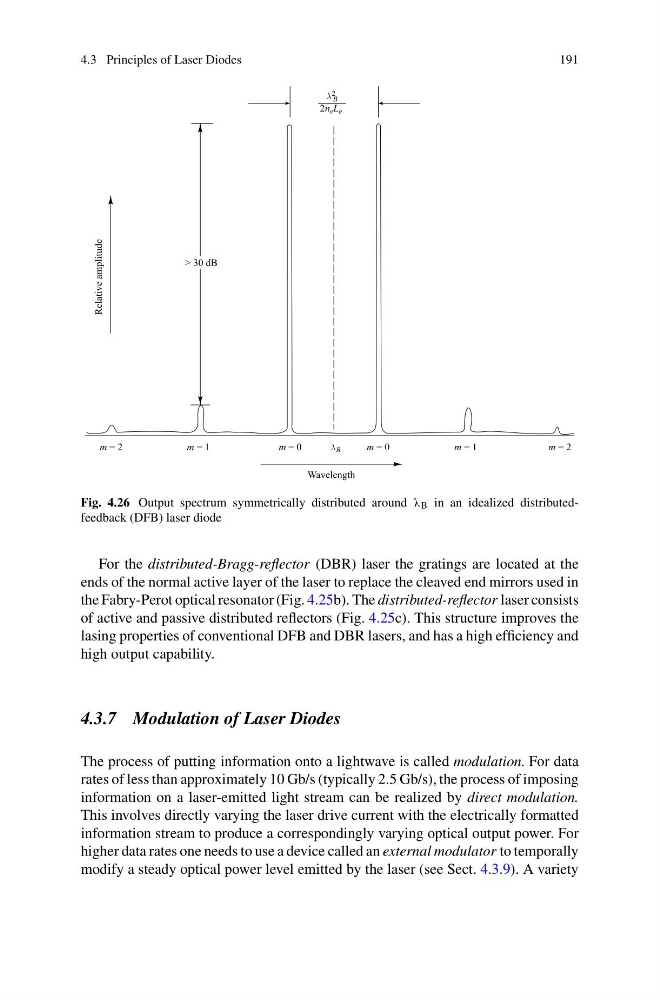
Fig. 4.26 Output spectrum symmetrically distributed around λ B in an idealized distributedfeedback (DFB) laser diode
For the distributed-Bragg-reflector (DBR) laser the gratings are located at the
ends of the normal active layer of the laser to replace the cleaved end mirrors used in
the Fabry-Perot optical resonator (Fig. 4.25b). The distributed-reflector laser consists
of active and passive distributed reflectors (Fig. 4.25c). This structure improves the
lasing properties of conventional DFB and DBR lasers, and has a high efficiency and
high output capability.
4.3.7 Modulation of Laser Diodes
The process of putting information onto a lightwave is called modulation. For data
rates of less than approximately 10 Gb/s (typically 2.5 Gb/s), the process of imposing
information on a laser-emitted light stream can be realized by direct modulation.
This involves directly varying the laser drive current with the electrically formatted
information stream to produce a correspondingly varying optical output power. For
higher data rates one needs to use a device called an external modulator to temporally
modify a steady optical power level emitted by the laser (see Sect. 4.3.9). A variety
191
Fig. 4.26 Output spectrum symmetrically distributed around λ B in an idealized distributedfeedback (DFB) laser diode
For the distributed-Bragg-reflector (DBR) laser the gratings are located at the
ends of the normal active layer of the laser to replace the cleaved end mirrors used in
the Fabry-Perot optical resonator (Fig. 4.25b). The distributed-reflector laser consists
of active and passive distributed reflectors (Fig. 4.25c). This structure improves the
lasing properties of conventional DFB and DBR lasers, and has a high efficiency and
high output capability.
4.3.7 Modulation of Laser Diodes
The process of putting information onto a lightwave is called modulation. For data
rates of less than approximately 10 Gb/s (typically 2.5 Gb/s), the process of imposing
information on a laser-emitted light stream can be realized by direct modulation.
This involves directly varying the laser drive current with the electrically formatted
information stream to produce a correspondingly varying optical output power. For
higher data rates one needs to use a device called an external modulator to temporally
modify a steady optical power level emitted by the laser (see Sect. 4.3.9). A variety