

166
4 Light Sources for Fiber Links
4.2.3 LED Quantum Efficiency and Output Power
An excess of electrons and holes in p-type and n-type material, respectively (referred
to as minority carriers) is created in a semiconductor light source by carrier injection
at the device contacts. The excess densities of electrons n and holes p are equal,
because the injected carriers are formed and recombine in pairs in accordance with
the requirement for charge neutrality in the crystal. When carrier injection stops, the
carrier density returns to the equilibrium value. In general, the excess carrier density
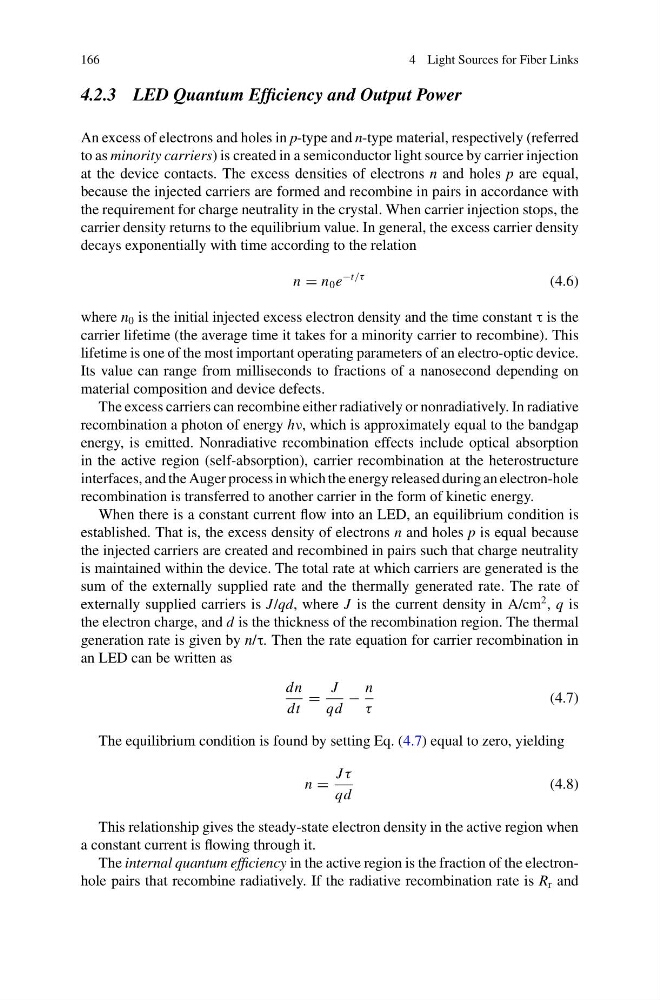
decays exponentially with time according to the relation
n = n 0 e
−t/τ
(4.6)
where n 0 is the initial injected excess electron density and the time constant τ is the
carrier lifetime (the average time it takes for a minority carrier to recombine). This
lifetime is one of the most important operating parameters of an electro-optic device.
Its value can range from milliseconds to fractions of a nanosecond depending on
material composition and device defects.
The excess carriers can recombine either radiatively or nonradiatively. In radiative
recombination a photon of energy hν, which is approximately equal to the bandgap
energy, is emitted. Nonradiative recombination effects include optical absorption
in the active region (self-absorption), carrier recombination at the heterostructure
interfaces, and the Auger process in which the energy released during an electron-hole
recombination is transferred to another carrier in the form of kinetic energy.
When there is a constant current flow into an LED, an equilibrium condition is
established. That is, the excess density of electrons n and holes p is equal because
the injected carriers are created and recombined in pairs such that charge neutrality
is maintained within the device. The total rate at which carriers are generated is the
sum of the externally supplied rate and the thermally generated rate. The rate of
externally supplied carriers is J/qd, where J is the current density in A/cm
2 , q is
the electron charge, and d is the thickness of the recombination region. The thermal
generation rate is given by n/τ. Then the rate equation for carrier recombination in
an LED can be written as
dn
dt
=
J
qd
−
n
τ
(4.7)
The equilibrium condition is found by setting Eq. (4.7) equal to zero, yielding
n =
J τ
qd
(4.8)
This relationship gives the steady-state electron density in the active region when
a constant current is flowing through it.
The internal quantum efficiency in the active region is the fraction of the electronhole pairs that recombine radiatively. If the radiative recombination rate is R r and
4 Light Sources for Fiber Links
4.2.3 LED Quantum Efficiency and Output Power
An excess of electrons and holes in p-type and n-type material, respectively (referred
to as minority carriers) is created in a semiconductor light source by carrier injection
at the device contacts. The excess densities of electrons n and holes p are equal,
because the injected carriers are formed and recombine in pairs in accordance with
the requirement for charge neutrality in the crystal. When carrier injection stops, the
carrier density returns to the equilibrium value. In general, the excess carrier density
decays exponentially with time according to the relation
n = n 0 e
−t/τ
(4.6)
where n 0 is the initial injected excess electron density and the time constant τ is the
carrier lifetime (the average time it takes for a minority carrier to recombine). This
lifetime is one of the most important operating parameters of an electro-optic device.
Its value can range from milliseconds to fractions of a nanosecond depending on
material composition and device defects.
The excess carriers can recombine either radiatively or nonradiatively. In radiative
recombination a photon of energy hν, which is approximately equal to the bandgap
energy, is emitted. Nonradiative recombination effects include optical absorption
in the active region (self-absorption), carrier recombination at the heterostructure
interfaces, and the Auger process in which the energy released during an electron-hole
recombination is transferred to another carrier in the form of kinetic energy.
When there is a constant current flow into an LED, an equilibrium condition is
established. That is, the excess density of electrons n and holes p is equal because
the injected carriers are created and recombined in pairs such that charge neutrality
is maintained within the device. The total rate at which carriers are generated is the
sum of the externally supplied rate and the thermally generated rate. The rate of
externally supplied carriers is J/qd, where J is the current density in A/cm
2 , q is
the electron charge, and d is the thickness of the recombination region. The thermal
generation rate is given by n/τ. Then the rate equation for carrier recombination in
an LED can be written as
dn
dt
=
J
qd
−
n
τ
(4.7)
The equilibrium condition is found by setting Eq. (4.7) equal to zero, yielding
n =
J τ
qd
(4.8)
This relationship gives the steady-state electron density in the active region when
a constant current is flowing through it.
The internal quantum efficiency in the active region is the fraction of the electronhole pairs that recombine radiatively. If the radiative recombination rate is R r and