

4.2 Principles of Light-Emitting Diodes (LEDs)
163
and 50 nm depending on the wavelength. As an example, Fig. 4.12 shows a FWHM
spectral width σ λ of 36 nm for the 810-nm LED.
At longer wavelengths the quaternary alloy In 1−x Ga x As y P 1−y is one of the primary
material candidates. By varying the mole fractions x and y in the active area,
LEDs with peak output powers at any wavelength between 1.0 and 1.7 μm can be
constructed. For simplicity, the notations GaAlAs and InGaAsP are generally used
unless there is an explicit need to know the values of x and y. Other notations such
as AlGaAs, (Al, Ga)As, (GaAl)As, GaInPAs, and In x Ga 1−x As y P 1−y are also found in
the literature. From the last notation, it is obvious that, depending on the preference
of the particular author, the values of x and 1 − x for the same material could be
interchanged in different articles in the literature.
The alloys GaAlAs and InGaAsP are chosen to make semiconductor light sources
because it is possible to match the lattice parameters of the heterostructure interfaces
by using a proper combination of binary, ternary, and quaternary materials. A very
close match between the crystal lattice parameters of the two adjoining heterojunctions is required to reduce interfacial defects and to minimize strains in the device
as the temperature varies. These factors directly affect the radiative efficiency and
lifetime of a light source. Using the fundamental quantum mechanical relationship
between energy E and frequency ν, which is E = hν = hc/λ, the peak emission
wavelength λ in micrometers can be expressed as a function of the bandgap energy
E g in electron volts by the equation
λ(in μm) =
1.240
E g (in eV)
(4.3)
One can determine the bandgap of a semiconductor by measuring the energy
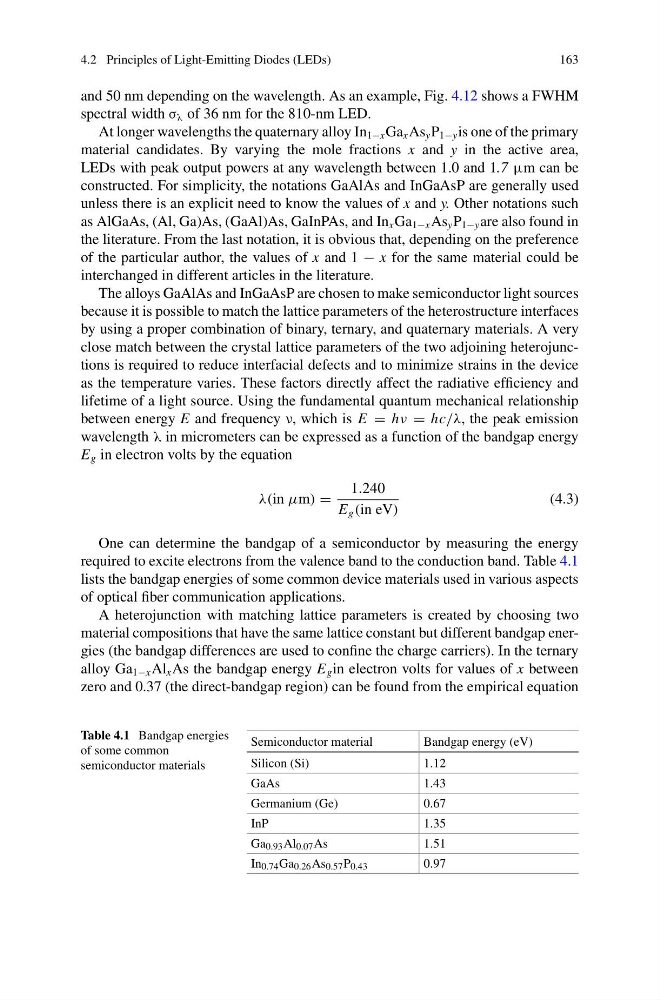
required to excite electrons from the valence band to the conduction band. Table 4.1
lists the bandgap energies of some common device materials used in various aspects
of optical fiber communication applications.
A heterojunction with matching lattice parameters is created by choosing two
material compositions that have the same lattice constant but different bandgap energies (the bandgap differences are used to confine the charge carriers). In the ternary
alloy Ga 1−x Al x As the bandgap energy E g in electron volts for values of x between
zero and 0.37 (the direct-bandgap region) can be found from the empirical equation
Table 4.1 Bandgap energies
of some common
semiconductor materials
Semiconductor material
Bandgap energy (eV)
Silicon (Si)
1.12
GaAs
1.43
Germanium (Ge)
0.67
InP
1.35
Ga 0.93 Al 0.07 As
1.51
In 0.74 Ga 0.26 As 0.57 P 0.43
0.97
163
and 50 nm depending on the wavelength. As an example, Fig. 4.12 shows a FWHM
spectral width σ λ of 36 nm for the 810-nm LED.
At longer wavelengths the quaternary alloy In 1−x Ga x As y P 1−y is one of the primary
material candidates. By varying the mole fractions x and y in the active area,
LEDs with peak output powers at any wavelength between 1.0 and 1.7 μm can be
constructed. For simplicity, the notations GaAlAs and InGaAsP are generally used
unless there is an explicit need to know the values of x and y. Other notations such
as AlGaAs, (Al, Ga)As, (GaAl)As, GaInPAs, and In x Ga 1−x As y P 1−y are also found in
the literature. From the last notation, it is obvious that, depending on the preference
of the particular author, the values of x and 1 − x for the same material could be
interchanged in different articles in the literature.
The alloys GaAlAs and InGaAsP are chosen to make semiconductor light sources
because it is possible to match the lattice parameters of the heterostructure interfaces
by using a proper combination of binary, ternary, and quaternary materials. A very
close match between the crystal lattice parameters of the two adjoining heterojunctions is required to reduce interfacial defects and to minimize strains in the device
as the temperature varies. These factors directly affect the radiative efficiency and
lifetime of a light source. Using the fundamental quantum mechanical relationship
between energy E and frequency ν, which is E = hν = hc/λ, the peak emission
wavelength λ in micrometers can be expressed as a function of the bandgap energy
E g in electron volts by the equation
λ(in μm) =
1.240
E g (in eV)
(4.3)
One can determine the bandgap of a semiconductor by measuring the energy
required to excite electrons from the valence band to the conduction band. Table 4.1
lists the bandgap energies of some common device materials used in various aspects
of optical fiber communication applications.
A heterojunction with matching lattice parameters is created by choosing two
material compositions that have the same lattice constant but different bandgap energies (the bandgap differences are used to confine the charge carriers). In the ternary
alloy Ga 1−x Al x As the bandgap energy E g in electron volts for values of x between
zero and 0.37 (the direct-bandgap region) can be found from the empirical equation
Table 4.1 Bandgap energies
of some common
semiconductor materials
Semiconductor material
Bandgap energy (eV)
Silicon (Si)
1.12
GaAs
1.43
Germanium (Ge)
0.67
InP
1.35
Ga 0.93 Al 0.07 As
1.51
In 0.74 Ga 0.26 As 0.57 P 0.43
0.97