

3.4 ITU-T Standards for Fibers
133
System operation for this fiber is allowed either in each wavelength band individually or simultaneously in both spectral bands. The applications are intended for
access and enterprise networks in multiple-tenant building environments in which
broadband services have to be delivered to individual apartments or offices of individual businesses. The recommended multimode fiber supports the cost-effective use
of 1 Gb/s Ethernet systems over link lengths up to 550 m. The optical fiber attenuation
values range from 2.5 dB/km at 850 nm to less than 0.6 dB/km at 1310 nm.
In addition to the recommendations of G.651.1, the IEEE 802.3 series of standards
describes the implementation of Ethernet links running at data rates up to 10 Gb/s
over distances up to 550 m.
3.4.2 Recommendation G.652
Recommendation G.652 deals with the geometrical, mechanical, and transmission
characteristics of a single-mode fiber that has a zero-dispersion value at 1310 nm.
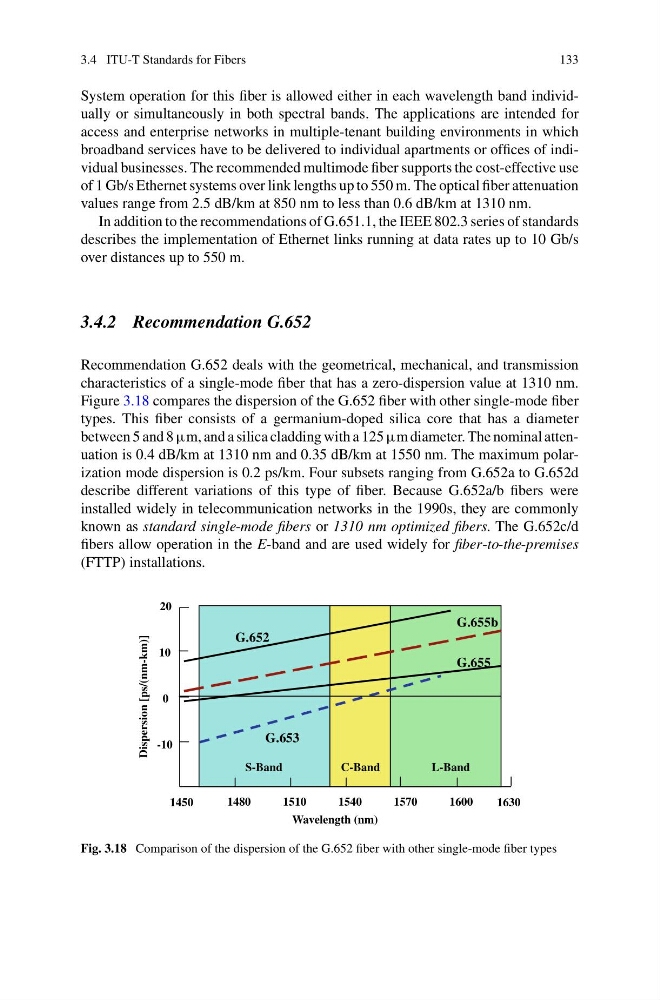
Figure 3.18 compares the dispersion of the G.652 fiber with other single-mode fiber
types. This fiber consists of a germanium-doped silica core that has a diameter
between 5 and 8 μm, and a silica cladding with a 125 μm diameter. The nominal attenuation is 0.4 dB/km at 1310 nm and 0.35 dB/km at 1550 nm. The maximum polarization mode dispersion is 0.2 ps/km. Four subsets ranging from G.652a to G.652d
describe different variations of this type of fiber. Because G.652a/b fibers were
installed widely in telecommunication networks in the 1990s, they are commonly
known as standard single-mode fibers or 1310 nm optimized fibers. The G.652c/d
fibers allow operation in the E-band and are used widely for fiber-to-the-premises
(FTTP) installations.
-10
0
10
20
1480
1510
1540
1570
1600
Wavelength (nm)
Dispersion [ps/(nm-km)]
G.652
G.653
C-Band
1450
1630
G.655b
L-Band
S-Band
G.655
Fig. 3.18 Comparison of the dispersion of the G.652 fiber with other single-mode fiber types
133
System operation for this fiber is allowed either in each wavelength band individually or simultaneously in both spectral bands. The applications are intended for
access and enterprise networks in multiple-tenant building environments in which
broadband services have to be delivered to individual apartments or offices of individual businesses. The recommended multimode fiber supports the cost-effective use
of 1 Gb/s Ethernet systems over link lengths up to 550 m. The optical fiber attenuation
values range from 2.5 dB/km at 850 nm to less than 0.6 dB/km at 1310 nm.
In addition to the recommendations of G.651.1, the IEEE 802.3 series of standards
describes the implementation of Ethernet links running at data rates up to 10 Gb/s
over distances up to 550 m.
3.4.2 Recommendation G.652
Recommendation G.652 deals with the geometrical, mechanical, and transmission
characteristics of a single-mode fiber that has a zero-dispersion value at 1310 nm.
Figure 3.18 compares the dispersion of the G.652 fiber with other single-mode fiber
types. This fiber consists of a germanium-doped silica core that has a diameter
between 5 and 8 μm, and a silica cladding with a 125 μm diameter. The nominal attenuation is 0.4 dB/km at 1310 nm and 0.35 dB/km at 1550 nm. The maximum polarization mode dispersion is 0.2 ps/km. Four subsets ranging from G.652a to G.652d
describe different variations of this type of fiber. Because G.652a/b fibers were
installed widely in telecommunication networks in the 1990s, they are commonly
known as standard single-mode fibers or 1310 nm optimized fibers. The G.652c/d
fibers allow operation in the E-band and are used widely for fiber-to-the-premises
(FTTP) installations.
-10
0
10
20
1480
1510
1540
1570
1600
Wavelength (nm)
Dispersion [ps/(nm-km)]
G.652
G.653
C-Band
1450
1630
G.655b
L-Band
S-Band
G.655
Fig. 3.18 Comparison of the dispersion of the G.652 fiber with other single-mode fiber types