

3.2 Optical Signal Dispersion Effects
111
T
L
=
n
2
1
cn 2
= 50 ns/km
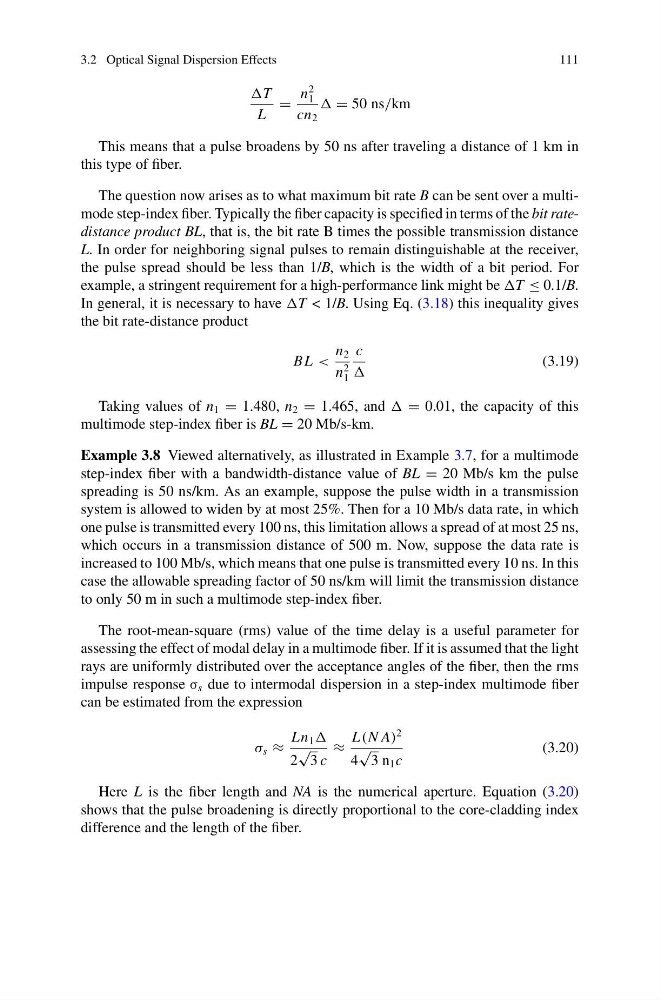
This means that a pulse broadens by 50 ns after traveling a distance of 1 km in
this type of fiber.
The question now arises as to what maximum bit rate B can be sent over a multimode step-index fiber. Typically the fiber capacity is specified in terms of the bit ratedistance product BL, that is, the bit rate B times the possible transmission distance
L. In order for neighboring signal pulses to remain distinguishable at the receiver,
the pulse spread should be less than 1/B, which is the width of a bit period. For
example, a stringent requirement for a high-performance link might be T ≤ 0.1/B.
In general, it is necessary to have T < 1/B. Using Eq. (3.18) this inequality gives
the bit rate-distance product
B L <
n 2
n
2
1
c
(3.19)
Taking values of n 1 = 1.480, n 2 = 1.465, and = 0.01, the capacity of this
multimode step-index fiber is BL = 20 Mb/s-km.
Example 3.8 Viewed alternatively, as illustrated in Example 3.7, for a multimode
step-index fiber with a bandwidth-distance value of BL = 20 Mb/s km the pulse
spreading is 50 ns/km. As an example, suppose the pulse width in a transmission
system is allowed to widen by at most 25%. Then for a 10 Mb/s data rate, in which
one pulse is transmitted every 100 ns, this limitation allows a spread of at most 25 ns,
which occurs in a transmission distance of 500 m. Now, suppose the data rate is
increased to 100 Mb/s, which means that one pulse is transmitted every 10 ns. In this
case the allowable spreading factor of 50 ns/km will limit the transmission distance
to only 50 m in such a multimode step-index fiber.
The root-mean-square (rms) value of the time delay is a useful parameter for
assessing the effect of modal delay in a multimode fiber. If it is assumed that the light
rays are uniformly distributed over the acceptance angles of the fiber, then the rms
impulse response σ s due to intermodal dispersion in a step-index multimode fiber
can be estimated from the expression
σ s ≈
Ln 1
2
√
3 c
≈
L(N A)
2
4
√
3 n 1 c
(3.20)
Here L is the fiber length and NA is the numerical aperture. Equation (3.20)
shows that the pulse broadening is directly proportional to the core-cladding index
difference and the length of the fiber.
111
T
L
=
n
2
1
cn 2
= 50 ns/km
This means that a pulse broadens by 50 ns after traveling a distance of 1 km in
this type of fiber.
The question now arises as to what maximum bit rate B can be sent over a multimode step-index fiber. Typically the fiber capacity is specified in terms of the bit ratedistance product BL, that is, the bit rate B times the possible transmission distance
L. In order for neighboring signal pulses to remain distinguishable at the receiver,
the pulse spread should be less than 1/B, which is the width of a bit period. For
example, a stringent requirement for a high-performance link might be T ≤ 0.1/B.
In general, it is necessary to have T < 1/B. Using Eq. (3.18) this inequality gives
the bit rate-distance product
B L <
n 2
n
2
1
c
(3.19)
Taking values of n 1 = 1.480, n 2 = 1.465, and = 0.01, the capacity of this
multimode step-index fiber is BL = 20 Mb/s-km.
Example 3.8 Viewed alternatively, as illustrated in Example 3.7, for a multimode
step-index fiber with a bandwidth-distance value of BL = 20 Mb/s km the pulse
spreading is 50 ns/km. As an example, suppose the pulse width in a transmission
system is allowed to widen by at most 25%. Then for a 10 Mb/s data rate, in which
one pulse is transmitted every 100 ns, this limitation allows a spread of at most 25 ns,
which occurs in a transmission distance of 500 m. Now, suppose the data rate is
increased to 100 Mb/s, which means that one pulse is transmitted every 10 ns. In this
case the allowable spreading factor of 50 ns/km will limit the transmission distance
to only 50 m in such a multimode step-index fiber.
The root-mean-square (rms) value of the time delay is a useful parameter for
assessing the effect of modal delay in a multimode fiber. If it is assumed that the light
rays are uniformly distributed over the acceptance angles of the fiber, then the rms
impulse response σ s due to intermodal dispersion in a step-index multimode fiber
can be estimated from the expression
σ s ≈
Ln 1
2
√
3 c
≈
L(N A)
2
4
√
3 n 1 c
(3.20)
Here L is the fiber length and NA is the numerical aperture. Equation (3.20)
shows that the pulse broadening is directly proportional to the core-cladding index
difference and the length of the fiber.