

3.1 Fiber Attenuation
101
These mechanisms result in a wedge-shaped spectral-loss characteristic. Within
this wedge, losses as low as 0.148 dB/km at 1.57 μm in a single-mode fiber have
been measured [6].
3.1.3 Scattering Losses in Optical Fibers
Scattering losses in glass arise from microscopic variations in the material density,
from compositional fluctuations, and from structural inhomogeneity or defects occurring during fiber manufacture. As Sect. 2.7 describes, glass is composed of a randomly
connected network of molecules. Such a structure naturally contains regions in which
the molecular density is either higher or lower than the average density in the glass. In
addition, because glass is made up of several oxides, such as SiO 2 , GeO 2 , and P 2 O 5 ,
compositional fluctuations can occur. These two effects give rise to refractive-index
variations that occur within the glass over distances that are small compared with
the wavelength. These index variations cause a Rayleigh-type scattering of the light.
Rayleigh scattering in glass is the same phenomenon that scatters light from the sun
in the atmosphere, thereby giving rise to a blue sky.
The exact expressions for scattering-induced attenuation are fairly complex owing
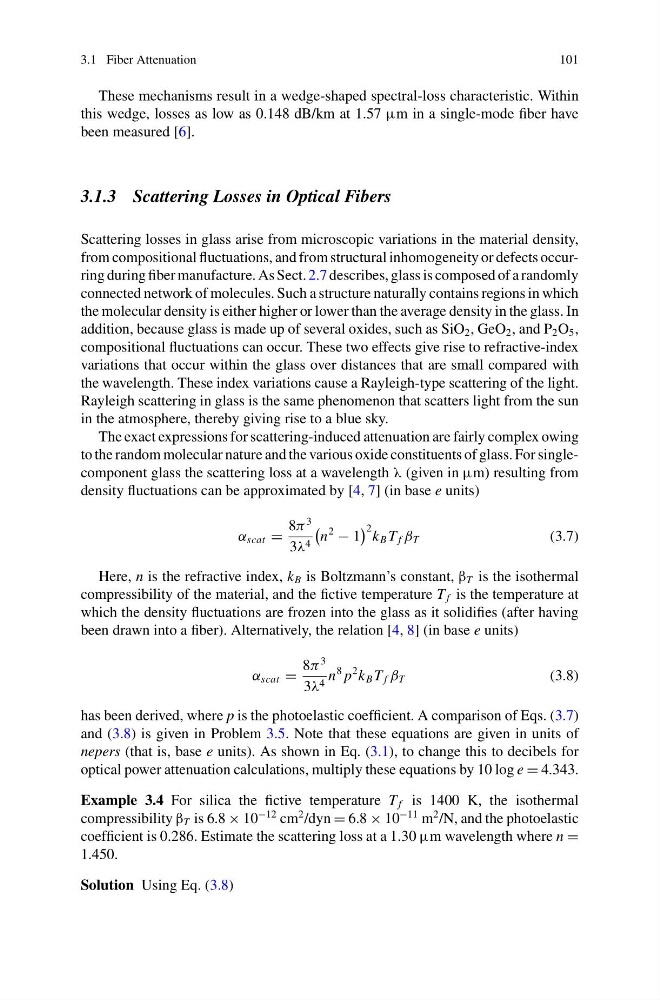
to the random molecular nature and the various oxide constituents of glass. For singlecomponent glass the scattering loss at a wavelength λ (given in μm) resulting from
density fluctuations can be approximated by [4, 7] (in base e units)
α scat =
8π
3
3λ 4
n
2
− 1
2 k B T f β T
(3.7)
Here, n is the refractive index, k B is Boltzmann’s constant, β T is the isothermal
compressibility of the material, and the fictive temperature T f is the temperature at
which the density fluctuations are frozen into the glass as it solidifies (after having
been drawn into a fiber). Alternatively, the relation [4, 8] (in base e units)
α scat =
8π
3
3λ 4 n
8 p
2 k B T f β T
(3.8)
has been derived, where p is the photoelastic coefficient. A comparison of Eqs. (3.7)
and (3.8) is given in Problem 3.5. Note that these equations are given in units of
nepers (that is, base e units). As shown in Eq. (3.1), to change this to decibels for
optical power attenuation calculations, multiply these equations by 10 log e = 4.343.
Example 3.4 For silica the fictive temperature T f is 1400 K, the isothermal
compressibility β T is 6.8 × 10
−12 cm
2 /dyn = 6.8 × 10
−11 m
2 /N, and the photoelastic
coefficient is 0.286. Estimate the scattering loss at a 1.30 μm wavelength where n =
1.450.
Solution Using Eq. (3.8)
101
These mechanisms result in a wedge-shaped spectral-loss characteristic. Within
this wedge, losses as low as 0.148 dB/km at 1.57 μm in a single-mode fiber have
been measured [6].
3.1.3 Scattering Losses in Optical Fibers
Scattering losses in glass arise from microscopic variations in the material density,
from compositional fluctuations, and from structural inhomogeneity or defects occurring during fiber manufacture. As Sect. 2.7 describes, glass is composed of a randomly
connected network of molecules. Such a structure naturally contains regions in which
the molecular density is either higher or lower than the average density in the glass. In
addition, because glass is made up of several oxides, such as SiO 2 , GeO 2 , and P 2 O 5 ,
compositional fluctuations can occur. These two effects give rise to refractive-index
variations that occur within the glass over distances that are small compared with
the wavelength. These index variations cause a Rayleigh-type scattering of the light.
Rayleigh scattering in glass is the same phenomenon that scatters light from the sun
in the atmosphere, thereby giving rise to a blue sky.
The exact expressions for scattering-induced attenuation are fairly complex owing
to the random molecular nature and the various oxide constituents of glass. For singlecomponent glass the scattering loss at a wavelength λ (given in μm) resulting from
density fluctuations can be approximated by [4, 7] (in base e units)
α scat =
8π
3
3λ 4
n
2
− 1
2 k B T f β T
(3.7)
Here, n is the refractive index, k B is Boltzmann’s constant, β T is the isothermal
compressibility of the material, and the fictive temperature T f is the temperature at
which the density fluctuations are frozen into the glass as it solidifies (after having
been drawn into a fiber). Alternatively, the relation [4, 8] (in base e units)
α scat =
8π
3
3λ 4 n
8 p
2 k B T f β T
(3.8)
has been derived, where p is the photoelastic coefficient. A comparison of Eqs. (3.7)
and (3.8) is given in Problem 3.5. Note that these equations are given in units of
nepers (that is, base e units). As shown in Eq. (3.1), to change this to decibels for
optical power attenuation calculations, multiply these equations by 10 log e = 4.343.
Example 3.4 For silica the fictive temperature T f is 1400 K, the isothermal
compressibility β T is 6.8 × 10
−12 cm
2 /dyn = 6.8 × 10
−11 m
2 /N, and the photoelastic
coefficient is 0.286. Estimate the scattering loss at a 1.30 μm wavelength where n =
1.450.
Solution Using Eq. (3.8)