

98
3 Optical Signal Attenuation and Dispersion
O
E S C L U
T
Spectral bands
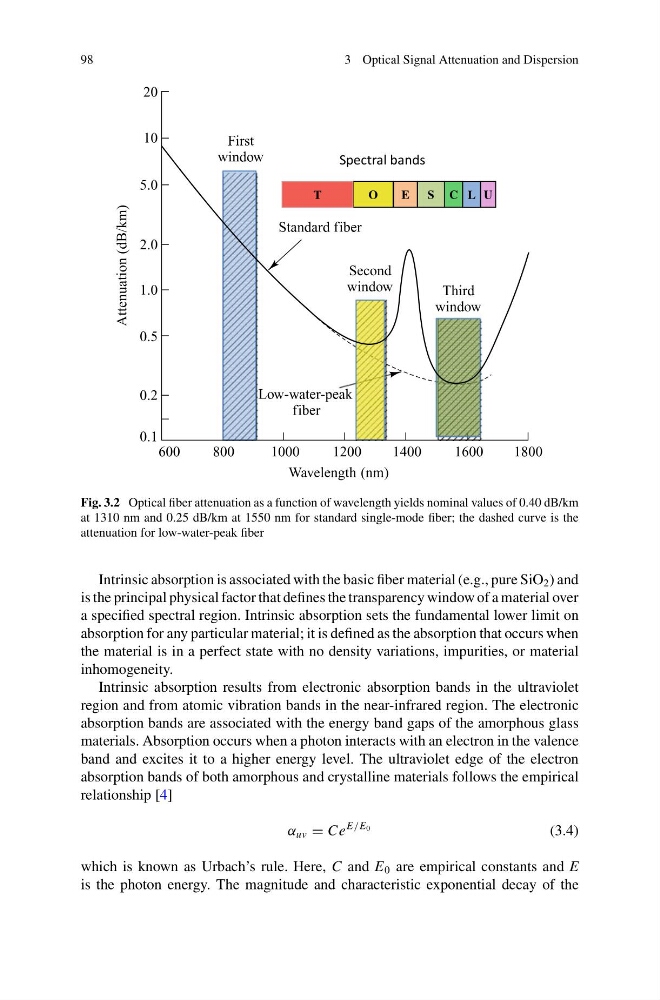
Fig. 3.2 Optical fiber attenuation as a function of wavelength yields nominal values of 0.40 dB/km
at 1310 nm and 0.25 dB/km at 1550 nm for standard single-mode fiber; the dashed curve is the
attenuation for low-water-peak fiber
Intrinsic absorption is associated with the basic fiber material (e.g., pure SiO 2 ) and
is the principal physical factor that defines the transparency window of a material over
a specified spectral region. Intrinsic absorption sets the fundamental lower limit on
absorption for any particular material; it is defined as the absorption that occurs when
the material is in a perfect state with no density variations, impurities, or material
inhomogeneity.
Intrinsic absorption results from electronic absorption bands in the ultraviolet
region and from atomic vibration bands in the near-infrared region. The electronic
absorption bands are associated with the energy band gaps of the amorphous glass
materials. Absorption occurs when a photon interacts with an electron in the valence
band and excites it to a higher energy level. The ultraviolet edge of the electron
absorption bands of both amorphous and crystalline materials follows the empirical
relationship [4]
α uv = Ce
E/E 0
(3.4)
which is known as Urbach’s rule. Here, C and E 0 are empirical constants and E
is the photon energy. The magnitude and characteristic exponential decay of the
3 Optical Signal Attenuation and Dispersion
O
E S C L U
T
Spectral bands
Fig. 3.2 Optical fiber attenuation as a function of wavelength yields nominal values of 0.40 dB/km
at 1310 nm and 0.25 dB/km at 1550 nm for standard single-mode fiber; the dashed curve is the
attenuation for low-water-peak fiber
Intrinsic absorption is associated with the basic fiber material (e.g., pure SiO 2 ) and
is the principal physical factor that defines the transparency window of a material over
a specified spectral region. Intrinsic absorption sets the fundamental lower limit on
absorption for any particular material; it is defined as the absorption that occurs when
the material is in a perfect state with no density variations, impurities, or material
inhomogeneity.
Intrinsic absorption results from electronic absorption bands in the ultraviolet
region and from atomic vibration bands in the near-infrared region. The electronic
absorption bands are associated with the energy band gaps of the amorphous glass
materials. Absorption occurs when a photon interacts with an electron in the valence
band and excites it to a higher energy level. The ultraviolet edge of the electron
absorption bands of both amorphous and crystalline materials follows the empirical
relationship [4]
α uv = Ce
E/E 0
(3.4)
which is known as Urbach’s rule. Here, C and E 0 are empirical constants and E
is the photon energy. The magnitude and characteristic exponential decay of the