

94
3 Optical Signal Attenuation and Dispersion
3.1 Fiber Attenuation
Optical power attenuation of a light signal as it propagates along a fiber is an important
consideration in the design of an optical communication system; the degree of attenuation plays a major role in determining the maximum transmission distance between
a transmitter and a receiver or an in-line amplifier. The basic attenuation mechanisms
that cause power level reductions in a fiber are absorption, scattering, and radiative
losses of the optical energy [1–3]. Absorption is related to the fiber material, whereas
scattering is associated both with the fiber material and with structural imperfections
in the optical waveguide. Attenuation owing to radiative loss effects originates from
perturbations (both microscopic and macroscopic) of the fiber geometry.
This section first discusses the units in which fiber losses are measured and then
presents the physical phenomena that give rise to attenuation.
3.1.1 Units for Fiber Attenuation
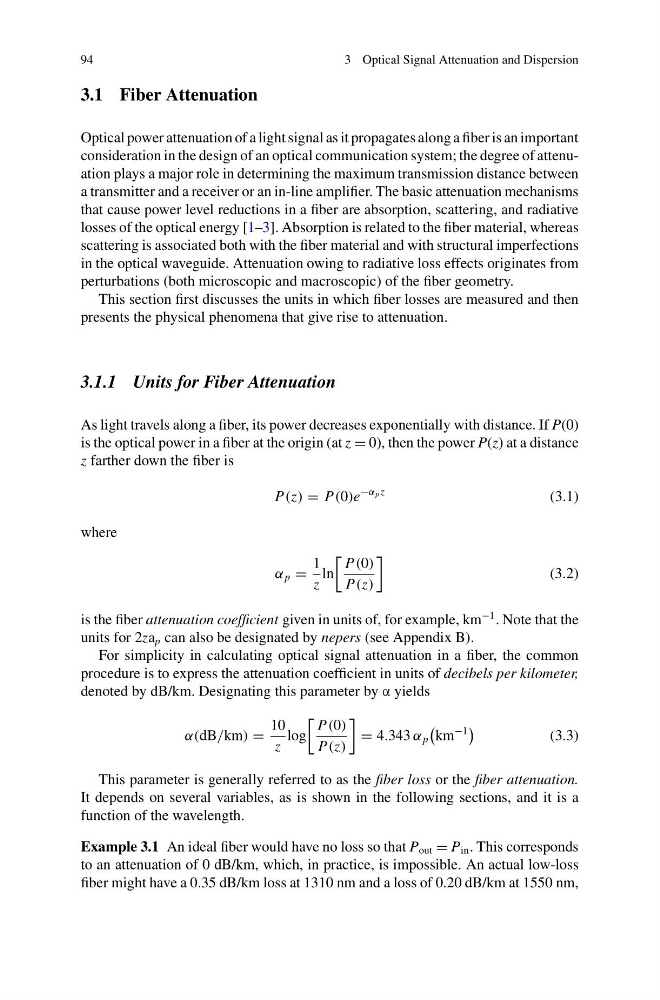
As light travels along a fiber, its power decreases exponentially with distance. If P(0)
is the optical power in a fiber at the origin (at z = 0), then the power P(z) at a distance
z farther down the fiber is
P(z) = P(0)e
−α p z
(3.1)
where
α p =
1
z
ln
P(0)
P(z)
(3.2)
is the fiber attenuation coefficient given in units of, for example, km
−1 . Note that the
units for 2za p can also be designated by nepers (see Appendix B).
For simplicity in calculating optical signal attenuation in a fiber, the common
procedure is to express the attenuation coefficient in units of decibels per kilometer,
denoted by dB/km. Designating this parameter by α yields
α(dB/km) =
10
z
log
P(0)
P(z)
= 4.343 α p
km
−1
(3.3)
This parameter is generally referred to as the fiber loss or the fiber attenuation.
It depends on several variables, as is shown in the following sections, and it is a
function of the wavelength.
Example 3.1 An ideal fiber would have no loss so that P out = P in . This corresponds
to an attenuation of 0 dB/km, which, in practice, is impossible. An actual low-loss
fiber might have a 0.35 dB/km loss at 1310 nm and a loss of 0.20 dB/km at 1550 nm,
3 Optical Signal Attenuation and Dispersion
3.1 Fiber Attenuation
Optical power attenuation of a light signal as it propagates along a fiber is an important
consideration in the design of an optical communication system; the degree of attenuation plays a major role in determining the maximum transmission distance between
a transmitter and a receiver or an in-line amplifier. The basic attenuation mechanisms
that cause power level reductions in a fiber are absorption, scattering, and radiative
losses of the optical energy [1–3]. Absorption is related to the fiber material, whereas
scattering is associated both with the fiber material and with structural imperfections
in the optical waveguide. Attenuation owing to radiative loss effects originates from
perturbations (both microscopic and macroscopic) of the fiber geometry.
This section first discusses the units in which fiber losses are measured and then
presents the physical phenomena that give rise to attenuation.
3.1.1 Units for Fiber Attenuation
As light travels along a fiber, its power decreases exponentially with distance. If P(0)
is the optical power in a fiber at the origin (at z = 0), then the power P(z) at a distance
z farther down the fiber is
P(z) = P(0)e
−α p z
(3.1)
where
α p =
1
z
ln
P(0)
P(z)
(3.2)
is the fiber attenuation coefficient given in units of, for example, km
−1 . Note that the
units for 2za p can also be designated by nepers (see Appendix B).
For simplicity in calculating optical signal attenuation in a fiber, the common
procedure is to express the attenuation coefficient in units of decibels per kilometer,
denoted by dB/km. Designating this parameter by α yields
α(dB/km) =
10
z
log
P(0)
P(z)
= 4.343 α p
km
−1
(3.3)
This parameter is generally referred to as the fiber loss or the fiber attenuation.
It depends on several variables, as is shown in the following sections, and it is a
function of the wavelength.
Example 3.1 An ideal fiber would have no loss so that P out = P in . This corresponds
to an attenuation of 0 dB/km, which, in practice, is impossible. An actual low-loss
fiber might have a 0.35 dB/km loss at 1310 nm and a loss of 0.20 dB/km at 1550 nm,