

84
2 Optical Fiber Structures and Light Guiding Principles
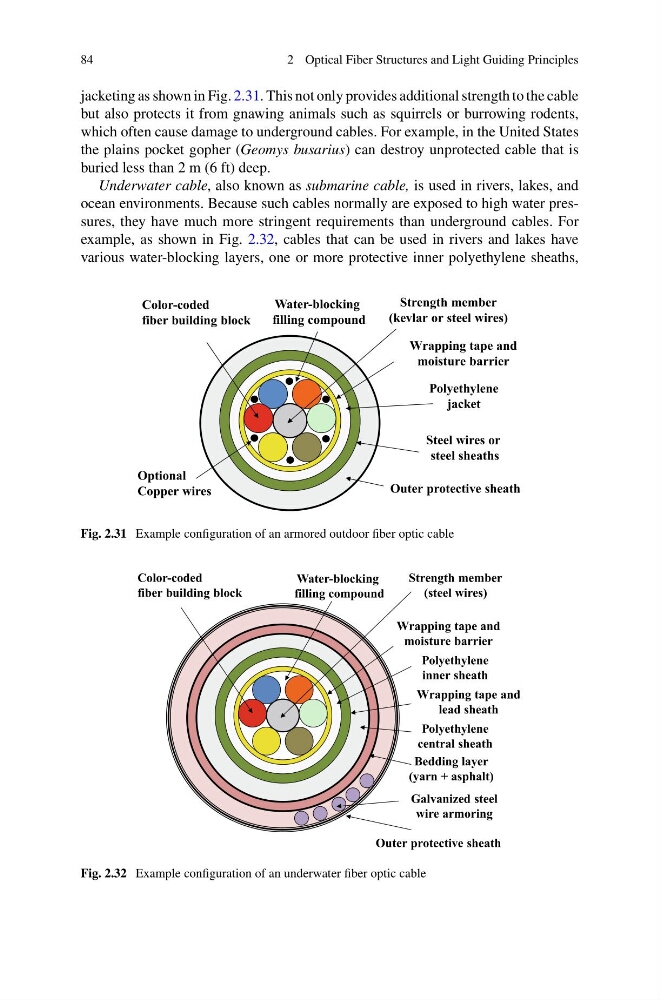
jacketing as shown in Fig. 2.31. This not only provides additional strength to the cable
but also protects it from gnawing animals such as squirrels or burrowing rodents,
which often cause damage to underground cables. For example, in the United States
the plains pocket gopher (Geomys busarius) can destroy unprotected cable that is
buried less than 2 m (6 ft) deep.
Underwater cable, also known as submarine cable, is used in rivers, lakes, and
ocean environments. Because such cables normally are exposed to high water pressures, they have much more stringent requirements than underground cables. For
example, as shown in Fig. 2.32, cables that can be used in rivers and lakes have
various water-blocking layers, one or more protective inner polyethylene sheaths,
Wrapping tape and
moisture barrier
Color-coded
fiber building block
Strength member
(kevlar or steel wires)
Water-blocking
filling compound
Polyethylene
jacket
Steel wires or
steel sheaths
Outer protective sheath
Optional
Copper wires
Fig. 2.31 Example configuration of an armored outdoor fiber optic cable
Galvanized steel
wire armoring
Wrapping tape and
moisture barrier
Color-coded
fiber building block
Strength member
(steel wires)
Water-blocking
filling compound
Bedding layer
(yarn + asphalt)
Polyethylene
inner sheath
Wrapping tape and
lead sheath
Polyethylene
central sheath
Outer protective sheath
Fig. 2.32 Example configuration of an underwater fiber optic cable
2 Optical Fiber Structures and Light Guiding Principles
jacketing as shown in Fig. 2.31. This not only provides additional strength to the cable
but also protects it from gnawing animals such as squirrels or burrowing rodents,
which often cause damage to underground cables. For example, in the United States
the plains pocket gopher (Geomys busarius) can destroy unprotected cable that is
buried less than 2 m (6 ft) deep.
Underwater cable, also known as submarine cable, is used in rivers, lakes, and
ocean environments. Because such cables normally are exposed to high water pressures, they have much more stringent requirements than underground cables. For
example, as shown in Fig. 2.32, cables that can be used in rivers and lakes have
various water-blocking layers, one or more protective inner polyethylene sheaths,
Wrapping tape and
moisture barrier
Color-coded
fiber building block
Strength member
(kevlar or steel wires)
Water-blocking
filling compound
Polyethylene
jacket
Steel wires or
steel sheaths
Outer protective sheath
Optional
Copper wires
Fig. 2.31 Example configuration of an armored outdoor fiber optic cable
Galvanized steel
wire armoring
Wrapping tape and
moisture barrier
Color-coded
fiber building block
Strength member
(steel wires)
Water-blocking
filling compound
Bedding layer
(yarn + asphalt)
Polyethylene
inner sheath
Wrapping tape and
lead sheath
Polyethylene
central sheath
Outer protective sheath
Fig. 2.32 Example configuration of an underwater fiber optic cable