

2.9 Optical Fiber Cables
81
Outer PE jacket
Wrapping tapes
Color-coded
fiber structures
Central buffered
strength member
Filling gel or
water-absorbing yarn
Steel tape armoring
Inner PE jacket or
water-absorbing tape
Rip cords
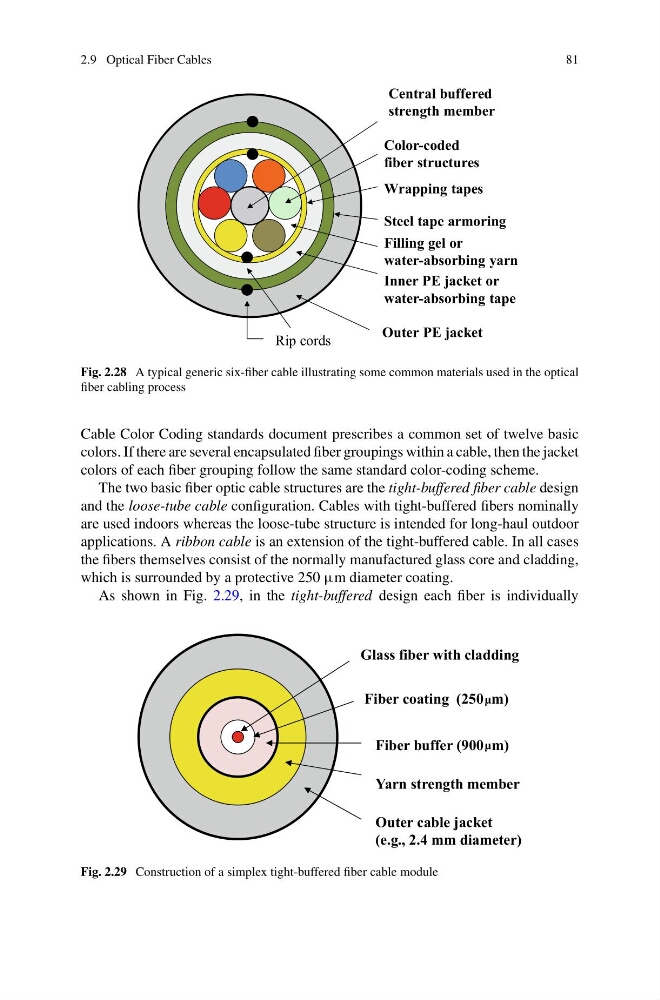
Fig. 2.28 A typical generic six-fiber cable illustrating some common materials used in the optical
fiber cabling process
Cable Color Coding standards document prescribes a common set of twelve basic
colors. If there are several encapsulated fiber groupings within a cable, then the jacket
colors of each fiber grouping follow the same standard color-coding scheme.
The two basic fiber optic cable structures are the tight-buffered fiber cable design
and the loose-tube cable configuration. Cables with tight-buffered fibers nominally
are used indoors whereas the loose-tube structure is intended for long-haul outdoor
applications. A ribbon cable is an extension of the tight-buffered cable. In all cases
the fibers themselves consist of the normally manufactured glass core and cladding,
which is surrounded by a protective 250 μm diameter coating.
As shown in Fig. 2.29, in the tight-buffered design each fiber is individually
Fiber buffer (900 m)
Glass fiber with cladding
Fiber coating (250 m)
Outer cable jacket
(e.g., 2.4 mm diameter)
Yarn strength member
µ
µ
Fig. 2.29 Construction of a simplex tight-buffered fiber cable module
81
Outer PE jacket
Wrapping tapes
Color-coded
fiber structures
Central buffered
strength member
Filling gel or
water-absorbing yarn
Steel tape armoring
Inner PE jacket or
water-absorbing tape
Rip cords
Fig. 2.28 A typical generic six-fiber cable illustrating some common materials used in the optical
fiber cabling process
Cable Color Coding standards document prescribes a common set of twelve basic
colors. If there are several encapsulated fiber groupings within a cable, then the jacket
colors of each fiber grouping follow the same standard color-coding scheme.
The two basic fiber optic cable structures are the tight-buffered fiber cable design
and the loose-tube cable configuration. Cables with tight-buffered fibers nominally
are used indoors whereas the loose-tube structure is intended for long-haul outdoor
applications. A ribbon cable is an extension of the tight-buffered cable. In all cases
the fibers themselves consist of the normally manufactured glass core and cladding,
which is surrounded by a protective 250 μm diameter coating.
As shown in Fig. 2.29, in the tight-buffered design each fiber is individually
Fiber buffer (900 m)
Glass fiber with cladding
Fiber coating (250 m)
Outer cable jacket
(e.g., 2.4 mm diameter)
Yarn strength member
µ
µ
Fig. 2.29 Construction of a simplex tight-buffered fiber cable module