

7 Development of Low Carbon Technology in China’s Iron …
265
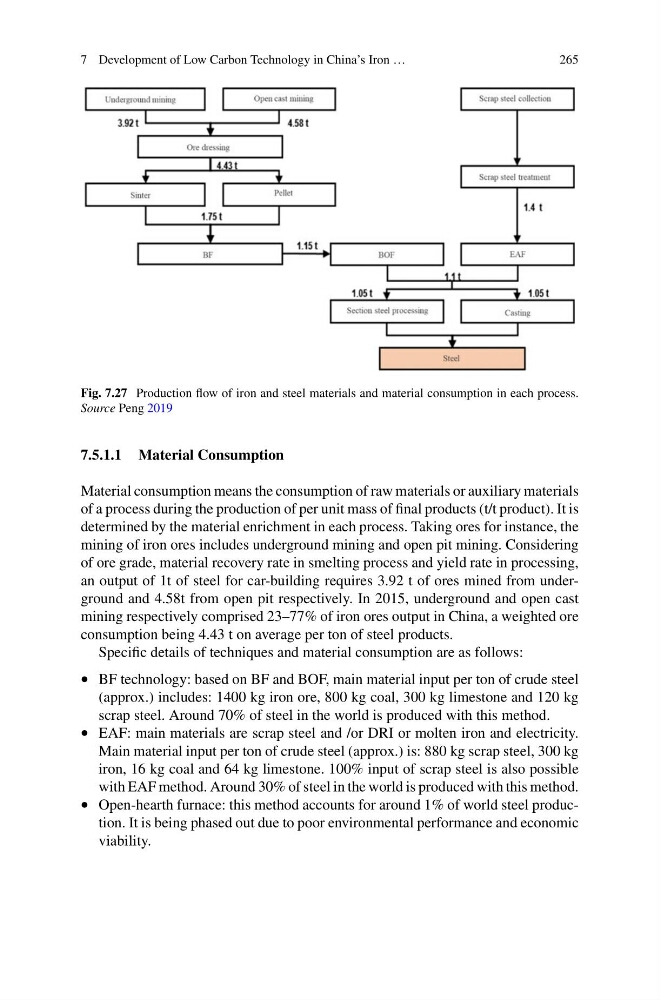
Fig. 7.27 Production flow of iron and steel materials and material consumption in each process.
Source Peng 2019
7.5.1.1 Material Consumption
Material consumption means the consumption of raw materials or auxiliary materials
of a process during the production of per unit mass of final products (t/t product). It is
determined by the material enrichment in each process. Taking ores for instance, the
mining of iron ores includes underground mining and open pit mining. Considering
of ore grade, material recovery rate in smelting process and yield rate in processing,
an output of 1t of steel for car-building requires 3.92 t of ores mined from underground and 4.58t from open pit respectively. In 2015, underground and open cast
mining respectively comprised 23–77% of iron ores output in China, a weighted ore
consumption being 4.43 t on average per ton of steel products.
Specific details of techniques and material consumption are as follows:
• BF technology: based on BF and BOF, main material input per ton of crude steel
(approx.) includes: 1400 kg iron ore, 800 kg coal, 300 kg limestone and 120 kg
scrap steel. Around 70% of steel in the world is produced with this method.
• EAF: main materials are scrap steel and /or DRI or molten iron and electricity.
Main material input per ton of crude steel (approx.) is: 880 kg scrap steel, 300 kg
iron, 16 kg coal and 64 kg limestone. 100% input of scrap steel is also possible
with EAF method. Around 30% of steel in the world is produced with this method.
• Open-hearth furnace: this method accounts for around 1% of world steel production. It is being phased out due to poor environmental performance and economic
viability.
265
Fig. 7.27 Production flow of iron and steel materials and material consumption in each process.
Source Peng 2019
7.5.1.1 Material Consumption
Material consumption means the consumption of raw materials or auxiliary materials
of a process during the production of per unit mass of final products (t/t product). It is
determined by the material enrichment in each process. Taking ores for instance, the
mining of iron ores includes underground mining and open pit mining. Considering
of ore grade, material recovery rate in smelting process and yield rate in processing,
an output of 1t of steel for car-building requires 3.92 t of ores mined from underground and 4.58t from open pit respectively. In 2015, underground and open cast
mining respectively comprised 23–77% of iron ores output in China, a weighted ore
consumption being 4.43 t on average per ton of steel products.
Specific details of techniques and material consumption are as follows:
• BF technology: based on BF and BOF, main material input per ton of crude steel
(approx.) includes: 1400 kg iron ore, 800 kg coal, 300 kg limestone and 120 kg
scrap steel. Around 70% of steel in the world is produced with this method.
• EAF: main materials are scrap steel and /or DRI or molten iron and electricity.
Main material input per ton of crude steel (approx.) is: 880 kg scrap steel, 300 kg
iron, 16 kg coal and 64 kg limestone. 100% input of scrap steel is also possible
with EAF method. Around 30% of steel in the world is produced with this method.
• Open-hearth furnace: this method accounts for around 1% of world steel production. It is being phased out due to poor environmental performance and economic
viability.