

7 Development of Low Carbon Technology in China’s Iron …
243
with hydrogen) and electrolysis technology, which, combined with new techniques of
various procedures elaborated above (such as dry quenching, CCS, etc.), have aided
multiple comprehensive low-carbon steelmaking projects with satisfactory results.
7.2.4.1 EU
To combat climate change, EU launched the ultra-low CO 2 emission steelmaking
project (ULCOS) in 2004, aiming at reducing CO 2 emissions of iron and steel
industry by around 50%. Upon research, demo projects based on four key technologies were later unveiled, namely TGR-BF (top gas recycle-blast furnace), ULCORED
(new direct reduction technique), HIsarna (new smelting reduction technique) and
ULCOWIN/ULCOLYSIS (alkaline electrolysis reduced iron).
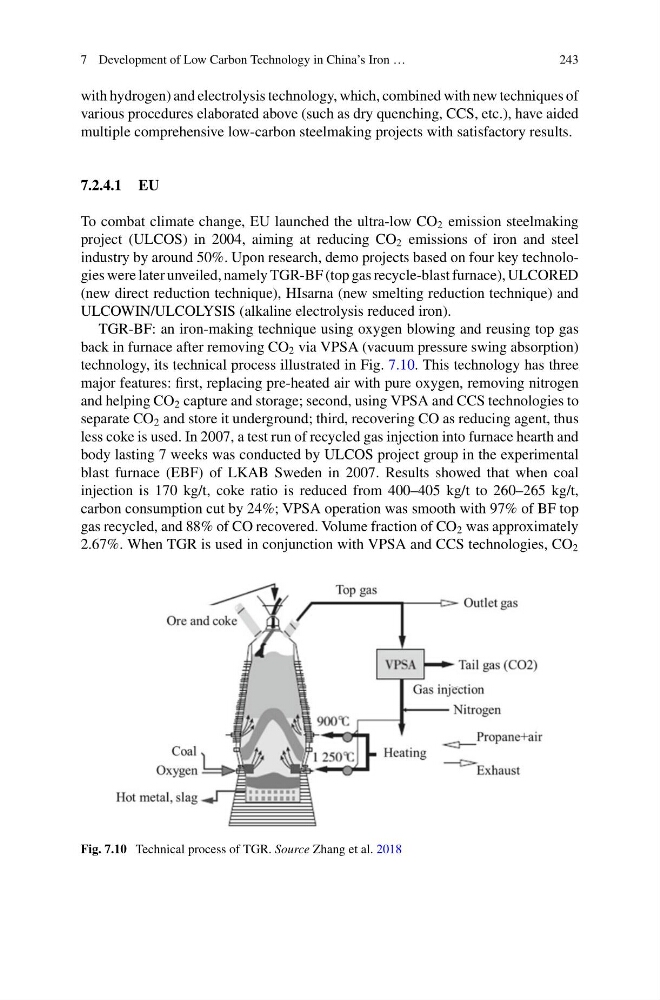
TGR-BF: an iron-making technique using oxygen blowing and reusing top gas
back in furnace after removing CO 2 via VPSA (vacuum pressure swing absorption)
technology, its technical process illustrated in Fig. 7.10. This technology has three
major features: first, replacing pre-heated air with pure oxygen, removing nitrogen
and helping CO 2 capture and storage; second, using VPSA and CCS technologies to
separate CO 2 and store it underground; third, recovering CO as reducing agent, thus
less coke is used. In 2007, a test run of recycled gas injection into furnace hearth and
body lasting 7 weeks was conducted by ULCOS project group in the experimental
blast furnace (EBF) of LKAB Sweden in 2007. Results showed that when coal
injection is 170 kg/t, coke ratio is reduced from 400–405 kg/t to 260–265 kg/t,
carbon consumption cut by 24%; VPSA operation was smooth with 97% of BF top
gas recycled, and 88% of CO recovered. Volume fraction of CO 2 was approximately
2.67%. When TGR is used in conjunction with VPSA and CCS technologies, CO 2
Fig. 7.10 Technical process of TGR. Source Zhang et al. 2018
243
with hydrogen) and electrolysis technology, which, combined with new techniques of
various procedures elaborated above (such as dry quenching, CCS, etc.), have aided
multiple comprehensive low-carbon steelmaking projects with satisfactory results.
7.2.4.1 EU
To combat climate change, EU launched the ultra-low CO 2 emission steelmaking
project (ULCOS) in 2004, aiming at reducing CO 2 emissions of iron and steel
industry by around 50%. Upon research, demo projects based on four key technologies were later unveiled, namely TGR-BF (top gas recycle-blast furnace), ULCORED
(new direct reduction technique), HIsarna (new smelting reduction technique) and
ULCOWIN/ULCOLYSIS (alkaline electrolysis reduced iron).
TGR-BF: an iron-making technique using oxygen blowing and reusing top gas
back in furnace after removing CO 2 via VPSA (vacuum pressure swing absorption)
technology, its technical process illustrated in Fig. 7.10. This technology has three
major features: first, replacing pre-heated air with pure oxygen, removing nitrogen
and helping CO 2 capture and storage; second, using VPSA and CCS technologies to
separate CO 2 and store it underground; third, recovering CO as reducing agent, thus
less coke is used. In 2007, a test run of recycled gas injection into furnace hearth and
body lasting 7 weeks was conducted by ULCOS project group in the experimental
blast furnace (EBF) of LKAB Sweden in 2007. Results showed that when coal
injection is 170 kg/t, coke ratio is reduced from 400–405 kg/t to 260–265 kg/t,
carbon consumption cut by 24%; VPSA operation was smooth with 97% of BF top
gas recycled, and 88% of CO recovered. Volume fraction of CO 2 was approximately
2.67%. When TGR is used in conjunction with VPSA and CCS technologies, CO 2
Fig. 7.10 Technical process of TGR. Source Zhang et al. 2018