

7 Development of Low Carbon Technology in China’s Iron …
221
efficiency. Currently, China’s steel output per capita is only 32% of the world’s
average or even lower; while the man-hour per ton of steel is 6 times higher than
that of developed countries, hence barely any comparative advantage in terms
of production cost.
7.1.2 Production Procedures and Emission Features
As is illustrated below, the production of iron and steel consists of multiple procedures
and equipment such as raw materials system, sintering, pelletizing, coking, ironmaking, steelmaking, rolling and public auxiliary system. By technical category and
corresponding raw materials used in furnaces, four groups of modern iron and steel
production routines are identified, namely blast furnace-basic oxygen furnace (BFBOF), steel scrap- electric arc furnace (steel scrap-EAF), direct reduction-electric
arc furnace (DR-EAF) and COREX-BOF (Huang 2016), which are categorized into
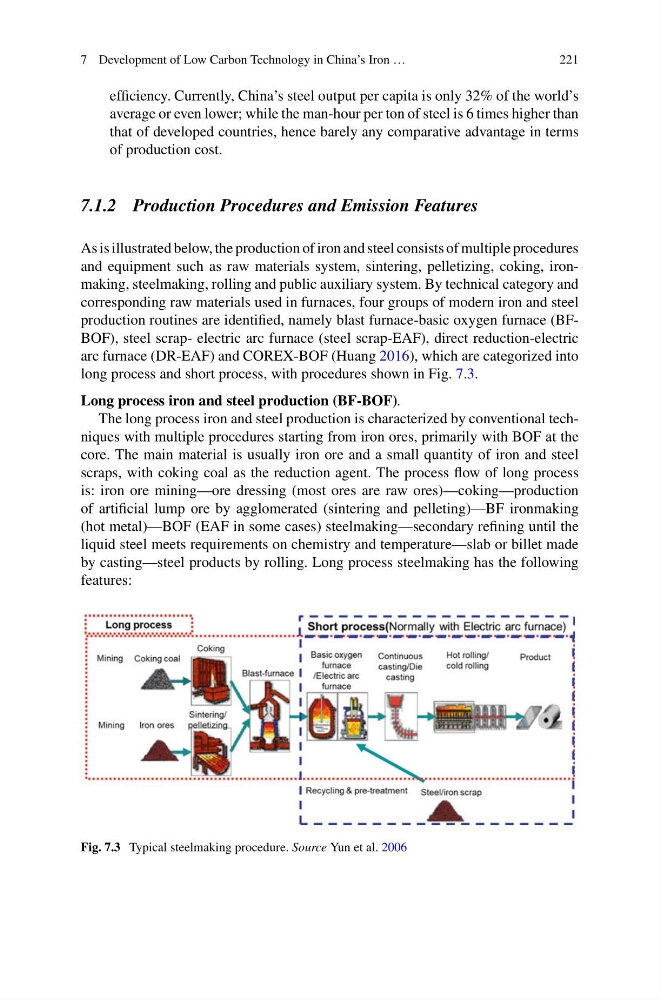
long process and short process, with procedures shown in Fig. 7.3.
Long process iron and steel production (BF-BOF).
The long process iron and steel production is characterized by conventional techniques with multiple procedures starting from iron ores, primarily with BOF at the
core. The main material is usually iron ore and a small quantity of iron and steel
scraps, with coking coal as the reduction agent. The process flow of long process
is: iron ore mining—ore dressing (most ores are raw ores)—coking—production
of artificial lump ore by agglomerated (sintering and pelleting)—BF ironmaking
(hot metal)—BOF (EAF in some cases) steelmaking—secondary refining until the
liquid steel meets requirements on chemistry and temperature—slab or billet made
by casting—steel products by rolling. Long process steelmaking has the following
features:
Fig. 7.3 Typical steelmaking procedure. Source Yun et al. 2006
221
efficiency. Currently, China’s steel output per capita is only 32% of the world’s
average or even lower; while the man-hour per ton of steel is 6 times higher than
that of developed countries, hence barely any comparative advantage in terms
of production cost.
7.1.2 Production Procedures and Emission Features
As is illustrated below, the production of iron and steel consists of multiple procedures
and equipment such as raw materials system, sintering, pelletizing, coking, ironmaking, steelmaking, rolling and public auxiliary system. By technical category and
corresponding raw materials used in furnaces, four groups of modern iron and steel
production routines are identified, namely blast furnace-basic oxygen furnace (BFBOF), steel scrap- electric arc furnace (steel scrap-EAF), direct reduction-electric
arc furnace (DR-EAF) and COREX-BOF (Huang 2016), which are categorized into
long process and short process, with procedures shown in Fig. 7.3.
Long process iron and steel production (BF-BOF).
The long process iron and steel production is characterized by conventional techniques with multiple procedures starting from iron ores, primarily with BOF at the
core. The main material is usually iron ore and a small quantity of iron and steel
scraps, with coking coal as the reduction agent. The process flow of long process
is: iron ore mining—ore dressing (most ores are raw ores)—coking—production
of artificial lump ore by agglomerated (sintering and pelleting)—BF ironmaking
(hot metal)—BOF (EAF in some cases) steelmaking—secondary refining until the
liquid steel meets requirements on chemistry and temperature—slab or billet made
by casting—steel products by rolling. Long process steelmaking has the following
features:
Fig. 7.3 Typical steelmaking procedure. Source Yun et al. 2006