

6 The Impacts of Electric Vehicles …
213
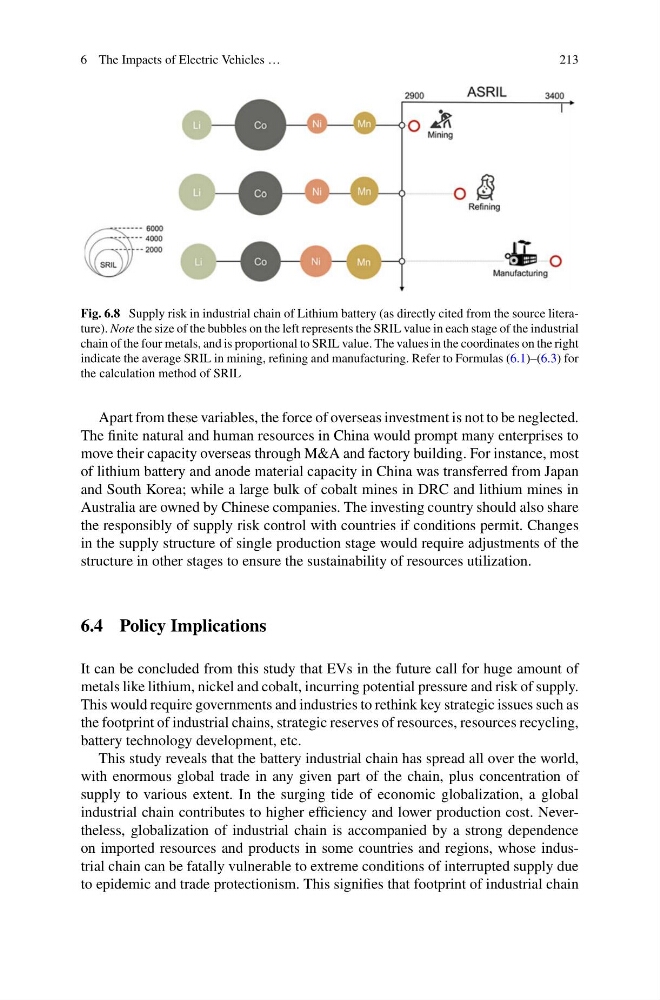
Fig. 6.8 Supply risk in industrial chain of Lithium battery (as directly cited from the source literature). Note the size of the bubbles on the left represents the SRIL value in each stage of the industrial
chain of the four metals, and is proportional to SRIL value. The values in the coordinates on the right
indicate the average SRIL in mining, refining and manufacturing. Refer to Formulas (6.1)–(6.3) for
the calculation method of SRIL
Apart from these variables, the force of overseas investment is not to be neglected.
The finite natural and human resources in China would prompt many enterprises to
move their capacity overseas through M&A and factory building. For instance, most
of lithium battery and anode material capacity in China was transferred from Japan
and South Korea; while a large bulk of cobalt mines in DRC and lithium mines in
Australia are owned by Chinese companies. The investing country should also share
the responsibly of supply risk control with countries if conditions permit. Changes
in the supply structure of single production stage would require adjustments of the
structure in other stages to ensure the sustainability of resources utilization.
6.4 Policy Implications
It can be concluded from this study that EVs in the future call for huge amount of
metals like lithium, nickel and cobalt, incurring potential pressure and risk of supply.
This would require governments and industries to rethink key strategic issues such as
the footprint of industrial chains, strategic reserves of resources, resources recycling,
battery technology development, etc.
This study reveals that the battery industrial chain has spread all over the world,
with enormous global trade in any given part of the chain, plus concentration of
supply to various extent. In the surging tide of economic globalization, a global
industrial chain contributes to higher efficiency and lower production cost. Nevertheless, globalization of industrial chain is accompanied by a strong dependence
on imported resources and products in some countries and regions, whose industrial chain can be fatally vulnerable to extreme conditions of interrupted supply due
to epidemic and trade protectionism. This signifies that footprint of industrial chain
213
Fig. 6.8 Supply risk in industrial chain of Lithium battery (as directly cited from the source literature). Note the size of the bubbles on the left represents the SRIL value in each stage of the industrial
chain of the four metals, and is proportional to SRIL value. The values in the coordinates on the right
indicate the average SRIL in mining, refining and manufacturing. Refer to Formulas (6.1)–(6.3) for
the calculation method of SRIL
Apart from these variables, the force of overseas investment is not to be neglected.
The finite natural and human resources in China would prompt many enterprises to
move their capacity overseas through M&A and factory building. For instance, most
of lithium battery and anode material capacity in China was transferred from Japan
and South Korea; while a large bulk of cobalt mines in DRC and lithium mines in
Australia are owned by Chinese companies. The investing country should also share
the responsibly of supply risk control with countries if conditions permit. Changes
in the supply structure of single production stage would require adjustments of the
structure in other stages to ensure the sustainability of resources utilization.
6.4 Policy Implications
It can be concluded from this study that EVs in the future call for huge amount of
metals like lithium, nickel and cobalt, incurring potential pressure and risk of supply.
This would require governments and industries to rethink key strategic issues such as
the footprint of industrial chains, strategic reserves of resources, resources recycling,
battery technology development, etc.
This study reveals that the battery industrial chain has spread all over the world,
with enormous global trade in any given part of the chain, plus concentration of
supply to various extent. In the surging tide of economic globalization, a global
industrial chain contributes to higher efficiency and lower production cost. Nevertheless, globalization of industrial chain is accompanied by a strong dependence
on imported resources and products in some countries and regions, whose industrial chain can be fatally vulnerable to extreme conditions of interrupted supply due
to epidemic and trade protectionism. This signifies that footprint of industrial chain