

210
H. Hao and X. Sun
of humans is limited during processing. For instance, a clear approach to decentralize
the supply is to relocate production capacity concentrated in a handful of countries to
a wider range. However, such approach is flawed by accommodating risk reduction
in material supply only. In the real world, capacity relocation involves a mixture of
political, social and economic factors and requires overall consideration of impact
on domestic employment, rising cost of production and sunk cost, etc. Therefore,
in defining the supply-centered strategy, hidden risks in the processing stage of the
supply chain should not be ignored. Systematic assessment of supply risks and their
corresponding impact in each stage of the supply chain is crucial, especially for long
term strategic decisions.
6.3.2 Method of Supply Risk Assessment
In order to fill this gap, we have developed a supply risk index of lithium battery
industry (SRIL) which consists of two dimensions: the probability of supply disruption and the impact of materials on lithium battery industry. The quantification of
supply disruption probability is based on Herfindahl-Hirschman Index (HHI) and
World Governance Indicator (WGI) of the World Bank. HHI is the most commonly
used in calculating market concentration: the higher its value, the more concentrated
the market, and the higher probability of supply disruption. WGI is annually updated
by the World Bank to reflect the impact of governance level of different countries
on the probability of supply disruption. The average WGI value from 1996 to 2017
is used in this study to mitigate the influence of unexpected incidents and statistical errors. Based on these two indexes, the supply disruption probability index,
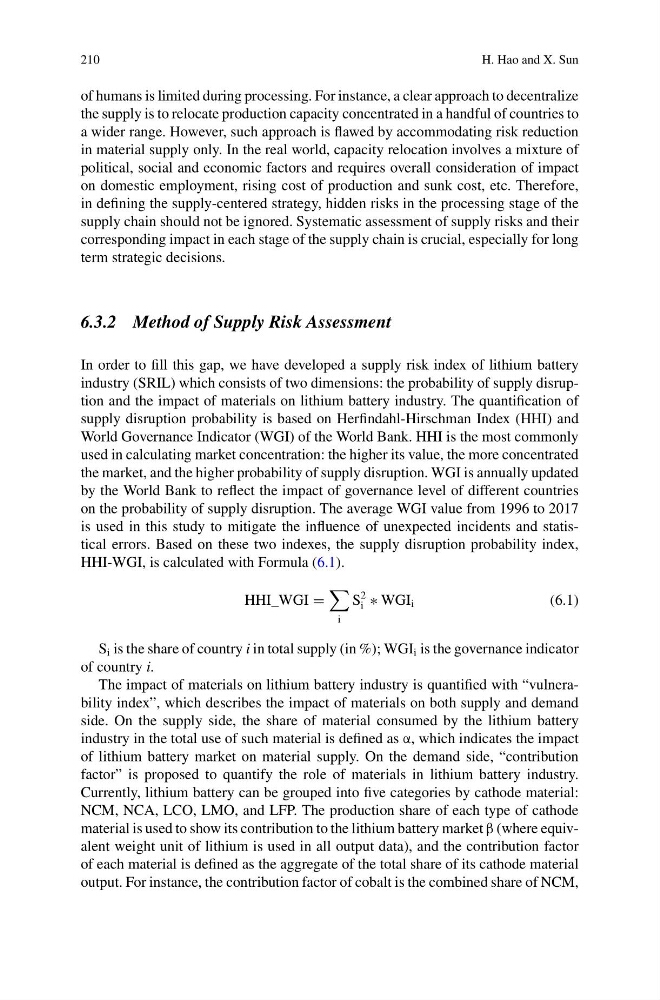
HHI-WGI, is calculated with Formula (6.1).
HHI_WGI =
i
S
2
i ∗ WGI i
(6.1)
S i is the share of country i in total supply (in %); WGI i is the governance indicator
of country i.
The impact of materials on lithium battery industry is quantified with “vulnerability index”, which describes the impact of materials on both supply and demand
side. On the supply side, the share of material consumed by the lithium battery
industry in the total use of such material is defined as α, which indicates the impact
of lithium battery market on material supply. On the demand side, “contribution
factor” is proposed to quantify the role of materials in lithium battery industry.
Currently, lithium battery can be grouped into five categories by cathode material:
NCM, NCA, LCO, LMO, and LFP. The production share of each type of cathode
material is used to show its contribution to the lithium battery market β (where equivalent weight unit of lithium is used in all output data), and the contribution factor
of each material is defined as the aggregate of the total share of its cathode material
output. For instance, the contribution factor of cobalt is the combined share of NCM,
H. Hao and X. Sun
of humans is limited during processing. For instance, a clear approach to decentralize
the supply is to relocate production capacity concentrated in a handful of countries to
a wider range. However, such approach is flawed by accommodating risk reduction
in material supply only. In the real world, capacity relocation involves a mixture of
political, social and economic factors and requires overall consideration of impact
on domestic employment, rising cost of production and sunk cost, etc. Therefore,
in defining the supply-centered strategy, hidden risks in the processing stage of the
supply chain should not be ignored. Systematic assessment of supply risks and their
corresponding impact in each stage of the supply chain is crucial, especially for long
term strategic decisions.
6.3.2 Method of Supply Risk Assessment
In order to fill this gap, we have developed a supply risk index of lithium battery
industry (SRIL) which consists of two dimensions: the probability of supply disruption and the impact of materials on lithium battery industry. The quantification of
supply disruption probability is based on Herfindahl-Hirschman Index (HHI) and
World Governance Indicator (WGI) of the World Bank. HHI is the most commonly
used in calculating market concentration: the higher its value, the more concentrated
the market, and the higher probability of supply disruption. WGI is annually updated
by the World Bank to reflect the impact of governance level of different countries
on the probability of supply disruption. The average WGI value from 1996 to 2017
is used in this study to mitigate the influence of unexpected incidents and statistical errors. Based on these two indexes, the supply disruption probability index,
HHI-WGI, is calculated with Formula (6.1).
HHI_WGI =
i
S
2
i ∗ WGI i
(6.1)
S i is the share of country i in total supply (in %); WGI i is the governance indicator
of country i.
The impact of materials on lithium battery industry is quantified with “vulnerability index”, which describes the impact of materials on both supply and demand
side. On the supply side, the share of material consumed by the lithium battery
industry in the total use of such material is defined as α, which indicates the impact
of lithium battery market on material supply. On the demand side, “contribution
factor” is proposed to quantify the role of materials in lithium battery industry.
Currently, lithium battery can be grouped into five categories by cathode material:
NCM, NCA, LCO, LMO, and LFP. The production share of each type of cathode
material is used to show its contribution to the lithium battery market β (where equivalent weight unit of lithium is used in all output data), and the contribution factor
of each material is defined as the aggregate of the total share of its cathode material
output. For instance, the contribution factor of cobalt is the combined share of NCM,