

184
W. Cai et al.
It shows the promise of the tertiary industry in promoting “power substitution” on
the consumption side. It’s also worth noting that despite the lower annual growth of
residential consumption than the three sectors of service industry, its momentum and
speed of growth remained strong and steady, meaning that improvement in people’s
livelihood has spurred electricity demand, with tremendous potential for emission
reduction and energy conservation, which also prompts the pressing need of “power
substitution” and “clean substitution” in this field.
5.3.2 Power Industry’s Demand for Water Resources
As essential natural resource and strategic economic resource, water underpins
economic and social development, and sustains ecological environment. The industrial sectors in China account for 21.0% of China’s economic and social water demand
(2018 China Resources Bulletin). Summarized from the existing researches, nearly
40.3% of water demand of industrial sectors comes from the power sector in 2015,
which is closely associated with the power generation process and the current power
supply structure in China, while the demand of iron & steel, textile, and chemical
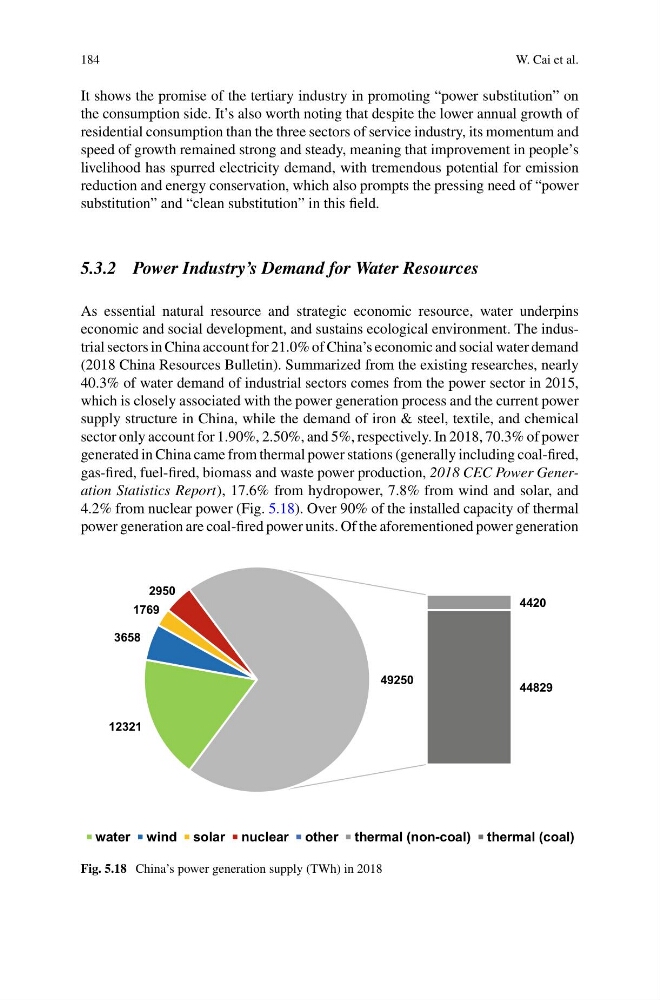
sector only account for 1.90%, 2.50%, and 5%, respectively. In 2018, 70.3% of power
generated in China came from thermal power stations (generally including coal-fired,
gas-fired, fuel-fired, biomass and waste power production, 2018 CEC Power Generation Statistics Report), 17.6% from hydropower, 7.8% from wind and solar, and
4.2% from nuclear power (Fig. 5.18). Over 90% of the installed capacity of thermal
power generation are coal-fired power units. Of the aforementioned power generation
12321
3658
1769
2950
4420
44829
49250
water wind solar nuclear other thermal (non-coal) thermal (coal)
Fig. 5.18 China’s power generation supply (TWh) in 2018
W. Cai et al.
It shows the promise of the tertiary industry in promoting “power substitution” on
the consumption side. It’s also worth noting that despite the lower annual growth of
residential consumption than the three sectors of service industry, its momentum and
speed of growth remained strong and steady, meaning that improvement in people’s
livelihood has spurred electricity demand, with tremendous potential for emission
reduction and energy conservation, which also prompts the pressing need of “power
substitution” and “clean substitution” in this field.
5.3.2 Power Industry’s Demand for Water Resources
As essential natural resource and strategic economic resource, water underpins
economic and social development, and sustains ecological environment. The industrial sectors in China account for 21.0% of China’s economic and social water demand
(2018 China Resources Bulletin). Summarized from the existing researches, nearly
40.3% of water demand of industrial sectors comes from the power sector in 2015,
which is closely associated with the power generation process and the current power
supply structure in China, while the demand of iron & steel, textile, and chemical
sector only account for 1.90%, 2.50%, and 5%, respectively. In 2018, 70.3% of power
generated in China came from thermal power stations (generally including coal-fired,
gas-fired, fuel-fired, biomass and waste power production, 2018 CEC Power Generation Statistics Report), 17.6% from hydropower, 7.8% from wind and solar, and
4.2% from nuclear power (Fig. 5.18). Over 90% of the installed capacity of thermal
power generation are coal-fired power units. Of the aforementioned power generation
12321
3658
1769
2950
4420
44829
49250
water wind solar nuclear other thermal (non-coal) thermal (coal)
Fig. 5.18 China’s power generation supply (TWh) in 2018