

5 Reality and Challenges of China’s Water Resources Management …
171
5000
6000
7000
8000
9000
10000
0
300000
600000
900000
1200000
1500000
2004 2006 2008 2010 2012 2014 2016 2018
TWC (100 million cu.m)
GDP (100 million Yuan)
GDP
TWC
TWC
GDP
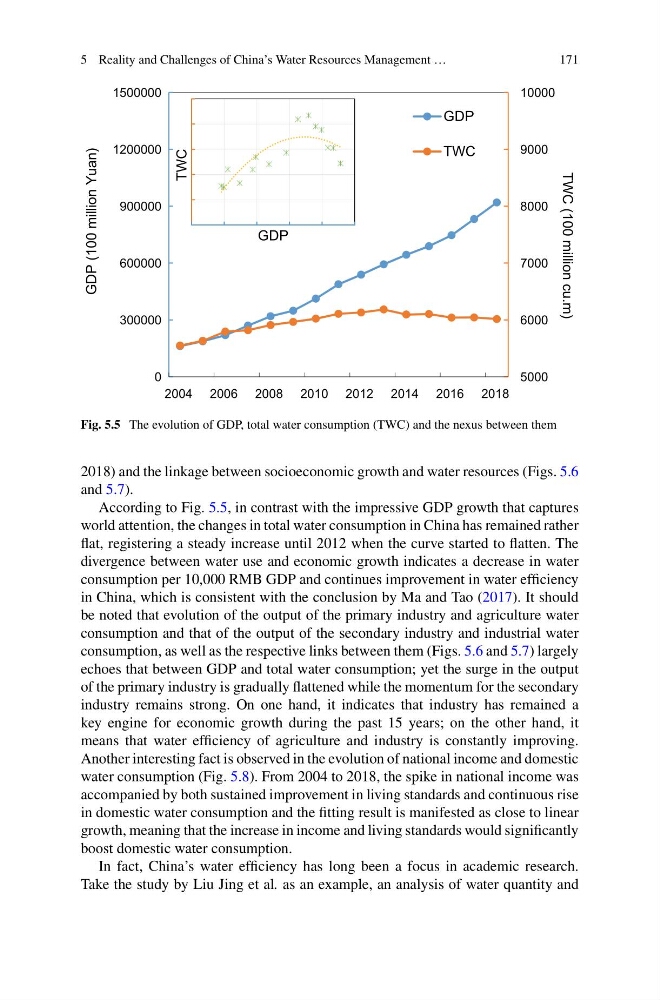
Fig. 5.5 The evolution of GDP, total water consumption (TWC) and the nexus between them
2018) and the linkage between socioeconomic growth and water resources (Figs. 5.6
and 5.7).
According to Fig. 5.5, in contrast with the impressive GDP growth that captures
world attention, the changes in total water consumption in China has remained rather
flat, registering a steady increase until 2012 when the curve started to flatten. The
divergence between water use and economic growth indicates a decrease in water
consumption per 10,000 RMB GDP and continues improvement in water efficiency
in China, which is consistent with the conclusion by Ma and Tao (2017). It should
be noted that evolution of the output of the primary industry and agriculture water
consumption and that of the output of the secondary industry and industrial water
consumption, as well as the respective links between them (Figs. 5.6 and 5.7) largely
echoes that between GDP and total water consumption; yet the surge in the output
of the primary industry is gradually flattened while the momentum for the secondary
industry remains strong. On one hand, it indicates that industry has remained a
key engine for economic growth during the past 15 years; on the other hand, it
means that water efficiency of agriculture and industry is constantly improving.
Another interesting fact is observed in the evolution of national income and domestic
water consumption (Fig. 5.8). From 2004 to 2018, the spike in national income was
accompanied by both sustained improvement in living standards and continuous rise
in domestic water consumption and the fitting result is manifested as close to linear
growth, meaning that the increase in income and living standards would significantly
boost domestic water consumption.
In fact, China’s water efficiency has long been a focus in academic research.
Take the study by Liu Jing et al. as an example, an analysis of water quantity and
171
5000
6000
7000
8000
9000
10000
0
300000
600000
900000
1200000
1500000
2004 2006 2008 2010 2012 2014 2016 2018
TWC (100 million cu.m)
GDP (100 million Yuan)
GDP
TWC
TWC
GDP
Fig. 5.5 The evolution of GDP, total water consumption (TWC) and the nexus between them
2018) and the linkage between socioeconomic growth and water resources (Figs. 5.6
and 5.7).
According to Fig. 5.5, in contrast with the impressive GDP growth that captures
world attention, the changes in total water consumption in China has remained rather
flat, registering a steady increase until 2012 when the curve started to flatten. The
divergence between water use and economic growth indicates a decrease in water
consumption per 10,000 RMB GDP and continues improvement in water efficiency
in China, which is consistent with the conclusion by Ma and Tao (2017). It should
be noted that evolution of the output of the primary industry and agriculture water
consumption and that of the output of the secondary industry and industrial water
consumption, as well as the respective links between them (Figs. 5.6 and 5.7) largely
echoes that between GDP and total water consumption; yet the surge in the output
of the primary industry is gradually flattened while the momentum for the secondary
industry remains strong. On one hand, it indicates that industry has remained a
key engine for economic growth during the past 15 years; on the other hand, it
means that water efficiency of agriculture and industry is constantly improving.
Another interesting fact is observed in the evolution of national income and domestic
water consumption (Fig. 5.8). From 2004 to 2018, the spike in national income was
accompanied by both sustained improvement in living standards and continuous rise
in domestic water consumption and the fitting result is manifested as close to linear
growth, meaning that the increase in income and living standards would significantly
boost domestic water consumption.
In fact, China’s water efficiency has long been a focus in academic research.
Take the study by Liu Jing et al. as an example, an analysis of water quantity and