

4 The Transition of China’s Power System
143
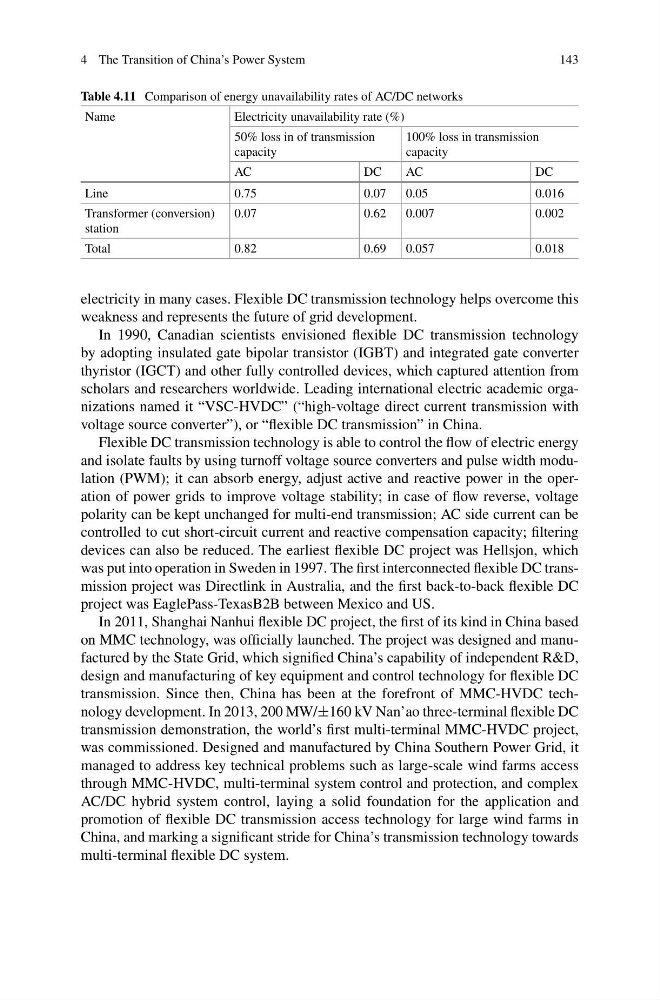
Table 4.11 Comparison of energy unavailability rates of AC/DC networks
Name
Electricity unavailability rate (%)
50% loss in of transmission
capacity
100% loss in transmission
capacity
AC
DC
AC
DC
Line
0.75
0.07
0.05
0.016
Transformer (conversion)
station
0.07
0.62
0.007
0.002
Total
0.82
0.69
0.057
0.018
electricity in many cases. Flexible DC transmission technology helps overcome this
weakness and represents the future of grid development.
In 1990, Canadian scientists envisioned flexible DC transmission technology
by adopting insulated gate bipolar transistor (IGBT) and integrated gate converter
thyristor (IGCT) and other fully controlled devices, which captured attention from
scholars and researchers worldwide. Leading international electric academic organizations named it “VSC-HVDC” (“high-voltage direct current transmission with
voltage source converter”), or “flexible DC transmission” in China.
Flexible DC transmission technology is able to control the flow of electric energy
and isolate faults by using turnoff voltage source converters and pulse width modulation (PWM); it can absorb energy, adjust active and reactive power in the operation of power grids to improve voltage stability; in case of flow reverse, voltage
polarity can be kept unchanged for multi-end transmission; AC side current can be
controlled to cut short-circuit current and reactive compensation capacity; filtering
devices can also be reduced. The earliest flexible DC project was Hellsjon, which
was put into operation in Sweden in 1997. The first interconnected flexible DC transmission project was Directlink in Australia, and the first back-to-back flexible DC
project was EaglePass-TexasB2B between Mexico and US.
In 2011, Shanghai Nanhui flexible DC project, the first of its kind in China based
on MMC technology, was officially launched. The project was designed and manufactured by the State Grid, which signified China’s capability of independent R&D,
design and manufacturing of key equipment and control technology for flexible DC
transmission. Since then, China has been at the forefront of MMC-HVDC technology development. In 2013, 200 MW/±160 kV Nan’ao three-terminal flexible DC
transmission demonstration, the world’s first multi-terminal MMC-HVDC project,
was commissioned. Designed and manufactured by China Southern Power Grid, it
managed to address key technical problems such as large-scale wind farms access
through MMC-HVDC, multi-terminal system control and protection, and complex
AC/DC hybrid system control, laying a solid foundation for the application and
promotion of flexible DC transmission access technology for large wind farms in
China, and marking a significant stride for China’s transmission technology towards
multi-terminal flexible DC system.
143
Table 4.11 Comparison of energy unavailability rates of AC/DC networks
Name
Electricity unavailability rate (%)
50% loss in of transmission
capacity
100% loss in transmission
capacity
AC
DC
AC
DC
Line
0.75
0.07
0.05
0.016
Transformer (conversion)
station
0.07
0.62
0.007
0.002
Total
0.82
0.69
0.057
0.018
electricity in many cases. Flexible DC transmission technology helps overcome this
weakness and represents the future of grid development.
In 1990, Canadian scientists envisioned flexible DC transmission technology
by adopting insulated gate bipolar transistor (IGBT) and integrated gate converter
thyristor (IGCT) and other fully controlled devices, which captured attention from
scholars and researchers worldwide. Leading international electric academic organizations named it “VSC-HVDC” (“high-voltage direct current transmission with
voltage source converter”), or “flexible DC transmission” in China.
Flexible DC transmission technology is able to control the flow of electric energy
and isolate faults by using turnoff voltage source converters and pulse width modulation (PWM); it can absorb energy, adjust active and reactive power in the operation of power grids to improve voltage stability; in case of flow reverse, voltage
polarity can be kept unchanged for multi-end transmission; AC side current can be
controlled to cut short-circuit current and reactive compensation capacity; filtering
devices can also be reduced. The earliest flexible DC project was Hellsjon, which
was put into operation in Sweden in 1997. The first interconnected flexible DC transmission project was Directlink in Australia, and the first back-to-back flexible DC
project was EaglePass-TexasB2B between Mexico and US.
In 2011, Shanghai Nanhui flexible DC project, the first of its kind in China based
on MMC technology, was officially launched. The project was designed and manufactured by the State Grid, which signified China’s capability of independent R&D,
design and manufacturing of key equipment and control technology for flexible DC
transmission. Since then, China has been at the forefront of MMC-HVDC technology development. In 2013, 200 MW/±160 kV Nan’ao three-terminal flexible DC
transmission demonstration, the world’s first multi-terminal MMC-HVDC project,
was commissioned. Designed and manufactured by China Southern Power Grid, it
managed to address key technical problems such as large-scale wind farms access
through MMC-HVDC, multi-terminal system control and protection, and complex
AC/DC hybrid system control, laying a solid foundation for the application and
promotion of flexible DC transmission access technology for large wind farms in
China, and marking a significant stride for China’s transmission technology towards
multi-terminal flexible DC system.