

4 The Transition of China’s Power System
109
Boiler
Fuel network
Heat supply
network
Fuel
cars
Thermalelectricity
coupling
Transportation
network
Smart grid
Electric vehicle
Components
Controllable
load
Load
Heat
Source
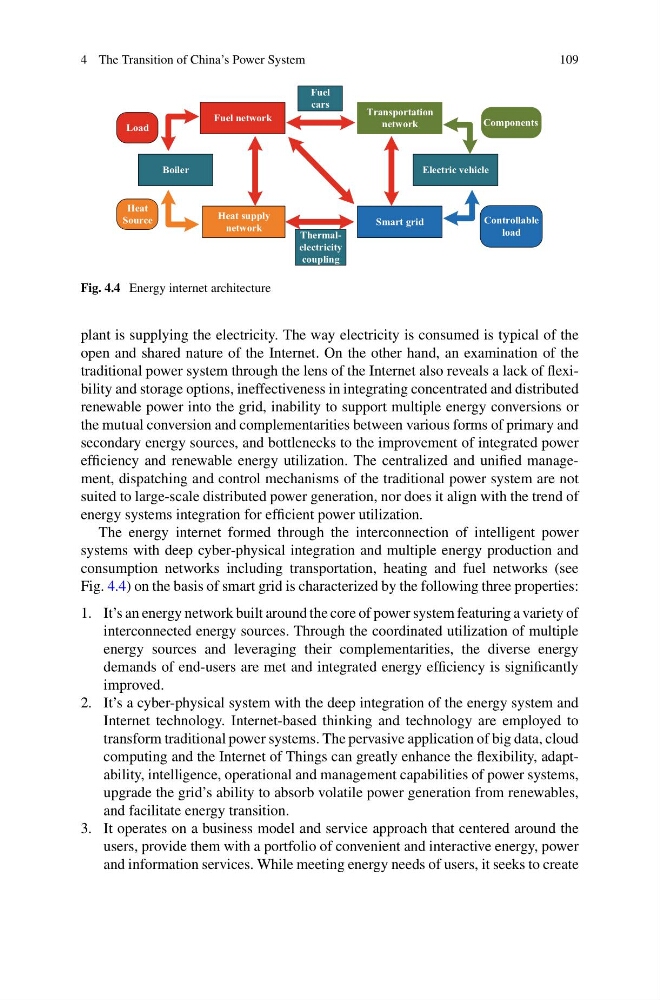
Fig. 4.4 Energy internet architecture
plant is supplying the electricity. The way electricity is consumed is typical of the
open and shared nature of the Internet. On the other hand, an examination of the
traditional power system through the lens of the Internet also reveals a lack of flexibility and storage options, ineffectiveness in integrating concentrated and distributed
renewable power into the grid, inability to support multiple energy conversions or
the mutual conversion and complementarities between various forms of primary and
secondary energy sources, and bottlenecks to the improvement of integrated power
efficiency and renewable energy utilization. The centralized and unified management, dispatching and control mechanisms of the traditional power system are not
suited to large-scale distributed power generation, nor does it align with the trend of
energy systems integration for efficient power utilization.
The energy internet formed through the interconnection of intelligent power
systems with deep cyber-physical integration and multiple energy production and
consumption networks including transportation, heating and fuel networks (see
Fig. 4.4) on the basis of smart grid is characterized by the following three properties:
1. It’s an energy network built around the core of power system featuring a variety of
interconnected energy sources. Through the coordinated utilization of multiple
energy sources and leveraging their complementarities, the diverse energy
demands of end-users are met and integrated energy efficiency is significantly
improved.
2. It’s a cyber-physical system with the deep integration of the energy system and
Internet technology. Internet-based thinking and technology are employed to
transform traditional power systems. The pervasive application of big data, cloud
computing and the Internet of Things can greatly enhance the flexibility, adaptability, intelligence, operational and management capabilities of power systems,
upgrade the grid’s ability to absorb volatile power generation from renewables,
and facilitate energy transition.
3. It operates on a business model and service approach that centered around the
users, provide them with a portfolio of convenient and interactive energy, power
and information services. While meeting energy needs of users, it seeks to create
109
Boiler
Fuel network
Heat supply
network
Fuel
cars
Thermalelectricity
coupling
Transportation
network
Smart grid
Electric vehicle
Components
Controllable
load
Load
Heat
Source
Fig. 4.4 Energy internet architecture
plant is supplying the electricity. The way electricity is consumed is typical of the
open and shared nature of the Internet. On the other hand, an examination of the
traditional power system through the lens of the Internet also reveals a lack of flexibility and storage options, ineffectiveness in integrating concentrated and distributed
renewable power into the grid, inability to support multiple energy conversions or
the mutual conversion and complementarities between various forms of primary and
secondary energy sources, and bottlenecks to the improvement of integrated power
efficiency and renewable energy utilization. The centralized and unified management, dispatching and control mechanisms of the traditional power system are not
suited to large-scale distributed power generation, nor does it align with the trend of
energy systems integration for efficient power utilization.
The energy internet formed through the interconnection of intelligent power
systems with deep cyber-physical integration and multiple energy production and
consumption networks including transportation, heating and fuel networks (see
Fig. 4.4) on the basis of smart grid is characterized by the following three properties:
1. It’s an energy network built around the core of power system featuring a variety of
interconnected energy sources. Through the coordinated utilization of multiple
energy sources and leveraging their complementarities, the diverse energy
demands of end-users are met and integrated energy efficiency is significantly
improved.
2. It’s a cyber-physical system with the deep integration of the energy system and
Internet technology. Internet-based thinking and technology are employed to
transform traditional power systems. The pervasive application of big data, cloud
computing and the Internet of Things can greatly enhance the flexibility, adaptability, intelligence, operational and management capabilities of power systems,
upgrade the grid’s ability to absorb volatile power generation from renewables,
and facilitate energy transition.
3. It operates on a business model and service approach that centered around the
users, provide them with a portfolio of convenient and interactive energy, power
and information services. While meeting energy needs of users, it seeks to create