

92
S. Shimizu
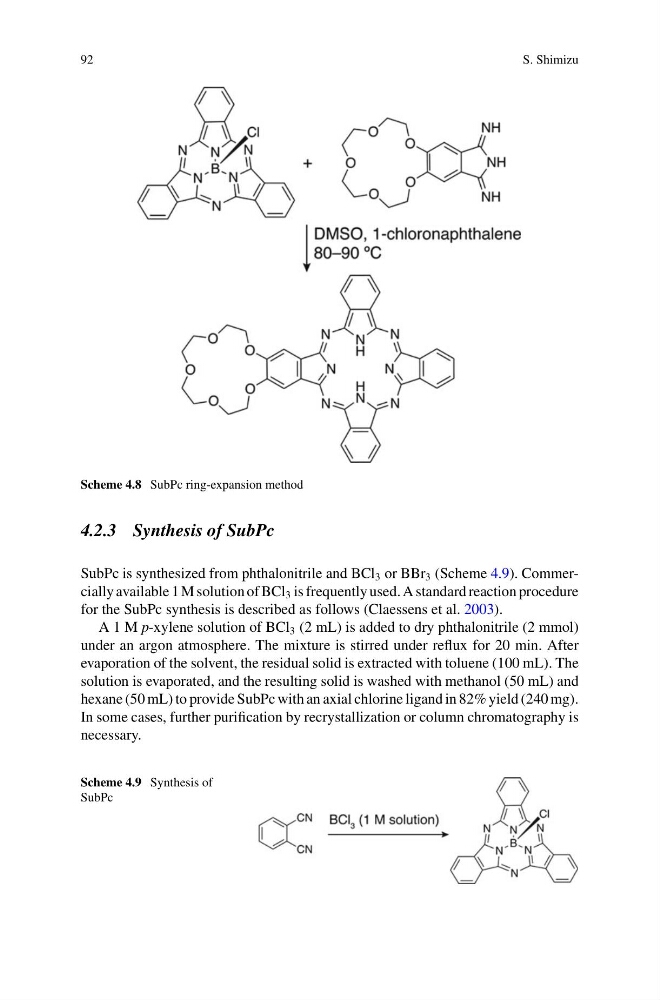
Scheme 4.8 SubPc ring-expansion method
4.2.3 Synthesis of SubPc
SubPc is synthesized from phthalonitrile and BCl 3 or BBr 3 (Scheme 4.9). Commercially available 1 M solution of BCl 3 is frequently used. A standard reaction procedure
for the SubPc synthesis is described as follows (Claessens et al. 2003).
A 1 M p-xylene solution of BCl 3 (2 mL) is added to dry phthalonitrile (2 mmol)
under an argon atmosphere. The mixture is stirred under reflux for 20 min. After
evaporation of the solvent, the residual solid is extracted with toluene (100 mL). The
solution is evaporated, and the resulting solid is washed with methanol (50 mL) and
hexane (50 mL) to provide SubPc with an axial chlorine ligand in 82% yield (240 mg).
In some cases, further purification by recrystallization or column chromatography is
necessary.
Scheme 4.9 Synthesis of
SubPc
S. Shimizu
Scheme 4.8 SubPc ring-expansion method
4.2.3 Synthesis of SubPc
SubPc is synthesized from phthalonitrile and BCl 3 or BBr 3 (Scheme 4.9). Commercially available 1 M solution of BCl 3 is frequently used. A standard reaction procedure
for the SubPc synthesis is described as follows (Claessens et al. 2003).
A 1 M p-xylene solution of BCl 3 (2 mL) is added to dry phthalonitrile (2 mmol)
under an argon atmosphere. The mixture is stirred under reflux for 20 min. After
evaporation of the solvent, the residual solid is extracted with toluene (100 mL). The
solution is evaporated, and the resulting solid is washed with methanol (50 mL) and
hexane (50 mL) to provide SubPc with an axial chlorine ligand in 82% yield (240 mg).
In some cases, further purification by recrystallization or column chromatography is
necessary.
Scheme 4.9 Synthesis of
SubPc