

76
J. Setsune
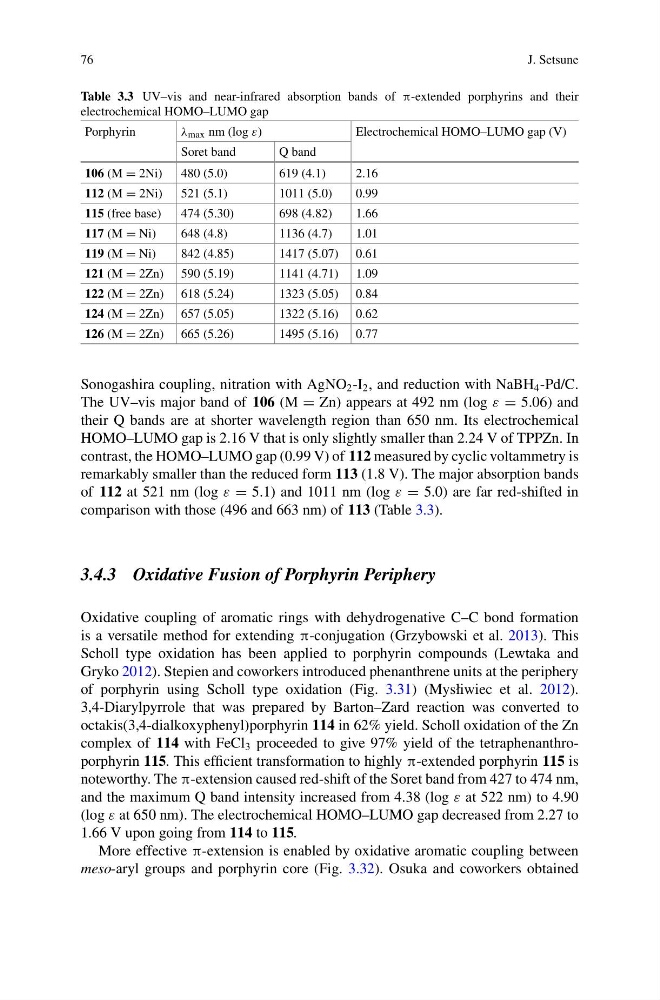
Table 3.3 UV–vis and near-infrared absorption bands of π-extended porphyrins and their
electrochemical HOMO–LUMO gap
Porphyrin
λ max nm (log ε)
Electrochemical HOMO–LUMO gap (V)
Soret band
Q band
106 (M = 2Ni) 480 (5.0)
619 (4.1)
2.16
112 (M = 2Ni) 521 (5.1)
1011 (5.0)
0.99
115 (free base)
474 (5.30)
698 (4.82)
1.66
117 (M = Ni)
648 (4.8)
1136 (4.7)
1.01
119 (M = Ni)
842 (4.85)
1417 (5.07) 0.61
121 (M = 2Zn) 590 (5.19)
1141 (4.71) 1.09
122 (M = 2Zn) 618 (5.24)
1323 (5.05) 0.84
124 (M = 2Zn) 657 (5.05)
1322 (5.16) 0.62
126 (M = 2Zn) 665 (5.26)
1495 (5.16) 0.77
Sonogashira coupling, nitration with AgNO 2 -I 2 , and reduction with NaBH 4 -Pd/C.
The UV–vis major band of 106 (M = Zn) appears at 492 nm (log ε = 5.06) and
their Q bands are at shorter wavelength region than 650 nm. Its electrochemical
HOMO–LUMO gap is 2.16 V that is only slightly smaller than 2.24 V of TPPZn. In
contrast, the HOMO–LUMO gap (0.99 V) of 112 measured by cyclic voltammetry is
remarkably smaller than the reduced form 113 (1.8 V). The major absorption bands
of 112 at 521 nm (log ε = 5.1) and 1011 nm (log ε = 5.0) are far red-shifted in
comparison with those (496 and 663 nm) of 113 (Table 3.3).
3.4.3 Oxidative Fusion of Porphyrin Periphery
Oxidative coupling of aromatic rings with dehydrogenative C–C bond formation
is a versatile method for extending π-conjugation (Grzybowski et al. 2013). This
Scholl type oxidation has been applied to porphyrin compounds (Lewtaka and
Gryko 2012). Stepien and coworkers introduced phenanthrene units at the periphery
of porphyrin using Scholl type oxidation (Fig. 3.31) (Mysłiwiec et al. 2012).
3,4-Diarylpyrrole that was prepared by Barton–Zard reaction was converted to
octakis(3,4-dialkoxyphenyl)porphyrin 114 in 62% yield. Scholl oxidation of the Zn
complex of 114 with FeCl 3 proceeded to give 97% yield of the tetraphenanthroporphyrin 115. This efficient transformation to highly π-extended porphyrin 115 is
noteworthy. The π-extension caused red-shift of the Soret band from 427 to 474 nm,
and the maximum Q band intensity increased from 4.38 (log ε at 522 nm) to 4.90
(log ε at 650 nm). The electrochemical HOMO–LUMO gap decreased from 2.27 to
1.66 V upon going from 114 to 115.
More effective π-extension is enabled by oxidative aromatic coupling between
meso-aryl groups and porphyrin core (Fig. 3.32). Osuka and coworkers obtained
J. Setsune
Table 3.3 UV–vis and near-infrared absorption bands of π-extended porphyrins and their
electrochemical HOMO–LUMO gap
Porphyrin
λ max nm (log ε)
Electrochemical HOMO–LUMO gap (V)
Soret band
Q band
106 (M = 2Ni) 480 (5.0)
619 (4.1)
2.16
112 (M = 2Ni) 521 (5.1)
1011 (5.0)
0.99
115 (free base)
474 (5.30)
698 (4.82)
1.66
117 (M = Ni)
648 (4.8)
1136 (4.7)
1.01
119 (M = Ni)
842 (4.85)
1417 (5.07) 0.61
121 (M = 2Zn) 590 (5.19)
1141 (4.71) 1.09
122 (M = 2Zn) 618 (5.24)
1323 (5.05) 0.84
124 (M = 2Zn) 657 (5.05)
1322 (5.16) 0.62
126 (M = 2Zn) 665 (5.26)
1495 (5.16) 0.77
Sonogashira coupling, nitration with AgNO 2 -I 2 , and reduction with NaBH 4 -Pd/C.
The UV–vis major band of 106 (M = Zn) appears at 492 nm (log ε = 5.06) and
their Q bands are at shorter wavelength region than 650 nm. Its electrochemical
HOMO–LUMO gap is 2.16 V that is only slightly smaller than 2.24 V of TPPZn. In
contrast, the HOMO–LUMO gap (0.99 V) of 112 measured by cyclic voltammetry is
remarkably smaller than the reduced form 113 (1.8 V). The major absorption bands
of 112 at 521 nm (log ε = 5.1) and 1011 nm (log ε = 5.0) are far red-shifted in
comparison with those (496 and 663 nm) of 113 (Table 3.3).
3.4.3 Oxidative Fusion of Porphyrin Periphery
Oxidative coupling of aromatic rings with dehydrogenative C–C bond formation
is a versatile method for extending π-conjugation (Grzybowski et al. 2013). This
Scholl type oxidation has been applied to porphyrin compounds (Lewtaka and
Gryko 2012). Stepien and coworkers introduced phenanthrene units at the periphery
of porphyrin using Scholl type oxidation (Fig. 3.31) (Mysłiwiec et al. 2012).
3,4-Diarylpyrrole that was prepared by Barton–Zard reaction was converted to
octakis(3,4-dialkoxyphenyl)porphyrin 114 in 62% yield. Scholl oxidation of the Zn
complex of 114 with FeCl 3 proceeded to give 97% yield of the tetraphenanthroporphyrin 115. This efficient transformation to highly π-extended porphyrin 115 is
noteworthy. The π-extension caused red-shift of the Soret band from 427 to 474 nm,
and the maximum Q band intensity increased from 4.38 (log ε at 522 nm) to 4.90
(log ε at 650 nm). The electrochemical HOMO–LUMO gap decreased from 2.27 to
1.66 V upon going from 114 to 115.
More effective π-extension is enabled by oxidative aromatic coupling between
meso-aryl groups and porphyrin core (Fig. 3.32). Osuka and coworkers obtained