

16 Luminescent Materials for Organic Light-Emitting Diodes
591
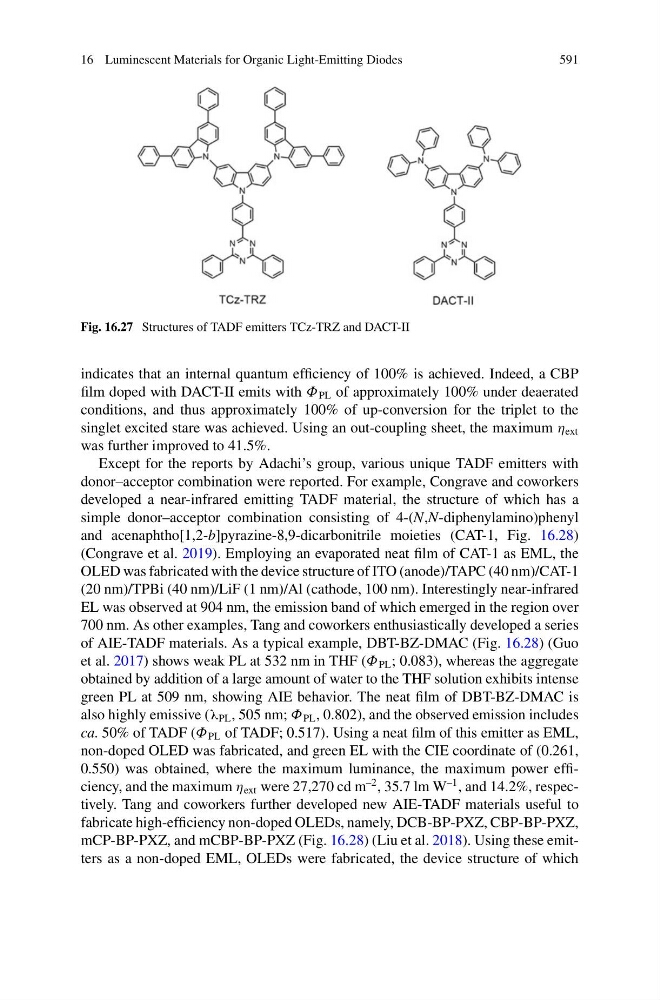
Fig. 16.27 Structures of TADF emitters TCz-TRZ and DACT-II
indicates that an internal quantum efficiency of 100% is achieved. Indeed, a CBP
film doped with DACT-II emits with Φ PL of approximately 100% under deaerated
conditions, and thus approximately 100% of up-conversion for the triplet to the
singlet excited stare was achieved. Using an out-coupling sheet, the maximum η ext
was further improved to 41.5%.
Except for the reports by Adachi’s group, various unique TADF emitters with
donor–acceptor combination were reported. For example, Congrave and coworkers
developed a near-infrared emitting TADF material, the structure of which has a
simple donor–acceptor combination consisting of 4-(N,N-diphenylamino)phenyl
and acenaphtho[1,2-b]pyrazine-8,9-dicarbonitrile moieties (CAT-1, Fig. 16.28)
(Congrave et al. 2019). Employing an evaporated neat film of CAT-1 as EML, the
OLED was fabricated with the device structure of ITO (anode)/TAPC (40 nm)/CAT-1
(20 nm)/TPBi (40 nm)/LiF (1 nm)/Al (cathode, 100 nm). Interestingly near-infrared
EL was observed at 904 nm, the emission band of which emerged in the region over
700 nm. As other examples, Tang and coworkers enthusiastically developed a series
of AIE-TADF materials. As a typical example, DBT-BZ-DMAC (Fig. 16.28) (Guo
et al. 2017) shows weak PL at 532 nm in THF (Φ PL ; 0.083), whereas the aggregate
obtained by addition of a large amount of water to the THF solution exhibits intense
green PL at 509 nm, showing AIE behavior. The neat film of DBT-BZ-DMAC is
also highly emissive (λ PL , 505 nm; Φ PL , 0.802), and the observed emission includes
ca. 50% of TADF (Φ PL of TADF; 0.517). Using a neat film of this emitter as EML,
non-doped OLED was fabricated, and green EL with the CIE coordinate of (0.261,
0.550) was obtained, where the maximum luminance, the maximum power efficiency, and the maximum η ext were 27,270 cd m
–2 , 35.7 lm W
–1 , and 14.2%, respectively. Tang and coworkers further developed new AIE-TADF materials useful to
fabricate high-efficiency non-doped OLEDs, namely, DCB-BP-PXZ, CBP-BP-PXZ,
mCP-BP-PXZ, and mCBP-BP-PXZ (Fig. 16.28) (Liu et al. 2018). Using these emitters as a non-doped EML, OLEDs were fabricated, the device structure of which