

542
I. Osaka
Whereas regioregular poly(3-hexylthiophene) (P3HT), the most common πconjugated polymer, has a simple 3-hexylthiophene ring as the lone building unit
(McCullough 1998), π-conjugated polymers that are used as p-type organic semiconductors for OPVs typically comprise several heteroaromatic rings as building
units in the backbone. More specifically, heteroaromatic rings having electron-rich
(donor) and electron-poor (acceptor) characteristics are alternately incorporated into
the π-conjugated polymer backbone (Boudreault et al. 2011; Biniek et al. 2012). This
alternating donor–acceptor arrangement has resulted in molecular orbital mixing and
thus intramolecular charge transfer (CT) interactions in the backbone, giving rise to
a wide light absorption range, e.g., a narrow optical bandgap (E g ), which is essential for OPVs. Furthermore, by choosing the strengths of the donor and acceptor
characteristics, the energy levels of the highest occupied molecular orbital (HOMO)
and the lowest unoccupied molecular orbital (LUMO) can be easily tuned. When
π-conjugated polymers are used as p-type organic semiconductors, their HOMO
energy levels must be as deep as possible in order to afford a high open-circuit
voltage (V OC ) for the OPV cell, because V OC is proportional to the energy difference
between the HOMO of the p-type organic semiconductor and the LUMO of the n-type
organic semiconductor (Thompson and Fréchet 2008). Therefore, the combination
of “weak” donor and “strong” acceptor building units is desirable for donor–acceptor
π-conjugated polymers. In addition to their electronic features, donor–acceptor polymers can provide high charge carrier mobilities due to the enhanced intermolecular
π–π stacking that originates in dipole–dipole interactions. Furthermore, the use of
larger heteroaromatic fused rings as either donor or acceptor building units or both
is also expected to provide improved π–π interactions.
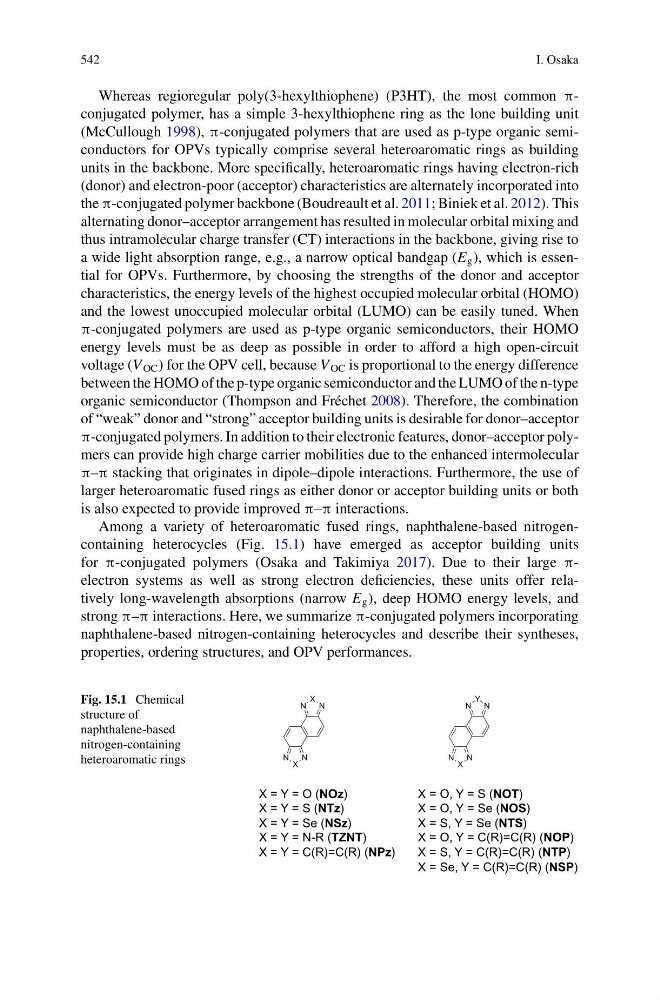
Among a variety of heteroaromatic fused rings, naphthalene-based nitrogencontaining heterocycles (Fig. 15.1) have emerged as acceptor building units
for π-conjugated polymers (Osaka and Takimiya 2017). Due to their large πelectron systems as well as strong electron deficiencies, these units offer relatively long-wavelength absorptions (narrow E g ), deep HOMO energy levels, and
strong π–π interactions. Here, we summarize π-conjugated polymers incorporating
naphthalene-based nitrogen-containing heterocycles and describe their syntheses,
properties, ordering structures, and OPV performances.
Fig. 15.1 Chemical
structure of
naphthalene-based
nitrogen-containing
heteroaromatic rings
N
X
N
N
Y
N
X = Y = O (NOz)
X = Y = S (NTz)
X = Y = Se (NSz)
X = Y = N-R (TZNT)
X = Y = C(R)=C(R) (NPz)
N
X
N
N
X
N
X = O, Y = S (NOT)
X = O, Y = Se (NOS)
X = S, Y = Se (NTS)
X = O, Y = C(R)=C(R) (NOP)
X = S, Y = C(R)=C(R) (NTP)
X = Se, Y = C(R)=C(R) (NSP)
I. Osaka
Whereas regioregular poly(3-hexylthiophene) (P3HT), the most common πconjugated polymer, has a simple 3-hexylthiophene ring as the lone building unit
(McCullough 1998), π-conjugated polymers that are used as p-type organic semiconductors for OPVs typically comprise several heteroaromatic rings as building
units in the backbone. More specifically, heteroaromatic rings having electron-rich
(donor) and electron-poor (acceptor) characteristics are alternately incorporated into
the π-conjugated polymer backbone (Boudreault et al. 2011; Biniek et al. 2012). This
alternating donor–acceptor arrangement has resulted in molecular orbital mixing and
thus intramolecular charge transfer (CT) interactions in the backbone, giving rise to
a wide light absorption range, e.g., a narrow optical bandgap (E g ), which is essential for OPVs. Furthermore, by choosing the strengths of the donor and acceptor
characteristics, the energy levels of the highest occupied molecular orbital (HOMO)
and the lowest unoccupied molecular orbital (LUMO) can be easily tuned. When
π-conjugated polymers are used as p-type organic semiconductors, their HOMO
energy levels must be as deep as possible in order to afford a high open-circuit
voltage (V OC ) for the OPV cell, because V OC is proportional to the energy difference
between the HOMO of the p-type organic semiconductor and the LUMO of the n-type
organic semiconductor (Thompson and Fréchet 2008). Therefore, the combination
of “weak” donor and “strong” acceptor building units is desirable for donor–acceptor
π-conjugated polymers. In addition to their electronic features, donor–acceptor polymers can provide high charge carrier mobilities due to the enhanced intermolecular
π–π stacking that originates in dipole–dipole interactions. Furthermore, the use of
larger heteroaromatic fused rings as either donor or acceptor building units or both
is also expected to provide improved π–π interactions.
Among a variety of heteroaromatic fused rings, naphthalene-based nitrogencontaining heterocycles (Fig. 15.1) have emerged as acceptor building units
for π-conjugated polymers (Osaka and Takimiya 2017). Due to their large πelectron systems as well as strong electron deficiencies, these units offer relatively long-wavelength absorptions (narrow E g ), deep HOMO energy levels, and
strong π–π interactions. Here, we summarize π-conjugated polymers incorporating
naphthalene-based nitrogen-containing heterocycles and describe their syntheses,
properties, ordering structures, and OPV performances.
Fig. 15.1 Chemical
structure of
naphthalene-based
nitrogen-containing
heteroaromatic rings
N
X
N
N
Y
N
X = Y = O (NOz)
X = Y = S (NTz)
X = Y = Se (NSz)
X = Y = N-R (TZNT)
X = Y = C(R)=C(R) (NPz)
N
X
N
N
X
N
X = O, Y = S (NOT)
X = O, Y = Se (NOS)
X = S, Y = Se (NTS)
X = O, Y = C(R)=C(R) (NOP)
X = S, Y = C(R)=C(R) (NTP)
X = Se, Y = C(R)=C(R) (NSP)