

14 Photoenergy Conversion (Dye-Sensitized Solar Cells)
499
14.2.16 Phenothiazine and Phenoxazine Dyes
The phenothiazine skeleton with the electron-rich nitrogen and sulfur atoms
possesses a stronger electron-donating character than other amines such as triphenylamine, tetrahydroquinoline, carbazole, iminodibenzyl, and many other Nheterocycles. The introduction of an electron-accepting group such as cyanoacrylic
acid on the phenothiazine skeleton can produce a D–π–A system, which exhibits
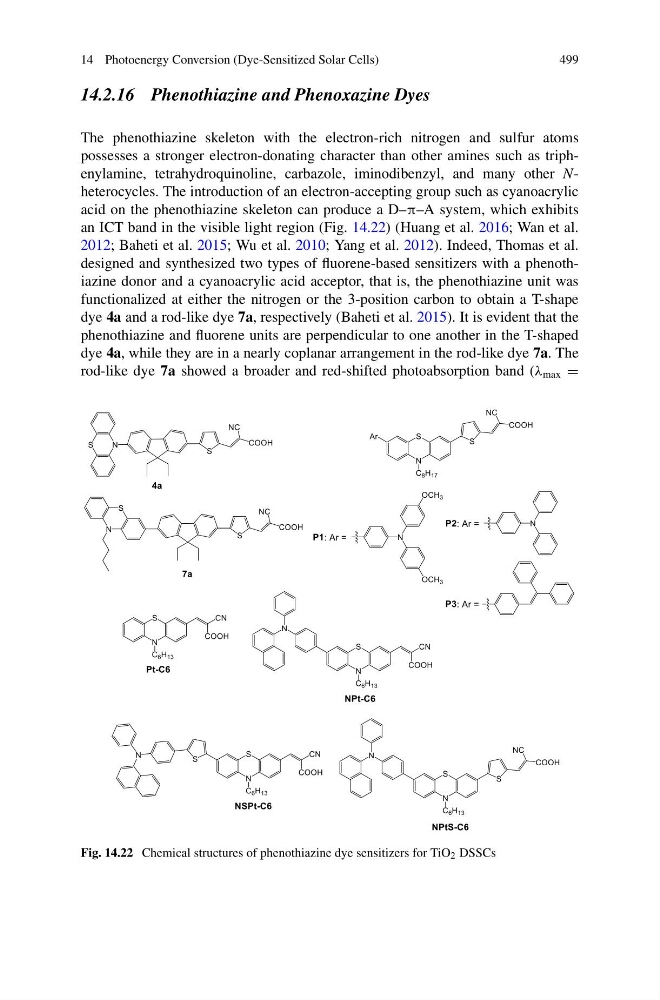
an ICT band in the visible light region (Fig. 14.22) (Huang et al. 2016; Wan et al.
2012; Baheti et al. 2015; Wu et al. 2010; Yang et al. 2012). Indeed, Thomas et al.
designed and synthesized two types of fluorene-based sensitizers with a phenothiazine donor and a cyanoacrylic acid acceptor, that is, the phenothiazine unit was
functionalized at either the nitrogen or the 3-position carbon to obtain a T-shape
dye 4a and a rod-like dye 7a, respectively (Baheti et al. 2015). It is evident that the
phenothiazine and fluorene units are perpendicular to one another in the T-shaped
dye 4a, while they are in a nearly coplanar arrangement in the rod-like dye 7a. The
rod-like dye 7a showed a broader and red-shifted photoabsorption band (λ max =
Fig. 14.22 Chemical structures of phenothiazine dye sensitizers for TiO 2 DSSCs
499
14.2.16 Phenothiazine and Phenoxazine Dyes
The phenothiazine skeleton with the electron-rich nitrogen and sulfur atoms
possesses a stronger electron-donating character than other amines such as triphenylamine, tetrahydroquinoline, carbazole, iminodibenzyl, and many other Nheterocycles. The introduction of an electron-accepting group such as cyanoacrylic
acid on the phenothiazine skeleton can produce a D–π–A system, which exhibits
an ICT band in the visible light region (Fig. 14.22) (Huang et al. 2016; Wan et al.
2012; Baheti et al. 2015; Wu et al. 2010; Yang et al. 2012). Indeed, Thomas et al.
designed and synthesized two types of fluorene-based sensitizers with a phenothiazine donor and a cyanoacrylic acid acceptor, that is, the phenothiazine unit was
functionalized at either the nitrogen or the 3-position carbon to obtain a T-shape
dye 4a and a rod-like dye 7a, respectively (Baheti et al. 2015). It is evident that the
phenothiazine and fluorene units are perpendicular to one another in the T-shaped
dye 4a, while they are in a nearly coplanar arrangement in the rod-like dye 7a. The
rod-like dye 7a showed a broader and red-shifted photoabsorption band (λ max =
Fig. 14.22 Chemical structures of phenothiazine dye sensitizers for TiO 2 DSSCs