

472
Y. Ooyama
(3) Regeneration
(6) Dark Current
e -
I − /I 3
−
E/V vs. NHE
—0.5
0.5
0
1.0
—1.0
e -
(4)
E redox
External Circuit
ITO
Pt
e -
HOMO
LUMO
e -
e -
Dye/Dye –
Dye – /Dye*
Sunlight
Dye
NiO
NiO Electrode
FTO
TCO
(1) Photoexcitation
(2) Injection
E vb
E f
p-NiO DSSC
(5) Recombination
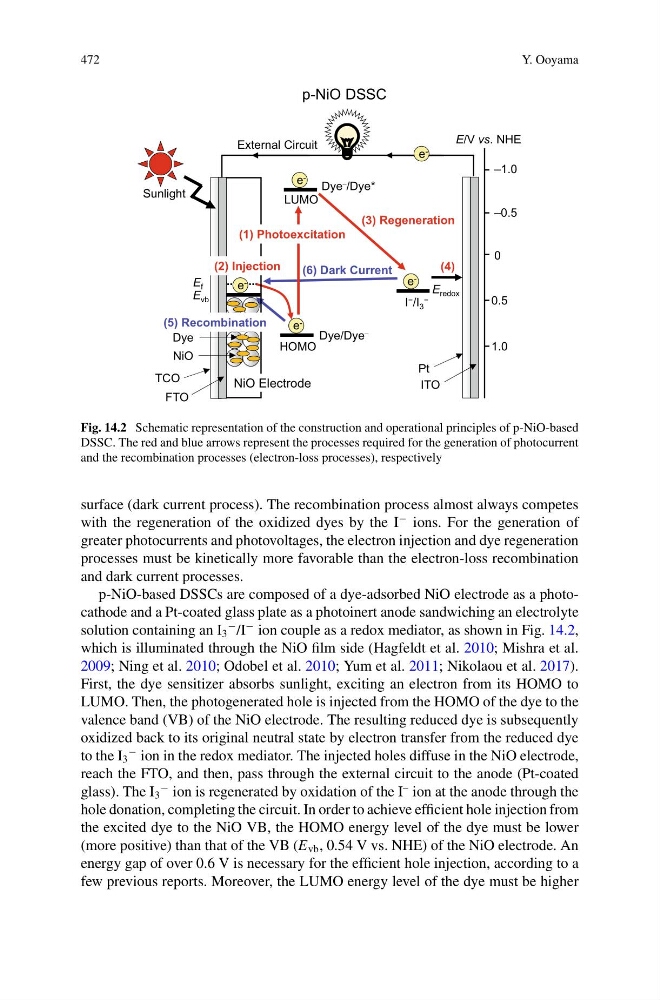
Fig. 14.2 Schematic representation of the construction and operational principles of p-NiO-based
DSSC. The red and blue arrows represent the processes required for the generation of photocurrent
and the recombination processes (electron-loss processes), respectively
surface (dark current process). The recombination process almost always competes
with the regeneration of the oxidized dyes by the I
− ions. For the generation of
greater photocurrents and photovoltages, the electron injection and dye regeneration
processes must be kinetically more favorable than the electron-loss recombination
and dark current processes.
p-NiO-based DSSCs are composed of a dye-adsorbed NiO electrode as a photocathode and a Pt-coated glass plate as a photoinert anode sandwiching an electrolyte
solution containing an I 3
− /I
− ion couple as a redox mediator, as shown in Fig. 14.2,
which is illuminated through the NiO film side (Hagfeldt et al. 2010; Mishra et al.
2009; Ning et al. 2010; Odobel et al. 2010; Yum et al. 2011; Nikolaou et al. 2017).
First, the dye sensitizer absorbs sunlight, exciting an electron from its HOMO to
LUMO. Then, the photogenerated hole is injected from the HOMO of the dye to the
valence band (VB) of the NiO electrode. The resulting reduced dye is subsequently
oxidized back to its original neutral state by electron transfer from the reduced dye
to the I 3
− ion in the redox mediator. The injected holes diffuse in the NiO electrode,
reach the FTO, and then, pass through the external circuit to the anode (Pt-coated
glass). The I 3
− ion is regenerated by oxidation of the I
– ion at the anode through the
hole donation, completing the circuit. In order to achieve efficient hole injection from
the excited dye to the NiO VB, the HOMO energy level of the dye must be lower
(more positive) than that of the VB (E vb , 0.54 V vs. NHE) of the NiO electrode. An
energy gap of over 0.6 V is necessary for the efficient hole injection, according to a
few previous reports. Moreover, the LUMO energy level of the dye must be higher
Y. Ooyama
(3) Regeneration
(6) Dark Current
e -
I − /I 3
−
E/V vs. NHE
—0.5
0.5
0
1.0
—1.0
e -
(4)
E redox
External Circuit
ITO
Pt
e -
HOMO
LUMO
e -
e -
Dye/Dye –
Dye – /Dye*
Sunlight
Dye
NiO
NiO Electrode
FTO
TCO
(1) Photoexcitation
(2) Injection
E vb
E f
p-NiO DSSC
(5) Recombination
Fig. 14.2 Schematic representation of the construction and operational principles of p-NiO-based
DSSC. The red and blue arrows represent the processes required for the generation of photocurrent
and the recombination processes (electron-loss processes), respectively
surface (dark current process). The recombination process almost always competes
with the regeneration of the oxidized dyes by the I
− ions. For the generation of
greater photocurrents and photovoltages, the electron injection and dye regeneration
processes must be kinetically more favorable than the electron-loss recombination
and dark current processes.
p-NiO-based DSSCs are composed of a dye-adsorbed NiO electrode as a photocathode and a Pt-coated glass plate as a photoinert anode sandwiching an electrolyte
solution containing an I 3
− /I
− ion couple as a redox mediator, as shown in Fig. 14.2,
which is illuminated through the NiO film side (Hagfeldt et al. 2010; Mishra et al.
2009; Ning et al. 2010; Odobel et al. 2010; Yum et al. 2011; Nikolaou et al. 2017).
First, the dye sensitizer absorbs sunlight, exciting an electron from its HOMO to
LUMO. Then, the photogenerated hole is injected from the HOMO of the dye to the
valence band (VB) of the NiO electrode. The resulting reduced dye is subsequently
oxidized back to its original neutral state by electron transfer from the reduced dye
to the I 3
− ion in the redox mediator. The injected holes diffuse in the NiO electrode,
reach the FTO, and then, pass through the external circuit to the anode (Pt-coated
glass). The I 3
− ion is regenerated by oxidation of the I
– ion at the anode through the
hole donation, completing the circuit. In order to achieve efficient hole injection from
the excited dye to the NiO VB, the HOMO energy level of the dye must be lower
(more positive) than that of the VB (E vb , 0.54 V vs. NHE) of the NiO electrode. An
energy gap of over 0.6 V is necessary for the efficient hole injection, according to a
few previous reports. Moreover, the LUMO energy level of the dye must be higher