

470
Y. Ooyama
selenide (CIGS)) are representative inorganic solar cells, which have achieved the
solar energy-to-electricity conversion efficiency of up to 15–20%.
Organic solar cells based on dye photosensitizers (organic dyes and metal complex
dyes) or polymer blend films (e.g., poly(3-hexylthiophene): P3HT) with fullerene
derivatives (e.g., [6,6]-phenyl-C61-butyric acid methyl ester: PCBM) are known as
one of the third-generation photovoltaic cells (O’Regan and Grätzel 1991; Hagfeldt
et al. 2010; Kim et al. 2007; Günes et al. 2007).
Dye-sensitized solar cells (DSSCs), in which dye photosensitizers are adsorbed
on photoelectrodes (e.g., TiO 2 and ZnO as n-type oxide semiconductor electrode or
NiO as p-type oxide semiconductor electrode) have particularly received considerable attention from the viewpoint of their interesting construction and operational
principles, decorative natures, high power conversion efficiency, and low cost of
fabrication (O’Regan and Grätzel 1991; Hagfeldt et al. 2010; Nazeeruddin et al.
1993, 1997, 1999; 2001, 2003; Pashaei et al. 2016; Robertson 2006; Chen et al.
2007; Xie and Guo 2007; Imahori et al. 2009; Ooyama and Harima 2009; Ning and
Tian 2009; Mishra et al. 2009; Ning et al. 2010; Yen et al. 2012; Odobel et al. 2010,
2012; Ooyama and Harima 2012; Yum et al. 2011; Nikolaou et al. 2017; Li and
Diau 2013; Ladomenou et al. 2014; Manfredi et al. 2014; Zhang and Cole 2015;
Lee et al. 2015; Li et al. 2017; Urbani et al. 2014; Higashino 2015; Brogdon et al.
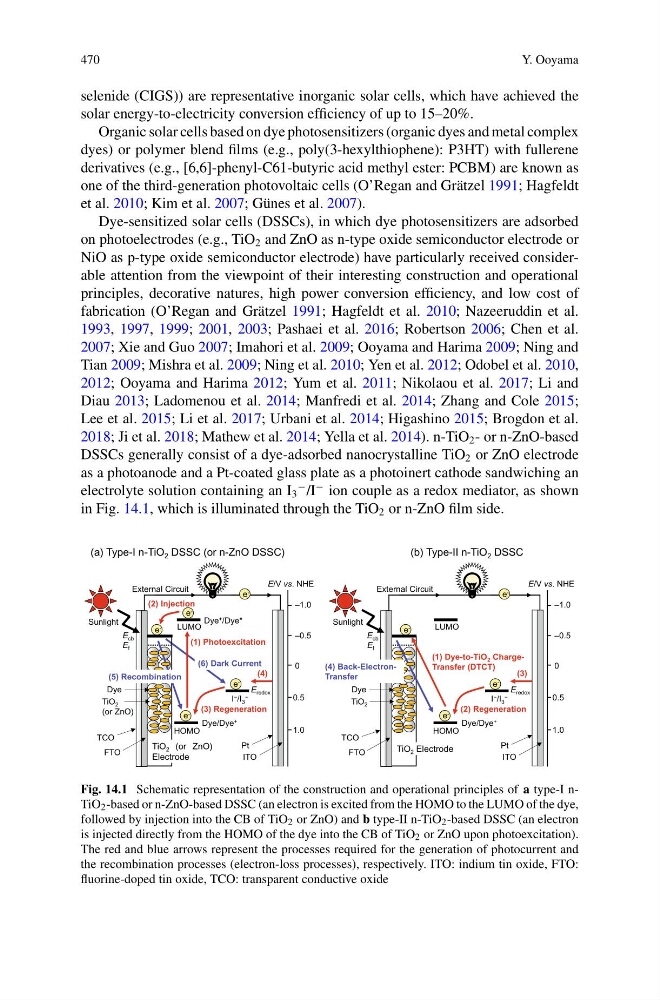
2018; Ji et al. 2018; Mathew et al. 2014; Yella et al. 2014). n-TiO 2 - or n-ZnO-based
DSSCs generally consist of a dye-adsorbed nanocrystalline TiO 2 or ZnO electrode
as a photoanode and a Pt-coated glass plate as a photoinert cathode sandwiching an
electrolyte solution containing an I 3
− /I
− ion couple as a redox mediator, as shown
in Fig. 14.1, which is illuminated through the TiO 2 or n-ZnO film side.
I − /I 3
−
E/V vs. NHE
—0.5
0.5
0
1.0
—1.0
HOMO
LUMO
E cb
E f
e -
e -
e -
e -
Dye/Dye +
Dye + /Dye*
(3) Regeneration
(4)
E redox
(2) Injection
Sunlight
External Circuit
ITO
Pt
(6) Dark Current
(1) Photoexcitation
e -
(5) Recombination
Dye
TiO 2
(or ZnO)
TiO 2 (or ZnO)
Electrode
FTO
TCO
(a) Type-I n-TiO 2 DSSC (or n-ZnO DSSC)
(b) Type-II n-TiO 2 DSSC
I − /I 3
−
E/V vs. NHE
—0.5
0.5
0
1.0
—1.0
HOMO
LUMO
E cb
E f
e -
e -
e -
Dye/Dye +
(2) Regeneration
(3)
E redox
Sunlight
External Circuit
ITO
Pt
e -
Dye
TiO 2
TiO 2 Electrode
FTO
TCO
(4) Back-ElectronTransfer
(1) Dye-to-TiO 2 ChargeTransfer (DTCT)
Fig. 14.1 Schematic representation of the construction and operational principles of a type-I nTiO 2 -based or n-ZnO-based DSSC (an electron is excited from the HOMO to the LUMO of the dye,
followed by injection into the CB of TiO 2 or ZnO) and b type-II n-TiO 2 -based DSSC (an electron
is injected directly from the HOMO of the dye into the CB of TiO 2 or ZnO upon photoexcitation).
The red and blue arrows represent the processes required for the generation of photocurrent and
the recombination processes (electron-loss processes), respectively. ITO: indium tin oxide, FTO:
fluorine-doped tin oxide, TCO: transparent conductive oxide
Y. Ooyama
selenide (CIGS)) are representative inorganic solar cells, which have achieved the
solar energy-to-electricity conversion efficiency of up to 15–20%.
Organic solar cells based on dye photosensitizers (organic dyes and metal complex
dyes) or polymer blend films (e.g., poly(3-hexylthiophene): P3HT) with fullerene
derivatives (e.g., [6,6]-phenyl-C61-butyric acid methyl ester: PCBM) are known as
one of the third-generation photovoltaic cells (O’Regan and Grätzel 1991; Hagfeldt
et al. 2010; Kim et al. 2007; Günes et al. 2007).
Dye-sensitized solar cells (DSSCs), in which dye photosensitizers are adsorbed
on photoelectrodes (e.g., TiO 2 and ZnO as n-type oxide semiconductor electrode or
NiO as p-type oxide semiconductor electrode) have particularly received considerable attention from the viewpoint of their interesting construction and operational
principles, decorative natures, high power conversion efficiency, and low cost of
fabrication (O’Regan and Grätzel 1991; Hagfeldt et al. 2010; Nazeeruddin et al.
1993, 1997, 1999; 2001, 2003; Pashaei et al. 2016; Robertson 2006; Chen et al.
2007; Xie and Guo 2007; Imahori et al. 2009; Ooyama and Harima 2009; Ning and
Tian 2009; Mishra et al. 2009; Ning et al. 2010; Yen et al. 2012; Odobel et al. 2010,
2012; Ooyama and Harima 2012; Yum et al. 2011; Nikolaou et al. 2017; Li and
Diau 2013; Ladomenou et al. 2014; Manfredi et al. 2014; Zhang and Cole 2015;
Lee et al. 2015; Li et al. 2017; Urbani et al. 2014; Higashino 2015; Brogdon et al.
2018; Ji et al. 2018; Mathew et al. 2014; Yella et al. 2014). n-TiO 2 - or n-ZnO-based
DSSCs generally consist of a dye-adsorbed nanocrystalline TiO 2 or ZnO electrode
as a photoanode and a Pt-coated glass plate as a photoinert cathode sandwiching an
electrolyte solution containing an I 3
− /I
− ion couple as a redox mediator, as shown
in Fig. 14.1, which is illuminated through the TiO 2 or n-ZnO film side.
I − /I 3
−
E/V vs. NHE
—0.5
0.5
0
1.0
—1.0
HOMO
LUMO
E cb
E f
e -
e -
e -
e -
Dye/Dye +
Dye + /Dye*
(3) Regeneration
(4)
E redox
(2) Injection
Sunlight
External Circuit
ITO
Pt
(6) Dark Current
(1) Photoexcitation
e -
(5) Recombination
Dye
TiO 2
(or ZnO)
TiO 2 (or ZnO)
Electrode
FTO
TCO
(a) Type-I n-TiO 2 DSSC (or n-ZnO DSSC)
(b) Type-II n-TiO 2 DSSC
I − /I 3
−
E/V vs. NHE
—0.5
0.5
0
1.0
—1.0
HOMO
LUMO
E cb
E f
e -
e -
e -
Dye/Dye +
(2) Regeneration
(3)
E redox
Sunlight
External Circuit
ITO
Pt
e -
Dye
TiO 2
TiO 2 Electrode
FTO
TCO
(4) Back-ElectronTransfer
(1) Dye-to-TiO 2 ChargeTransfer (DTCT)
Fig. 14.1 Schematic representation of the construction and operational principles of a type-I nTiO 2 -based or n-ZnO-based DSSC (an electron is excited from the HOMO to the LUMO of the dye,
followed by injection into the CB of TiO 2 or ZnO) and b type-II n-TiO 2 -based DSSC (an electron
is injected directly from the HOMO of the dye into the CB of TiO 2 or ZnO upon photoexcitation).
The red and blue arrows represent the processes required for the generation of photocurrent and
the recombination processes (electron-loss processes), respectively. ITO: indium tin oxide, FTO:
fluorine-doped tin oxide, TCO: transparent conductive oxide