

460
K. Imato and Y. Ooyama
13.8 Pyrylium, Azinium, and Squalene Photosensitizing
Dyes
Pyrylium dyes and azinium dyes with pyridinium and pyrazinium rings have good
water solubility and tumor affinity (adsorption) and absorb light in a wide range of
wavelength around 600–800 nm (ε = 10
4 to 10
5 M
–1 cm
–1 ). Detty et al. synthesized
a series of pyrylium dyes (PYP-E and PY-E) containing chalcogen atoms (O, S, Se,
and Te) and investigated the influence of chalcogen atoms on the optical properties
and
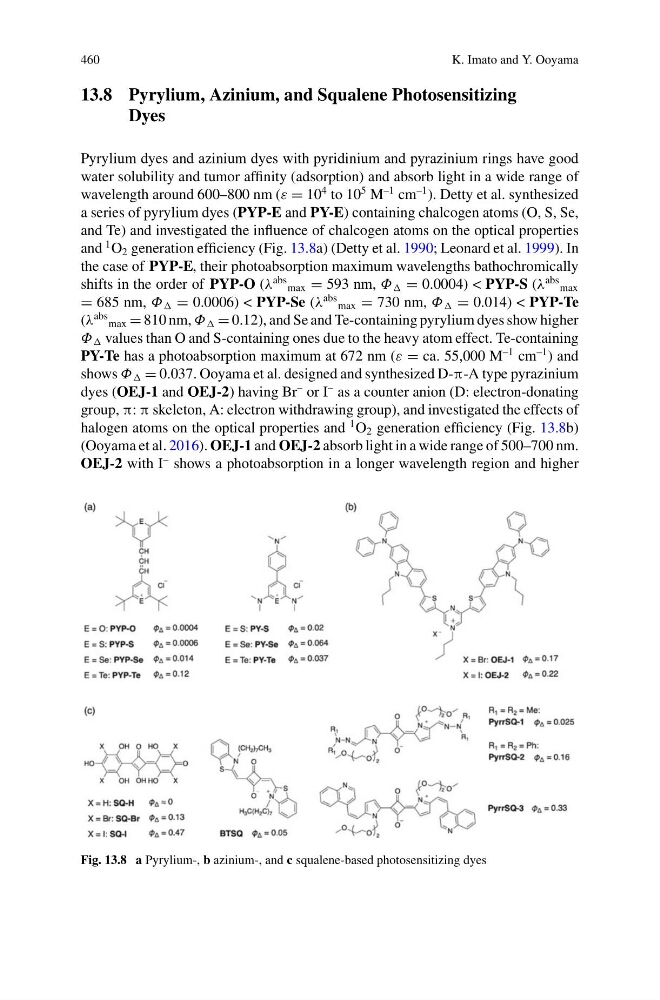
1 O 2 generation efficiency (Fig. 13.8a) (Detty et al. 1990; Leonard et al. 1999). In
the case of PYP-E, their photoabsorption maximum wavelengths bathochromically
shifts in the order of PYP-O (λ
abs
max = 593 nm, Φ = 0.0004) < PYP-S (λ
abs
max
= 685 nm, Φ = 0.0006) < PYP-Se (λ
abs
max = 730 nm, Φ = 0.014) < PYP-Te
(λ
abs
max = 810 nm, Φ = 0.12), and Se and Te-containing pyrylium dyes show higher
Φ values than O and S-containing ones due to the heavy atom effect. Te-containing
PY-Te has a photoabsorption maximum at 672 nm (ε = ca. 55,000 M
–1 cm
–1 ) and
shows Φ = 0.037. Ooyama et al. designed and synthesized D-π-A type pyrazinium
dyes (OEJ-1 and OEJ-2) having Br
– or I
– as a counter anion (D: electron-donating
group, π: π skeleton, A: electron withdrawing group), and investigated the effects of
halogen atoms on the optical properties and
1 O 2 generation efficiency (Fig. 13.8b)
(Ooyama et al. 2016). OEJ-1 and OEJ-2 absorb light in a wide range of 500–700 nm.
OEJ-2 with I
– shows a photoabsorption in a longer wavelength region and higher
Fig. 13.8 a Pyrylium-, b azinium-, and c squalene-based photosensitizing dyes
K. Imato and Y. Ooyama
13.8 Pyrylium, Azinium, and Squalene Photosensitizing
Dyes
Pyrylium dyes and azinium dyes with pyridinium and pyrazinium rings have good
water solubility and tumor affinity (adsorption) and absorb light in a wide range of
wavelength around 600–800 nm (ε = 10
4 to 10
5 M
–1 cm
–1 ). Detty et al. synthesized
a series of pyrylium dyes (PYP-E and PY-E) containing chalcogen atoms (O, S, Se,
and Te) and investigated the influence of chalcogen atoms on the optical properties
and
1 O 2 generation efficiency (Fig. 13.8a) (Detty et al. 1990; Leonard et al. 1999). In
the case of PYP-E, their photoabsorption maximum wavelengths bathochromically
shifts in the order of PYP-O (λ
abs
max = 593 nm, Φ = 0.0004) < PYP-S (λ
abs
max
= 685 nm, Φ = 0.0006) < PYP-Se (λ
abs
max = 730 nm, Φ = 0.014) < PYP-Te
(λ
abs
max = 810 nm, Φ = 0.12), and Se and Te-containing pyrylium dyes show higher
Φ values than O and S-containing ones due to the heavy atom effect. Te-containing
PY-Te has a photoabsorption maximum at 672 nm (ε = ca. 55,000 M
–1 cm
–1 ) and
shows Φ = 0.037. Ooyama et al. designed and synthesized D-π-A type pyrazinium
dyes (OEJ-1 and OEJ-2) having Br
– or I
– as a counter anion (D: electron-donating
group, π: π skeleton, A: electron withdrawing group), and investigated the effects of
halogen atoms on the optical properties and
1 O 2 generation efficiency (Fig. 13.8b)
(Ooyama et al. 2016). OEJ-1 and OEJ-2 absorb light in a wide range of 500–700 nm.
OEJ-2 with I
– shows a photoabsorption in a longer wavelength region and higher
Fig. 13.8 a Pyrylium-, b azinium-, and c squalene-based photosensitizing dyes